Quick Guide: Monocrystalline vs. Polycrystalline Solar Panels – Which Is Best for Your RV?
When you're building an RV solar system, one of the first decisions you'll face is choosing the type of solar panels to mount on your roof. You've likely seen labels for "Monocrystalline" and "Polycrystalline," but which one actually delivers the most power for your mobile lifestyle? In this deep-dive technical audit, we cut through the marketing jargon and give you the essential facts for 2026.
1. The Silicon Science: Single vs. Multi-Crystal Engineering
To understand why one panel costs more than the other, we have to look at the furnace. Monocrystalline (Mono) cells are grown from a single, continuous crystal of silicon. This is done using the Czochralski process, where a seed crystal is dipped into molten silicon and slowly pulled out, forming a solid cylindrical ingot called a 'boule.' This boule is then sliced into thin wafers. Because the electrons have a clear, uninterrupted path through the single crystal structure, they experience significantly less resistance, leading to higher efficiency.
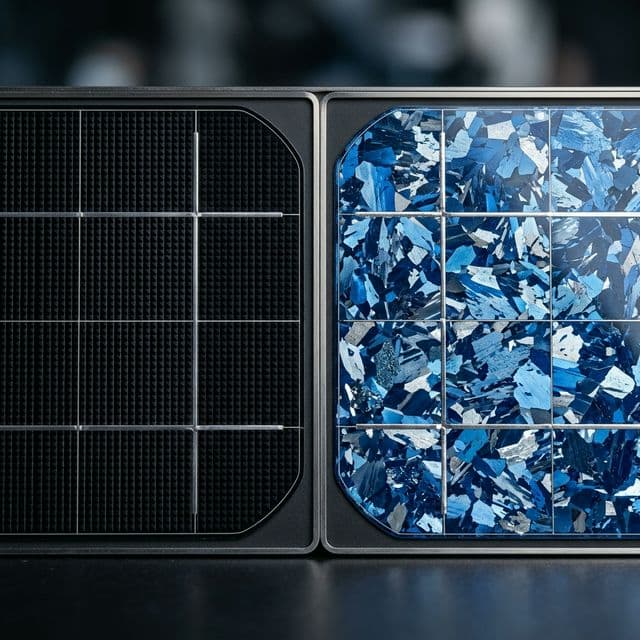
Polycrystalline (Poly) cells, by contrast, are made by melting many silicon fragments together in a square mold. As the silicon cools, it forms many individual crystals (grains). The boundaries where these crystals meet act as microscopic 'speed bumps' for electrons, causing them to lose energy as heat before they can be harvested by the busbars. This grain structure is what gives Poly panels their characteristic blue shimmering appearance.
2. Advanced Cell Technology: PERC, TopCon, and HJT
It is no longer enough to just say 'Monocrystalline.' Modern RV panels utilize PERC (Passivated Emitter and Rear Cell) technology. PERC adds a reflective layer to the back of the solar cell, allowing light that would normally pass through to the backsheet to reflect back into the cell for a second chance at absorption. This is particularly vital for RVers who often deal with low sun angles during winter camping.
The newest frontier in 2026 is TopCon (Tunnel Oxide Passivated Contact) and HJT (Heterojunction Technology). These Mono-derivatives are pushing efficiency beyond 24%. While more expensive, they offer superior spectral response, meaning they can generate power from the UV and Infrared spectrums even on deeply overcast days where older Poly panels would produce zero usable current.
Frequently Asked Questions
Q: Can I mix Mono and Poly panels in the same system?
A: It is highly discouraged. Because they have different Operating Voltages (Vmp) and Coefficients, your charge controller will struggle to find a stable Maximum Power Point (MPP), likely throttling the more expensive panels to match the performance of the cheaper ones.
Q: How do I tell them apart visually?
A: Look at the color and the cell shape. Mono cells are black with rounded corners. Poly cells are blue with perfectly square corners and visible 'grain' in the silicon.
Technical Expansion
Deepen your expertise with our most critical recent diagnostic reports.

V2L Masterclass: How to Power Your RV with a Ford F-150 Lightning or Cybertruck (2026 Guide)
Unlock the potential of Vehicle-to-Load (V2L) technology. Learn how to use your EV truck as a silent, high-capacity mobile power plant for your RV without generators or fuel.
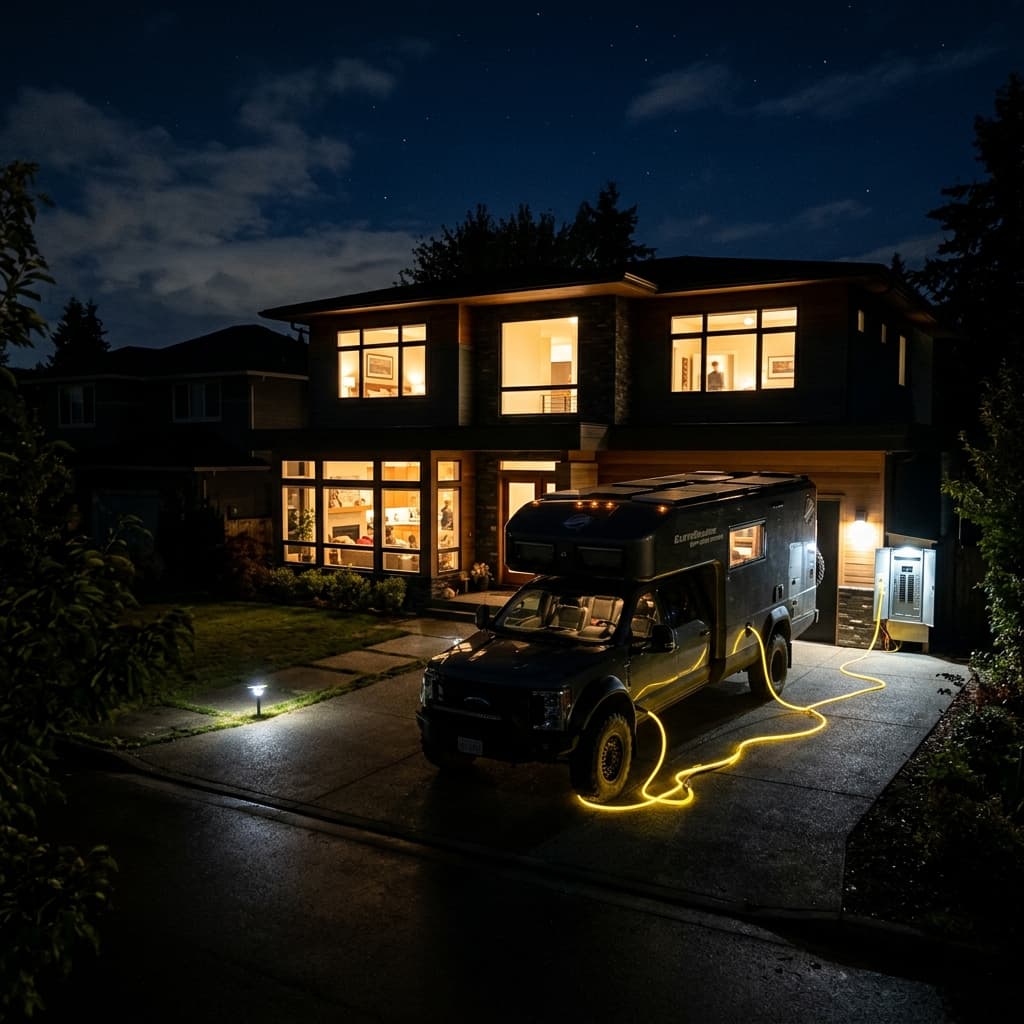
V2H (Vehicle-to-Home) RV Guide: Using Your Camper as a Backup Generator
Don't let your RV battery sit idle. Learn how to configure a V2H (Vehicle-to-Home) system to use your camper's massive solar and lithium bank as an emergency house backup generator.

The Off-Grid A/C Masterclass: How to Stay Cool Without a Plug
Standard RV electrical systems were never engineered to run air conditioning off-grid. This extensive technical brief dissects the precise engineering challenge...