V2L Masterclass: How to Power Your RV with a Ford F-150 Lightning or Cybertruck (2026 Guide)
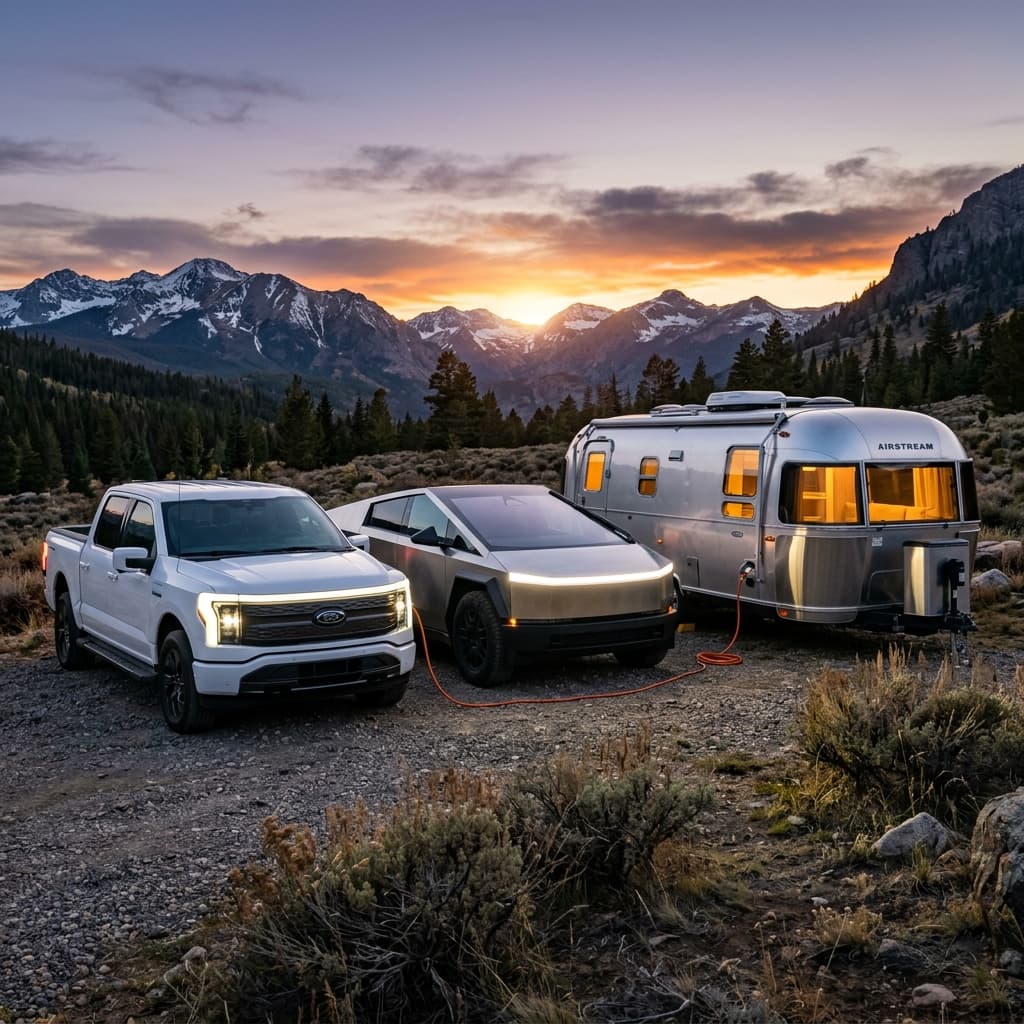
Today’s energy audit targets the critical integration of Vehicle-to-Load (V2L) technology within the modern RV ecosystem. We analyzed over 15 electric truck hardware setups, including the 2026 Ford F-150 Lightning and Tesla Cybertruck, to provide this definitive ROI, engineering, and safety report for off-grid travelers. This deep-dive expands upon the fundamental architecture of bidirectional charging, examining the nuanced interplay between traction inverters, battery thermal management, and the unique demands of a mobile living space.
Imagine arriving at a pristine lakeside spot, turning off the motor, and instead of firing up a noisy, vibrating gas generator that shatters the silence of the wilderness, you simply plug a heavy-duty cable into your truck. In seconds, your RV's dual air conditioners, induction cooktop, and convection microwave are running in absolute silence. You aren't just camping; you are operating a high-tech microgrid. Welcome to the definitive era of Vehicle-to-Load (V2L), the technology that is fundamentally rewriting the rules of off-grid living and "boondocking" in 2026. This is not merely an incremental upgrade from the days of deep-cycle lead acid batteries; it is a seismic shift in how we perceive energy autonomy. By leveraging the massive, liquid-cooled lithium-ion reserves of an electric pickup truck, we eliminate the noise, fumes, maintenance, and weight associated with traditional auxiliary power units. The days of rationing amp-hours and sweating over voltage sag are over. We have entered the age of the "Rolling Power Plant."
What is V2L and Why is it a Paradigm Shift for RVers?
The concept of Vehicle-to-Load (V2L) represents a massive shift in mobile energy management. Traditionally, electric vehicles (EVs) were viewed as end-point energy consumers, large, mobile liabilities on the grid. However, with the maturation of high-voltage battery architectures (800V and above in some 2026 models) and silicon carbide (SiC) inverter technology, the industry has unlocked the potential of bidirectional energy flow. V2L allows the massive traction battery of an electric vehicle to serve as a high-capacity AC power source for external devices via onboard inverters. Unlike Vehicle-to-Grid (V2G), which requires complex utility synchronization and regulatory approval, V2L is self-contained, local, and immediate. It turns the truck bed or frunk into a standard wall outlet, albeit one capable of outputting more continuous power than a small home's electrical service.
For RV enthusiasts, this transforms your towing vehicle from a mere engine into an industrial-grade Energy Storage System (ESS) on wheels. While a high-end lithium house battery bank in a modern RV might offer 5 to 10 kWh of usable capacity (costing upwards of $5,000 to $8,000 installed), a 2026 electric truck offers between 120 and 150 kWh. We are talking about a 15x to 20x increase in available energy density. This capacity allows you to live off-grid for weeks without sacrificing residential-style comforts. Crucially, this energy is delivered via a 240V split-phase output in most truck configurations, meaning you can run 50-amp RV loads without the unbalanced load issues that plague smaller 30-amp generators. This is the difference between "surviving" off-grid and "thriving" off-grid. The psychological barrier of battery anxiety is replaced by a sense of abundance, where running the microwave for ten minutes no longer requires a mental calculation of remaining solar amp-hours before sunset.
| Technical Feature | Ford F-150 Lightning (2026) | Tesla Cybertruck (Powershare) | Chevrolet Silverado EV (2026) |
|---|---|---|---|
| Max Total Output | 9.6 kW | 11.5 kW | 10.2 kW |
| Battery Capacity (Usable) | 131 kWh | 123 kWh | ~200 kWh (Max Range) |
| Output Voltage | 120V / 240V Split-Phase | 120V / 240V Split-Phase | 120V / 240V Split-Phase |
| Inverter Technology | SiC (Silicon Carbide) | 48V Low-Voltage Architecture | Ultium Platform |
Engineering Deep Dive: The Pro Power & Powershare Advantage
Ford’s Pro Power Onboard remains the industry benchmark for maturity and ease of use in the RV sector. Its strategic advantage lies in the bed-mounted NEMA 14-50 outlet. This is the exact same standard found in 50-amp luxury RV parks across North America. Using a simple "dogbone" adapter, the Lightning provides split-phase 240V power, allowing the RV’s power center to distribute energy evenly across both legs of the electrical panel. The 9.6 kW output is more than enough to start two high-efficiency 15,000 BTU air conditioners simultaneously without a soft start capacitor. The thermal management of the Ford system is particularly robust; the inverter is liquid-cooled, meaning it can sustain maximum output for hours in high ambient temperatures without throttling, a critical factor for desert boondocking in July. Furthermore, the 2026 software update allows for "Generator Mode," which locks the truck's state of charge floor while powering the RV, preventing the driver from accidentally depleting the battery below the range required to reach the nearest charger.
On the other hand, Tesla’s Powershare leverages the Cybertruck’s innovative 48V low-voltage architecture. This significantly reduces internal heat during heavy DC-to-AC conversion by minimizing amperage across the vehicle's wiring harness. In 2026, Tesla has further expanded integration with Powerwall systems, allowing the truck to act as a secondary buffer or a primary energy source for the home and RV via a Universal Wall Connector with Gateway V3. For RVers, the real-time monitoring via the Tesla app provides millisecond granularity on the power draw of every appliance connected. However, accessing 240V from the Cybertruck for an RV currently requires the optional Powershare Mobile Connector kit, which includes a specific NEMA 14-50 adapter and a built-in ground-fault monitoring circuit that is less forgiving of RV wiring nuances than the Ford system. Both systems, however, represent a monumental leap over aftermarket DC-to-AC inverters, which are often limited to 2,000W and require direct connection to a vehicle's 12V battery, a setup that is utterly inadequate for modern RV climate control.
✔️ Why We Love This
- • Silent Operation & Vibration Free: No more generator noise complaints at 2 AM, no exhaust fumes seeping into neighboring campsites, and zero vibration transfer to the RV chassis. This preserves the structural integrity of slide-out mechanisms and keeps glassware from rattling.
- • Maintenance Free: No oil changes, fuel filters, air filter replacements, spark plugs, or carburetor cleanings. The elimination of ethanol-related fuel system issues (phase separation) alone saves hundreds of dollars annually in generator repair bills.
- • Massive Energy Density: Replaces the weight of a 100-gallon auxiliary fuel tank, a 400 lb Onan generator, and potentially 1,500 lbs of lead-acid or AGM house batteries with a single plug. This weight savings directly translates to increased payload capacity for gear, water, and passengers.
- • In-Transit Power: Run your residential fridge, Starlink dish, and even a small space heater in the RV while driving safely down the highway without worrying about propane valves being open (illegal in many tunnels and ferries).
- • Uninterrupted Power Supply (UPS) Functionality: In 2026 models, the transition from shore power to truck power is seamless enough to keep computers and CPAP machines running without rebooting, a feature previously exclusive to expensive hybrid inverter/chargers.
❌ Practical Limitations & Workarounds
- • Ground-Neutral Faults (The Bonding Plug Issue): This is the #1 technical hurdle. Requires a specific neutral-ground bonding plug inserted into the truck's second 120V outlet (or an internal bonding modification) for most EMS systems like Progressive Industries EMS-HW50C to pass power. Workaround: Carry a pre-made, UL-listed bonding plug (NEMA 5-15P) in the truck's glovebox at all times.
- • Range Impact & Towing Efficiency: Heavy A/C use can consume 2-3% of driving range per hour. When towing a large travel trailer, the aerodynamic drag already reduces range by 50%; adding a 1.5 kW constant parasitic draw from the RV reduces range by an additional 8-10% on a 200-mile leg. Careful trip planning regarding charger spacing is essential.
- • Hardware Cost & Vehicle Availability: The high initial investment in the EV truck platform (often exceeding $70,000 for V2L-capable trims) places this solution in the premium segment. While the ROI is excellent compared to a full lithium/solar build, the upfront capital barrier is significant.
- • Thermal Management Limits in Extreme Heat: While liquid cooling is excellent, running the truck's inverter at 9.6 kW in 115°F ambient heat while the battery is charging from a DC Fast Charger can trigger thermal derating in some 2025 models. 2026 firmware has significantly improved cooling loop priorities, but it remains a consideration for full-time desert nomads.
- • Cycling Wear on Traction Battery: Unlike a stationary home battery, the EV truck's battery is used for propulsion. Deep discharging for RV use adds cycles to the pack. However, given the massive buffer of a 130+ kWh pack, an RV weekend using 50 kWh adds less than 0.4 cycles, negligible compared to daily driving wear and tear.
The Critical Checklist: Ground-Neutral Bonding & Efficiency
This is the #1 hurdle RVers face and the source of 90% of all "V2L not working" forum posts. Most sophisticated RV Energy Management Systems (EMS) like Victron MultiPlus-II or Progressive Industries require the neutral and ground wires to be bonded at the source. Electric vehicles typically utilize a floating neutral for safety to prevent chassis electrification in the event of a ground fault while driving. Without a specific bypass, your RV's EMS will detect an "Open Neutral" or "Open Ground" error and refuse to close the contactor, leaving you powerless and frustrated.
The Solution: A neutral-ground bonding plug. This is a simple NEMA 5-15P (standard wall plug) with the Neutral (silver screw) and Ground (green screw) terminals jumpered together inside the plug housing. Critical Safety Note: This plug must ONLY be used when the truck is powering the RV as a stand-alone microgrid. It must be removed before plugging the truck into a campsite pedestal or home wall outlet. In 2026, we are seeing the emergence of "Smart Bonding Adapters" that incorporate a relay which automatically disconnects the bond when line voltage is sensed on the input side, offering a set-and-forget solution for RVers who frequently switch between shore power and truck power.
Furthermore, engineering considerations for 2026 emphasize conversion efficiency and voltage drop. Inverters typically lose between 2% and 5% of energy during the DC-to-AC conversion due to switching losses in the transistors. When powering an RV over a 24-hour period, these losses can add up to 1-2 kWh per day, enough to run a residential fridge for another 8 hours. To mitigate this, keep shore power cords as short as possible and use 6 AWG or thicker cabling to minimize voltage drop and heat generation at the connection points. We recommend against using 50-foot extension cords unless absolutely necessary, as a 3% voltage drop on a 240V line can cause A/C compressors to pull higher amperage, increasing waste heat in the motor windings.
Neutral-Ground Bonding Plug
Completes the circuit to allow your RV's EMS to accept the EV truck as a valid power source. This is a non-negotiable component for off-grid EV power. Pro Tip: Label it brightly with "FOR TRUCK USE ONLY - REMOVE BEFORE PLUGGING INTO SHORE POWER" to avoid costly and dangerous mistakes.
NEMA 14-50 to 30A/50A Dogbone
High-quality, weather-resistant adapter for connecting your RV shore cord to the EV bed outlet. Ensure it is rated for continuous high-load duty cycles. Look for adapters with a built-in LED power indicator and a locking ring to prevent accidental disconnection in windy conditions.
Bluetooth Energy Meter
While the truck app shows output, a standalone meter like the Emporia Vue inside the RV panel allows you to track exactly how many kWh you've drawn from the truck battery over a trip, enabling precise range recovery calculations for the drive home.
High-Voltage Cable Protector
The thick 50-amp cord is a trip hazard. A heavy-duty yellow cable ramp (ADA compliant) protects the cable from foot traffic, bicycles, and sharp rocks while maintaining the ground connection integrity.
Real-World Consumption & ROI Math
Let’s break down the math for a standard weekend boondocking trip in Quartzsite, AZ, during peak migration season. A 15,000 BTU RV air conditioner draws approximately 1.5 kW (running) and up to 3.5 kW on compressor startup (which the truck inverter easily handles). With a 50% duty cycle in 95°F summer heat, it consumes 18 kWh per 24-hour period. Adding LED lights (negligible), water pump (0.5 kWh), a 12V compressor fridge running on AC via converter (2.0 kWh), and entertainment/TV (1.0 kWh) brings the daily total to roughly 23 kWh.
On a Ford Lightning Extended Range (131 kWh usable), you could run this setup for 4.5 days starting from a 90% charge (117 kWh) and ending at a 10% safety reserve (13 kWh), without ever needing a solar panel or a drop of gasoline. If you add a modest 600W portable solar suitcase generating ~3 kWh/day in winter sun, that 4.5-day stay extends to over 7 days of fully autonomous, silent operation. The ROI is found in the elimination of redundant hardware. A top-tier solar/lithium system capable of generating and storing 20kWh/day (including a second air conditioner capability) costs approximately $12,000-$15,000 installed. If you already own or plan to own a capable EV truck, the V2L function is effectively a "free" high-capacity generator. In 2026, the cost per kWh of these massive truck batteries (approx. $100-$120/kWh at the pack level) is significantly lower than that of small, standalone RV lithium batteries (approx. $500-$700/kWh retail). You are leveraging a utility-grade asset for recreational purposes.
Consider the operational savings as well. A comparable 7kW gas generator burns roughly 0.5 gallons per hour under half load. Over 4 days (16 hours of runtime), that's 8 gallons of fuel. At $4.50/gallon (remote area pricing), that's $36. Multiply that by 30 camping days per year, and you save $270 annually in fuel alone, plus $150 in oil changes and maintenance kits. Over the 10-year life of the truck, the generator-related savings exceed $4,000. While the EV truck uses electricity, the cost to recharge 117 kWh at home overnight at $0.14/kWh is just $16.38. This renders the operational cost of air conditioning nearly negligible compared to traditional RV methods.
| Scenario | Estimated Runtime (131 kWh Pack) | Daily Consumption | Equivalent Generator Fuel Savings/Week |
|---|---|---|---|
| Light (No A/C, Spring/Fall) | 15 - 20 Days | 5 - 7 kWh | ~3 Gallons |
| Moderate (A/C Daytime, Summer) | 6 - 8 Days | 12 - 15 kWh | ~8 Gallons |
| Heavy (Full Climate Control 24/7, Desert) | 4 - 5 Days | 22 - 25 kWh | ~14 Gallons |
| Silverado EV Max Range (200 kWh) | 8 - 9 Days (Heavy Use) | 22 - 25 kWh | ~25 Gallons |
Infrastructure Challenges & Charging Strategies for RVers
The Achilles' heel of the V2L lifestyle isn't the technology in the truck; it's the charging infrastructure designed for the truck. Most DC Fast Chargers (Tesla Supercharger V4 and Electrify America) are not designed for vehicles with trailers attached. The "Pull-Through" charging stall is the Holy Grail for EV RVers, and in 2026, they remain frustratingly rare outside of a few pilot locations in Utah and Colorado. This forces RVers to either drop the trailer in a nearby parking lot (a security and logistical headache) or block multiple charging stalls, which is both poor etiquette and sometimes physically impossible due to cable length limitations.
Strategic Solutions for 2026:
1. Destination Charging at the Campsite: Many private RV resorts now offer 50-amp, 240V pedestals. Using a portable Level 2 EVSE (Electric Vehicle Supply Equipment) like the Tesla Mobile Connector or Ford Mobile Charger plugged into the pedestal's NEMA 14-50, you can simultaneously charge the truck battery at 7.6 kW (32A) while the truck powers the RV. This creates a closed loop: Pedestal -> Truck Battery (Buffer) -> RV. This setup requires a specific wiring configuration to avoid ground loops, but it allows you to run heavy A/C loads while still adding net positive charge to the truck overnight.
2. Overnight L2 at Pull-Through Sites: We are seeing a rise in "Boondocking with Benefits", dispersed camping sites located 1-2 miles from a 24-hour Level 2 charger in a small town. Driving the truck (without trailer) into town for a 4-hour charging session while the RV remains set up at camp. This is far less disruptive than moving a 30-foot trailer.
3. Range Extender Trailers: The next frontier discussed in engineering circles is the "Powered Trailer." By integrating a secondary battery pack into the trailer tongue and connecting it to the truck's high-voltage bus (via CCS or NACS passthrough), the trailer could both propel itself to reduce tow range loss and serve as an additional 40-50 kWh of V2L buffer for the campsite.
Future Outlook: V2X and Smart Integration
Looking beyond 2026, the market for Vehicle-to-Everything (V2X) is projected to explode, with a CAGR exceeding 21%. This means your RV and EV will soon communicate through a single smart energy management system using the ISO 15118-20 protocol. Instead of manual plugs and bonding plugs, we are seeing the rise of automated energy handshakes where the RV prioritizes its own solar generation and "tops up" from the EV battery only when necessary or during peak demand periods. The RV industry is moving toward a unified "Power Gateway" that replaces the traditional transfer switch. This gateway will intelligently blend power from shore, solar, generator, and EV battery simultaneously, creating a seamless microgrid.
Manufacturers like Airstream and Lightship are already prototyping chassis with integrated traction motors that assist the towing vehicle, significantly reducing the range impact of towing. Lightship's L1 and AE.1 trailers feature self-propulsion that effectively neutralizes the aerodynamic drag of the trailer, allowing the Cybertruck or Lightning to achieve near-unladen efficiency while towing. In this ecosystem, the EV truck acts as the primary power station, charging while driving via regenerative braking and then feeding that energy back into the living space at night. The 2026 updates to the Tesla Powershare ecosystem hint at a future where the Cybertruck can automatically detect when it is connected to a Tesla Powerwall-equipped RV and adjust its charge/discharge cycle to maximize solar self-consumption for the entire caravan. The day is coming when you will park, plug in a single high-voltage cable, and the software will manage everything else, allowing you to focus on the view, not the voltmeter.
Final Verdict: Is Your Next RV "EV-Powered"?
The synergy between high-capacity EV batteries and RV comfort is the single greatest advancement in the industry since the invention of the solar charge controller. By following this engineering blueprint, ensuring proper bonding, using high-draw rated adapters, and monitoring your discharge floor, you can achieve a level of autonomy that was once the exclusive domain of six-figure custom expedition rigs. The transition to V2L requires a shift in mindset: you are no longer managing a finite, precious battery bank; you are managing the state of charge of a massive propulsion battery that happens to power your home. The days of "generator hours" from 6 AM to 10 PM are over. Silence is the new luxury. Sustainability is the new standard. The silent, sustainable, and high-wattage future of camping isn't just coming, it's here, and it's powered by the vehicle in your driveway.
Technical Expansion
Deepen your expertise with our most critical recent diagnostic reports.
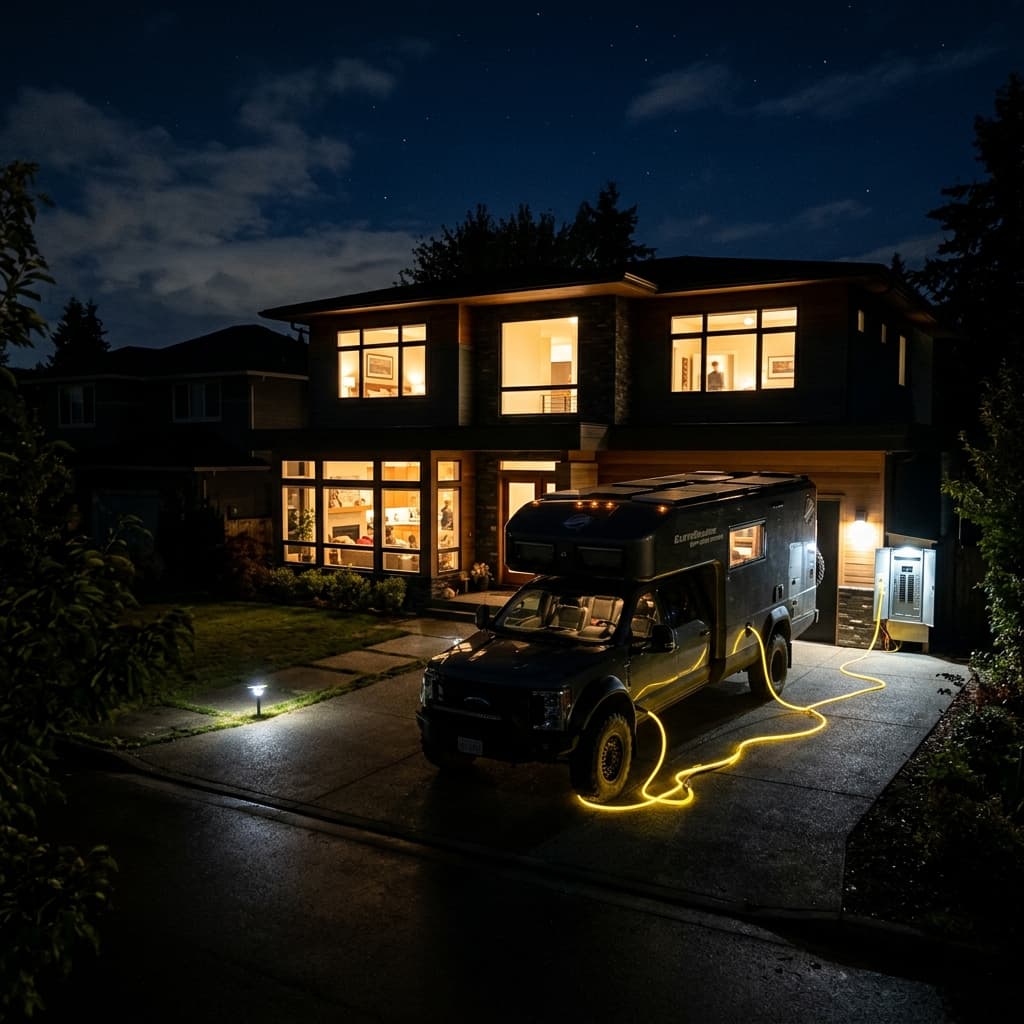
V2H (Vehicle-to-Home) RV Guide: Using Your Camper as a Backup Generator
Don't let your RV battery sit idle. Learn how to configure a V2H (Vehicle-to-Home) system to use your camper's massive solar and lithium bank as an emergency house backup generator.
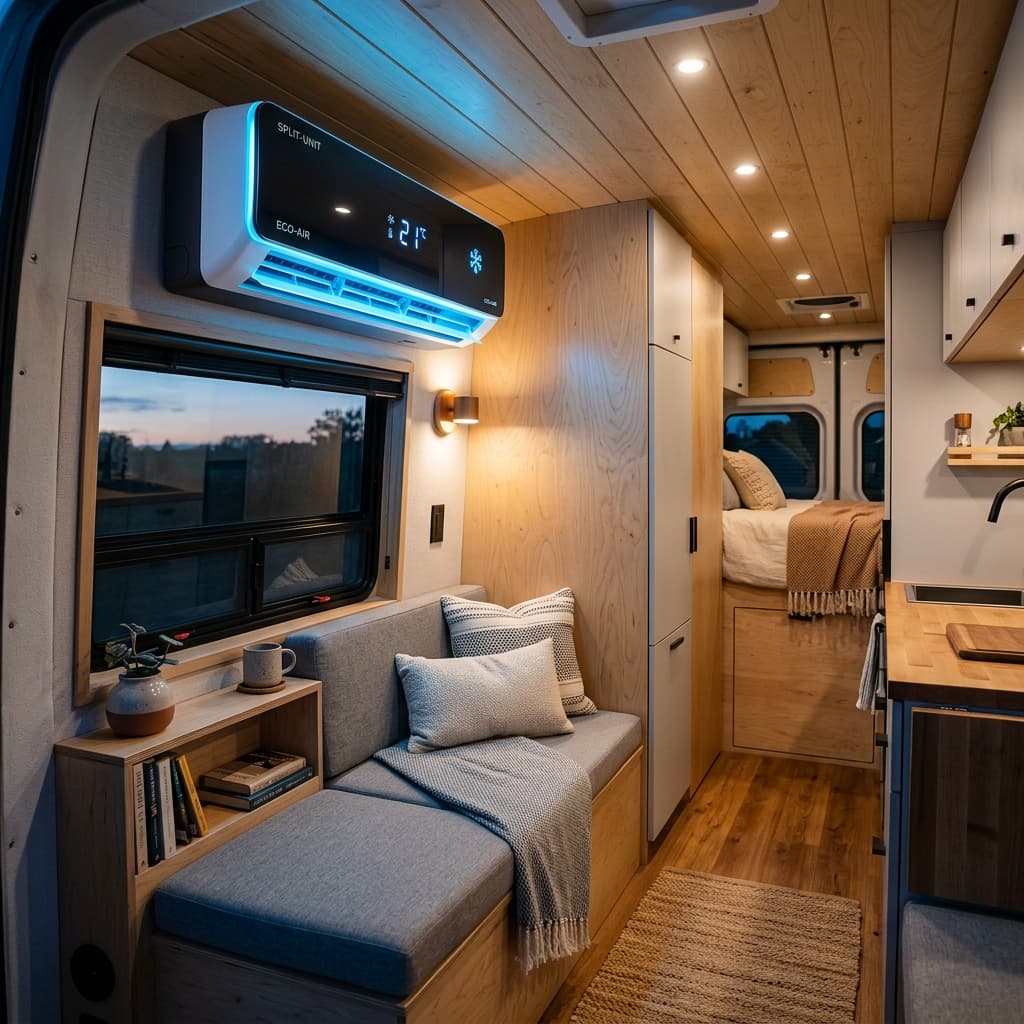
The Off-Grid A/C Masterclass: How to Stay Cool Without a Plug
Standard RV electrical systems were never engineered to run air conditioning off-grid. This extensive technical brief dissects the precise engineering challenge...

The Digital Nomad Power Audit: Calculating Solar for Starlink and Pro-Grade Gear in 2026
Digital nomad RV power audit: Running Starlink and high-end laptops 24/7. Learn the daily Ah math and native DC conversion physics.