Predictive AI Microgrids in RVs: Satellite Data for Solar Energy (2026)
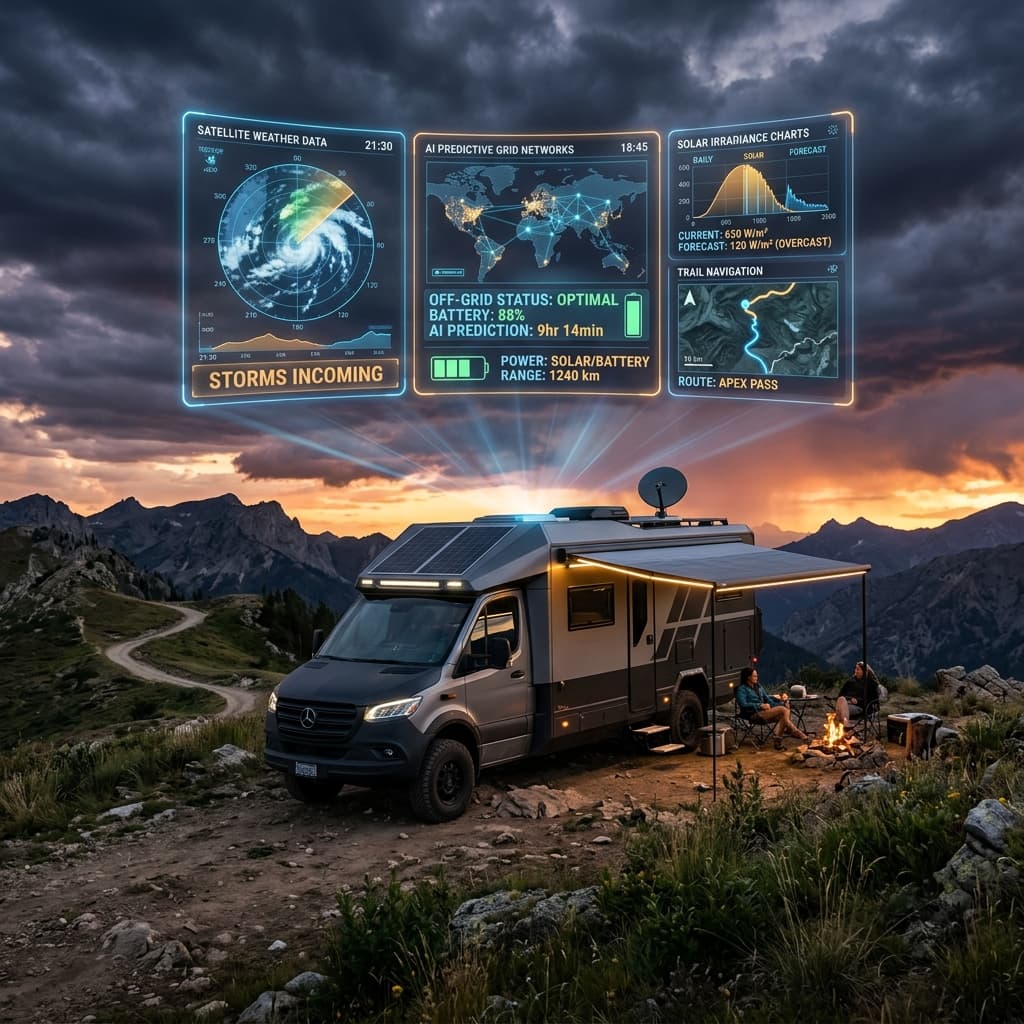
Arriving at 10% battery capacity while hopelessly praying for morning sun is officially a thing of the past. In 2026, the elite standard in off-grid power relies on Predictive AI Microgrids, systems that regulate your RV’s consumption based on real-time satellite telemetry and localized weather forecasting. This expanded technical deep-dive explores the architecture behind the algorithms, the specific protocols making it possible, and a candid look at where the technology still stumbles.
For years, RV solar energy management has been entirely reactive. Standard Maximum Power Point Tracking (MPPT) controllers do exactly what their name implies: they analyze the current voltage and current coming from your roof at any given millisecond. However, they possess absolutely zero context about the future. If a massive three-day storm system is approaching your boondocking location, a traditional system will blissfully allow you to run your electric water heater at full blast until the batteries hit critical depletion. You, the human, are the only failsafe, and humans forget, sleep, or simply don't have access to hyper-local weather data in the backcountry.
The result of this reactive paradigm is what seasoned nomads call "Battery Anxiety." It's that nagging feeling at 9 PM when the voltage reads 12.2V and you know the furnace is about to kick on for the night. You start doing mental math: "If I turn off the inverter now, and the sun hits the panels by 8 AM, I'll be at 11.8V by sunrise. That's cutting it close." This mental load is exhausting. The promise of the 2026 Smart Microgrid is to offload that cognitive burden onto a machine that never sleeps, never forgets to check the forecast, and can react in milliseconds to changing conditions.
The End of the "Dumb" MPPT Controller
The paradigm shifts entirely with the introduction of the Smart Microgrid. By bridging the gap between your power electronics and high-speed satellite internet arrays (such as the omnipresent Starlink Gen 3 or a Pepwave cellular router), your RV's energy gateway can now ping meteorological APIs on an hourly basis. It calculates exactly how much solar irradiance your specific roof array will receive tomorrow, aggressively factoring in your precise GPS coordinates, seasonal panel tilt, and local cloud cover density models. This is not a generic weather app forecast; it's a numerical weather prediction (NWP) model query that returns expected watts per square meter for your exact lat/long.
Consider the physics: A standard 400W solar array might produce 350W at solar noon in June. But under heavy overcast, that same array might struggle to produce 40W. A traditional MPPT doesn't know the difference between "it's 7 AM and the sun is low" and "it's noon but there's a thunderstorm." It just sees low voltage and low current. The AI gateway, however, knows that at your current location, solar noon is at 1:15 PM, and it also knows that the HRRR (High-Resolution Rapid Refresh) model predicts 95% cloud cover until 4 PM. It can therefore make a strategic decision: do not attempt to run the high-wattage convection microwave right now. Instead, suggest using the propane stove. Or, even better, if it's connected to your smart home relays, it simply won't allow the microwave to draw more than 500W until the storm passes. This is the difference between surviving a storm and thriving through it.
⛅ Traditional Management (Reactive)
- • Voltage-Only Logic: Reacts only to current battery voltage thresholds (e.g., "Battery < 12.1V, start generator"). No concept of future energy availability.
- • Cloud Blindness: Cannot differentiate between a brief passing cloud (5-minute dip) and a massive multi-day cold front. Treats all low-power events the same.
- • Manual Intervention Required: Requires constant human monitoring and manual load shedding, physically flipping breakers or turning off the inverter before bed to save power. This leads to decision fatigue.
- • Wasted Potential: Once the battery is full, the MPPT throttles back solar input. Any potential energy beyond that is simply reflected back into space or dissipated as heat.
🧠 AI Predictive Microgrid (Proactive)
- • 72-Hour Irradiance Forecasting: Pre-fetches hyper-local solar yield predictions using APIs like Solcast or OpenWeatherMap's solar radiation model. Adjusts charging strategy hours *before* the weather changes.
- • Behavioral Machine Learning: Employs on-device ML models (often running in Node-RED or a dedicated Python service on a Raspberry Pi) to chart your daily consumption habits, like the 7 PM cooking spike or the 3 AM furnace cycle.
- • Pre-Emptive Load Control: Automatically throttles non-essential loads (electric floor heating, outdoor lighting, secondary water heater elements) via smart relays *before* severe weather strikes, preserving battery for essential functions.
- • Opportunistic Dumping: When the forecast predicts a full battery *and* excess sun, the AI proactively turns on loads (like chilling the fridge an extra 2 degrees or running the ice maker) to store that energy as thermal or kinetic potential rather than wasting it.
How Automated Load Shedding Revolutionizes Boondocking
Imagine you are camped deep in the Hoh Rainforest of the Pacific Northwest in late October. Your AI gateway determines that tomorrow will bring 90% cloud cover, yielding exceptionally low solar input, perhaps only 300Wh total for the entire day instead of the usual 2.5kWh. The neural network algorithms embedded in platforms like a modernized Victron Cerbo GX system (or a custom Venus OS Large installation on a Raspberry Pi) seamlessly trigger what is known as "Deficit Mode."
Instantly, the system cuts relay power to your redundant AC heating loops and limits the inverter output, reserving the remaining lithium capacity strictly for vital survival systems: medical CPAP devices, the 12V compressor fridge, and essential LED lighting. This is not a blunt instrument; it's a surgical scalpel. The system might reduce the thermostat's "Comfort" setpoint by 2 degrees and switch the water heater from electric to propane (if equipped with a solenoid valve). This Pre-emptive Load Shedding prevents deep and damaging battery cycles, massively extending the operational longevity of your multi-thousand-dollar LiFePO4 bank. It also means you don't wake up to a dead battery and a warm fridge at 3 AM.
The psychological benefit is perhaps even greater than the technical one. When you know the system is actively managing the energy budget, you stop micromanaging the voltmeter. You trust the machine. You can watch a movie on a cloudy night without that nagging guilt, because the AI has already calculated that based on current consumption and tomorrow's forecast, you have a 94% probability of making it through the night above 20% state of charge. That peace of mind is the true luxury of a smart microgrid.
| Meteorological Event | Legacy System Reaction | AI Gateway Reaction (2026) | Net Energy Saved |
|---|---|---|---|
| Unexpected 3-Day Storm | Continues running HVAC at normal setpoints; battery enters low-voltage cutoff by Day 2. User must run generator or drive to recharge. | Throttles water heater and preemptively limits AC duty cycle hours before storm hits; survives 4+ full days on battery reserve alone. | ~2.5 - 4.0 kWh |
| High Heat / Clear Skies Peak | Battery reaches 100% SOC by 11 AM. MPPT throttles to Float. Excess 2kW of potential solar is wasted for the next 5 hours. | Detects "surplus" forecast. Diverts excess solar automatically to pre-cool the RV interior by 4°F utilizing the air conditioner, storing energy as thermal comfort. | ~3.0 - 5.0 kWh (utilized) |
| Early Morning Heavy Fog | MPPT stays in low-power mode. User wakes up, sees low battery, and manually starts generator to make coffee. | Anticipated fog delay from satellite imagery. Automatically engaged "Eco Mode" overnight (lower inverter idle draw) to preserve coffee-making capacity. | ~0.5 - 0.8 kWh |
The Architecture of an AI Microgrid: Protocols and Parts
The beauty of the Smart Microgrid transition is that upgrading your RV does not mandate tearing out your entire battery architecture. The core upgrade lies in modernizing the "brain" of your system. In 2026, the reference architecture consists of three distinct layers:
Layer 1: The Physical Layer (Hardware). This remains largely unchanged. You still have your LiFePO4 batteries, your MultiPlus or Quattro inverter/charger, and your MPPT solar controllers. The key requirement is that these devices support a robust communication protocol like VE.Can (Victron's CANbus implementation), Modbus TCP/IP, or the emerging RV-C standard. These protocols allow an external computer to read real-time data (battery voltage, solar wattage, AC loads) and, crucially, to *write* commands (change charge voltage, enable/disable inverter, switch relay states).
Layer 2: The Gateway and Logic Layer (The Brain). This is the new addition. It's typically a small, low-power Linux computer like a Raspberry Pi 4 or 5 running Venus OS Large (Victron's open-source monitoring OS) or a custom build of Home Assistant with solar-specific plugins. This gateway connects to the internet (via Starlink or cellular) to fetch weather APIs. It runs the logic that decides *when* to shed loads. This logic is most commonly written in Node-RED, a visual programming tool that allows you to wire together data flows. For example: "Every 30 minutes, fetch forecast from Solcast -> If tomorrow's predicted yield is less than 1.5 kWh -> Send MQTT message to turn off Relay 2 (Water Heater)."
Layer 3: The Actuator Layer (Smart Relays). The brain needs hands. This is where smart relays and solid-state switches come in. A Shelly Plus 1PM or a Victron BatteryProtect can be controlled via Wi-Fi or a simple 12V signal from the gateway. These devices physically interrupt the power to non-essential AC or DC loads. For larger loads like air conditioners, the control is often more sophisticated, using RV-C CANbus commands to tell the air conditioner's control board to enter "Eco Mode" rather than cutting power entirely, which could damage the compressor.
Upgrading to a Predictive System in Your Camper: A Practical Roadmap
Upgrading to a smart microgrid is a journey, not a single purchase. You can start small and add intelligence incrementally. The first step is to ensure your core power electronics are "smart-ready." If you're using older, non-networked components, the first upgrade should be to a Victron Cerbo GX or a similar communication hub. This gives you local monitoring via the Victron Connect app and, more importantly, opens up the VRM (Victron Remote Management) portal for cloud logging.
Once you have a Cerbo GX, you have access to Node-RED directly on the device (via Venus OS Large). This is where the magic happens. You don't need to be a professional programmer. You can find pre-built "flows" in the Victron Community forums that handle the heavy lifting. A typical flow might look like this:
- Inject Node: Triggers every 15 minutes.
- HTTP Request Node: Calls the Solcast API with your GPS coordinates and panel configuration.
- Function Node: Parses the JSON response and extracts the "pv_estimate" for the next 24 hours.
- Switch Node: If tomorrow's estimate < 2.0 kWh, proceed to "Conservation Mode."
- Modbus Write Node: Sends a command to the Victron MultiPlus to set the AC input current limit to 5A (limiting heavy inverter loads).
- MQTT Out Node: Publishes a message to a Shelly relay to turn off the electric towel warmer.
By ensuring your main inverter and solar charge controllers communicate over a unified robust protocol (such as VE.Can, RV-C, or industrial CANBus), the AI module acts as an omniscient conductor. It dictates the flow of every single watt, ensuring that energy goes exactly where it is needed, and stops flowing before disaster strikes. The beauty of this approach is that it is fully offline-capable. If Starlink goes down, the system retains its last known forecast and reverts to a conservative, time-based schedule rather than failing completely. This graceful degradation is essential for safety-critical systems in remote areas.
The Human Element: Trust and Override
No AI is perfect, and weather forecasting remains an exercise in probability. There will be times when the AI makes the "wrong" call, it conservatively limits your power usage because it predicted a storm that never materialized. This can be frustrating if you're sitting in bright sunshine but the system won't let you run the air conditioner at full blast.
Therefore, any well-designed microgrid must include a prominent "Override" button, either physical or in the app. This button temporarily suspends the predictive logic and allows the user to take manual control. The system should log when the override is used, feeding that data back into the machine learning model. If a user consistently overrides the system on days with a certain forecast pattern, the AI can learn to be less conservative in that specific scenario. This human-in-the-loop feedback mechanism is what elevates a simple "If-Then" script to a truly adaptive AI.
Grid Interaction: The Hidden Benefit of V2L Integration
For RVers who also have a home base with solar panels, the predictive microgrid extends its intelligence to the driveway. Using the same API calls, the system can determine the optimal time to charge the RV's house battery from the home's solar array. If the home battery is full and the forecast shows excess solar production in the afternoon, the AI can automatically enable the RV's charger at 2 PM, storing that free energy in the RV's battery rather than selling it back to the grid for pennies. This is Vehicle-to-Home (V2H) and Vehicle-to-Grid (V2G) integration at the consumer level, turning your RV into a mobile energy asset rather than just a passive consumer.
Scenario: Home Base with 10kW Solar and RV with 15kWh Battery
- Forecast: Sunny afternoon, home battery will be full by 1 PM.
- AI Action: At 1:15 PM, enables RV charger at 3kW.
- Result: RV battery charges from 40% to 100% by 4 PM using only excess solar that would have been exported to the grid at $0.04/kWh.
- Net Benefit: The RV now has a "free" full tank of energy for the next trip, worth approximately $2.50 in grid electricity but priceless in terms of boondocking autonomy.
Technical Expansion
Deepen your expertise with our most critical recent diagnostic reports.

V2L Masterclass: How to Power Your RV with a Ford F-150 Lightning or Cybertruck (2026 Guide)
Unlock the potential of Vehicle-to-Load (V2L) technology. Learn how to use your EV truck as a silent, high-capacity mobile power plant for your RV without generators or fuel.

V2H (Vehicle-to-Home) RV Guide: Using Your Camper as a Backup Generator
Don't let your RV battery sit idle. Learn how to configure a V2H (Vehicle-to-Home) system to use your camper's massive solar and lithium bank as an emergency house backup generator.
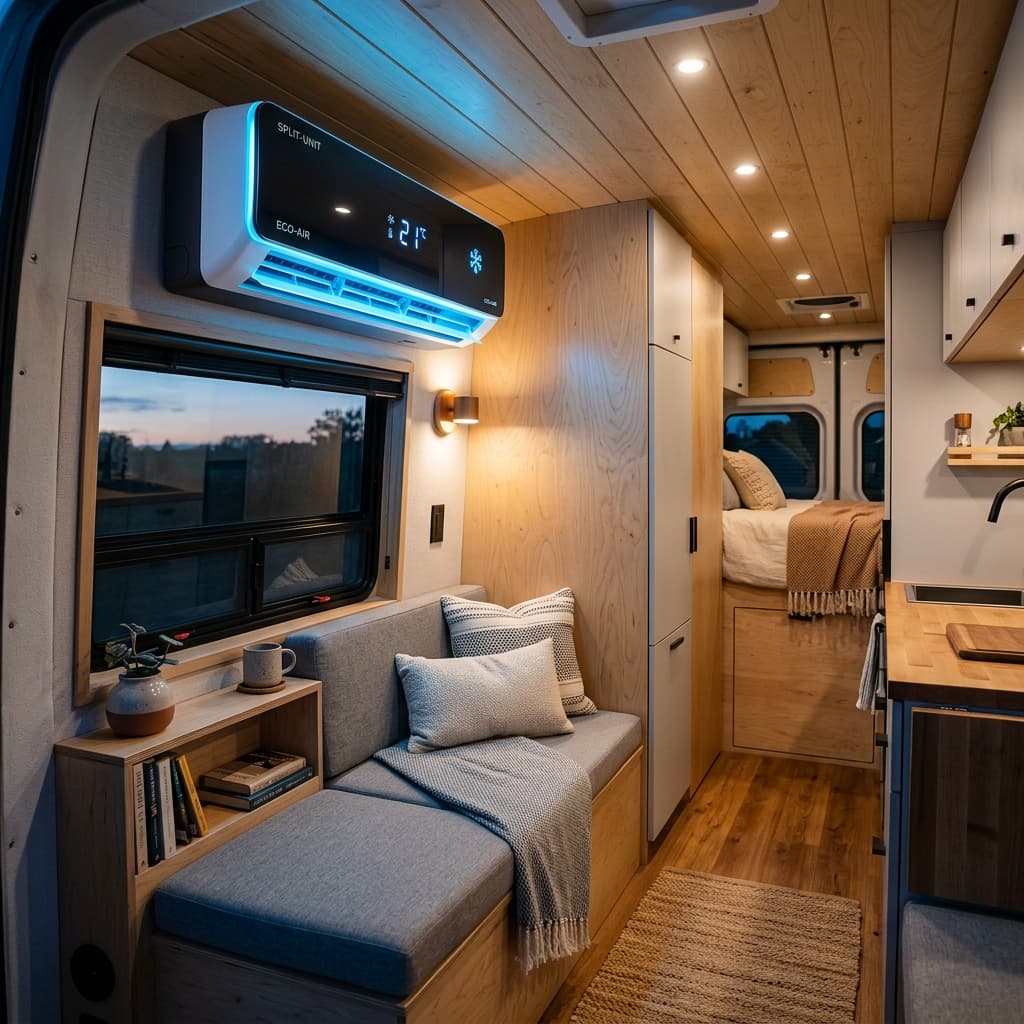
The Off-Grid A/C Masterclass: How to Stay Cool Without a Plug
Standard RV electrical systems were never engineered to run air conditioning off-grid. This extensive technical brief dissects the precise engineering challenge...