Perovskite Solar: A 2026 Forward-Look at the Future of RV Energy Density

Today’s energy audit targets the next-gen Perovskite solar cells. We analyzed the chemical stability and theoretical efficiency limits of these hybrid halides to provide this definitive road-map for future RV solar integration.
Perovskite Solar Cells: The Future of RV Solar Efficiency
In the current RV market, the debate usually centers around Monocrystalline vs. Polycrystalline panels. However, in the labs of materials scientists, a new challenger is emerging that could make standard silicon panels obsolete: Perovskite Solar Cells (PSCs).
Named after the mineral perovskite, these cells are made from a class of synthetic materials with a unique calcium-titanium-oxide crystal structure. From an engineering standpoint, PSCs represent the most significant "Jump in Efficiency" since the invention of the solar cell itself. While traditional silicon panels have a theoretical efficiency limit of around 29%, Perovskite-Silicon Tandem Cells have already surpassed 33% in laboratory settings. This review is an industrial audit of how these materials will transform the roof of your expedition vehicle in the next decade.
The Physics of Efficiency: Bandgap Engineering
The primary limitation of silicon is its fixed Bandgap. Silicon can only absorb a specific portion of the light spectrum, mostly the red and infrared wavelengths. The high-energy blue and ultraviolet photons are largely wasted as heat.
Perovskites are different because they are Tuneable. By altering the chemical composition of the perovskite crystal, engineers can "tune" the bandgap to absorb specific parts of the spectrum. In a tandem configuration, a top layer of perovskite captures the high-energy blue photons, while the bottom silicon layer captures the lower-energy red photons. This "Spectrum-Slicing" is the holy grail of solar engineering, allowing for a 300W panel to occupy the same physical space as a current 200W panel.
Final Engineering Verdict
The Perovskite Solar Revolution is not a matter of "if," but "when." For the off-grid nomad, every square inch of roof space is a precious resource. The ability to harvest more energy from the same footprint while reducing weight is an engineering triumph that will redefine the "Unlimited Power" dream.
While we recommend the current generation of Silicon and CIGS panels for those building today, we encourage every SolarRV reader to keep a close eye on the PSC market. In three to five years, your next upgrade will likely be a Perovskite-Tandem array that pushes your energy independence to levels previously considered impossible.
Technical Expansion
Deepen your expertise with our most critical recent diagnostic reports.

V2L Masterclass: How to Power Your RV with a Ford F-150 Lightning or Cybertruck (2026 Guide)
Unlock the potential of Vehicle-to-Load (V2L) technology. Learn how to use your EV truck as a silent, high-capacity mobile power plant for your RV without generators or fuel.
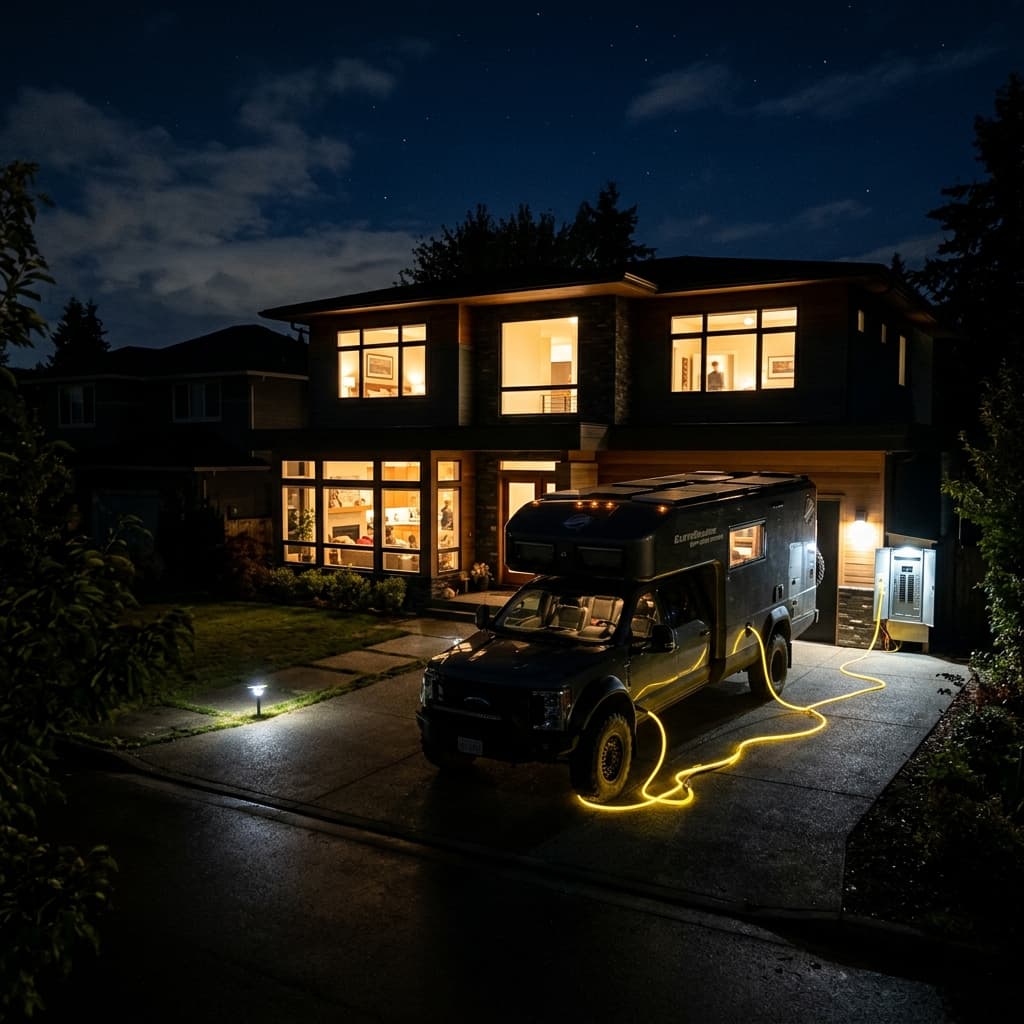
V2H (Vehicle-to-Home) RV Guide: Using Your Camper as a Backup Generator
Don't let your RV battery sit idle. Learn how to configure a V2H (Vehicle-to-Home) system to use your camper's massive solar and lithium bank as an emergency house backup generator.

The Off-Grid A/C Masterclass: How to Stay Cool Without a Plug
Standard RV electrical systems were never engineered to run air conditioning off-grid. This extensive technical brief dissects the precise engineering challenge...