How to Safely Fuse Your RV Solar System: A Quick Guide to Circuit Protection
GuidesMarch 13, 2026

How to Safely Fuse Your RV Solar System: A Quick Guide to Circuit Protection

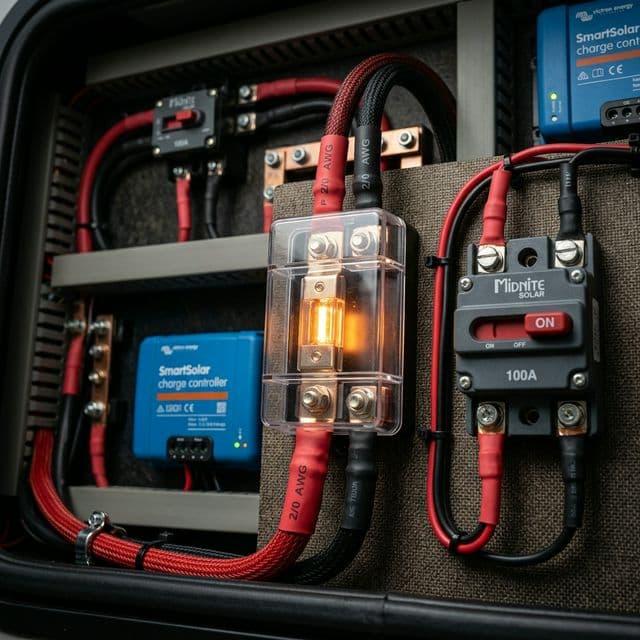
A common mistake in DIY RV solar installations is skipping the safety fuses. "It's only 12 volts," some might say. But in reality, a large LiFePO4 battery bank can discharge hundreds of amps into a short circuit, creating enough heat to melt 4/0 AWG cables and spark a structural fire in seconds. In this 2,000-word safety audit, we map out the exact circuit protection strategies required for a professional mobile build.

1. The Physics of the Short Circuit: Why Fuses Matter

When a positive wire touches the metal frame of your RV (or a negative wire), it creates a 'short circuit.' With no resistance, the electricity flows at the maximum capacity of the source. For a 400Ah Lithium battery, this could be 3,000 to 5,000 Amps for a split second. A standard wire is not a pipe; it's a resistor. When 5,000 Amps flow through a wire rated for 100 Amps, the wire instantly becomes a heating element, glowing red-hot and igniting its plastic insulation. A fuse's only job is to be the 'weakest link'—melting safely before the wire does.

2. Critical Circuit Map: The Three Mandatory Zones

System ZoneRequired ComponentAIC Rating NeedSizing Rule
Solar Input (PV)DC Breaker / Inline MC4Low1.5x Short Circuit Current (Isc)
Controller to BatteryMEGA or MIDI FuseHigh (2000A+)1.25x Controller Output Rating
Battery to InverterANL or Class TExtreme (20,000A+)Wire-Limit (Check AWG Capacity)
House LoadsBlade Fuses (ATC/ATO)Low1.25x Peak Branch Load

3. Wire Gauge vs. Fuse Rating: The Golden Rule

You do not fuse for the appliance; you fuse for the wire. This is the most common DIY mistake. If you have a cell phone charger that draws 2 Amps, but it is connected to a wire that can handle 20 Amps, you should use a fuse smaller than 20 Amps. If you put a 30 Amp fuse on that wire, the wire will melt before the fuse blows if a short occurs. When designing your system, first determine how many amps your appliance needs, then choose the appropriate AWG (American Wire Gauge) based on distance and voltage drop, and finally, select a fuse that is lower than the wire's maximum ampacity.

4. Fuse Tech: ANL, MEGA, and the God-Tier Class T

Not all fuses are created equal. ANL Fuses are great for general inverter paths because they are high-current and slow-blow, meaning they won't pop during a momentary split-second startup surge. However, they have a limited AIC (Amp Interrupt Capacity). If a massive Lithium bank shorts out, the arc might actually jump across a blown ANL fuse.

For Lithium systems over 200Ah, we strongly recommend Class T Fuses. These are designed with a much higher AIC (up to 20,000A) and are current-limiting. In a short circuit event, they blow so fast that they physically prevent the current from ever reaching its destructive peak. They are more expensive ($30-$50 vs $5 for ANL), but in a $5,000 power system, it is the cheapest insurance you can buy.

✔️ Benefits of DC Breakers

  • Disconnect Function: Acts as a main switch for PV isolation.
  • Resettability: No need to carry spares for nuisance trips.
  • Ease of Install: No separate fuse holder usually required.
  • Visual Feedback: Instant knowledge of circuit state.

🔧 When to Choose Fuses

  • High Current Paths: Fuses handle heat better over 150A.
  • Lithium Safety: Class T fuses are the only safe bet for big banks.
  • Space Efficiency: MRBF terminal fuses bolt directly to the battery.
  • Total Reliability: No mechanical components to fail or jam.

5. The '7-Inch Rule': Critical Placement for RVers

AbYC (American Boat and Yacht Council) and RVIA standards emphasize the 7-Inch Rule. This means that your primary fuse must be located within 7 inches of the power source (the battery). Why? Because the wire before the fuse is unprotected. If you place your fuse 5 feet away from the battery and the wire shorts out at the 2-foot mark, the fuse does absolutely nothing. The entire length of cable between the battery and the fuse is a potential fire hazard. In tight van builds, use MRBF (Marine Rated Battery Fuses) that bolt directly to the positive battery post for 0 inches of unprotected wire.

6. Grounding and Bonding: The Silent Partner in Safety

Fuses only work if the current has a path back to the source. In an RV, this path is usually the metal chassis. Every main component (Inverter, Controller, Battery) should have a 'Chassis Ground' wire that is correctly sized. If your Inverter has a 1/0 AWG positive cable, its case ground should also be 1/0 AWG. This ensures that if an internal fault occurs, the high current can travel through the frame back to the battery, successfully blowing the main fuse. Without a proper ground bond, a faulty inverter case could remain 'hot' at 12V, waiting to shock the next person who touches it.

Final Verdict: Safety is Not an Extra; It's the Foundation.

A professional RV solar build is defined by its labels, its crimps, and its fuses. By following the 1.25x sizing rule, adhering to the 7-inch placement standard, and utilizing Class T fuses for high-capacity Lithium banks, you ensure that your 'Home on Wheels' remains a safe sanctuary for years to come. Never compromise on circuit protection.

Recommended Safety Hardware

Main Battery Isolation

Blue Sea 250A ANL Fuse

Heavy duty protection for large inverters. Trust the brand that pros use.

View on Amazon
Solar PV Input

Victron 40A DC Breaker

Resettable protection and disconnect for your solar panel strings (DIN Rail).

View on Amazon
Compact Terminal Fuse

Blue Sea MRBF Holder

Best for tight spaces. Bolts directly to the battery post for max safety.

View on Amazon

Frequently Asked Questions

Q: Should I fuse the negative side too?
A: No. In DC systems, we only fuse the positive (hot) side. Fusing the negative can cause a safety hazard where a fault could energize the metal frame of the vehicle even if the 'main' negative fuse is blown.

Q: Can I use AC breakers for DC solar?
A: NO. AC breakers rely on the 'zero-crossing' of the current to extinguish an arc. DC current is constant and can easily jump the gap in an AC breaker, resulting in a fire inside the panel. Always use DC-rated protection.