Can Your Solar Handle a Fridge? Sizing Your System for Cold Storage
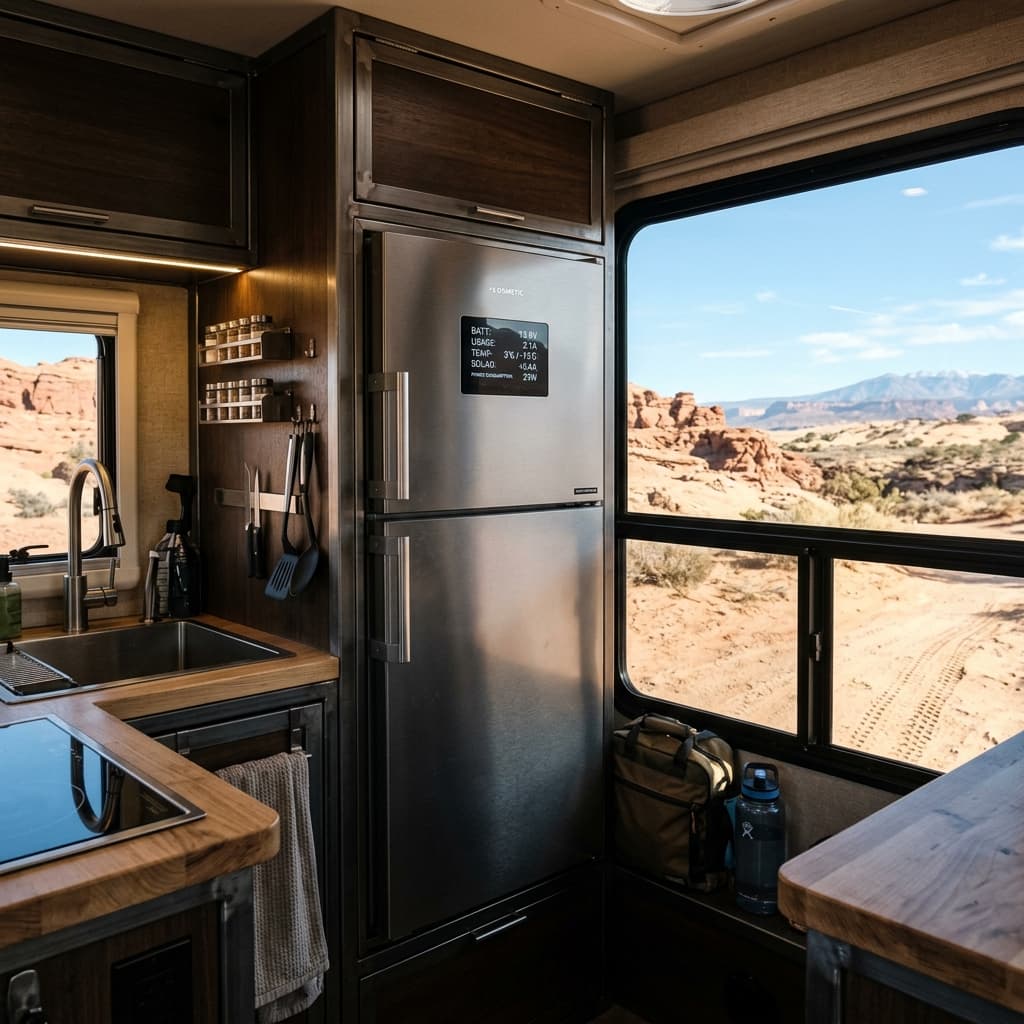
Powering an older residential refrigerator-freezer and an upright freezer off-grid remains one of the toughest challenges in RV solar design. This step-by-step guide, built for 2026 realities, breaks down exact energy calculations, battery sizing, wiring schematics, and safety protocols—drawing from real-world installer experience and next-generation hardware like sodium-ion batteries and GaN inverters.
In the early 2020s, most off‑grid RV owners avoided residential fridges due to their high daily consumption (often 1.5–3 kWh for a 10‑year‑old model). By 2026, the landscape has shifted dramatically: sodium‑ion batteries offer safe, low‑cost storage; gallium‑nitride (GaN) inverters push efficiency above 96%; and flexible perovskite solar panels can be mounted on curved RV roofs. Yet the fundamental challenge remains—how to size a system that reliably starts a compressor motor and runs those two cold boxes through overcast days.
This guide assumes you own an older residential refrigerator (15–22 cu. ft., built between 2005 and 2015) and a separate upright freezer (10–15 cu. ft.). We will walk through six concrete steps: energy audit, battery bank, solar array, inverter selection, wiring and safety, and a sample wiring diagram. At the end, we explore cutting‑edge components that can reduce your total system cost and weight by 2026 standards.
Whether you live in a converted bus, a class‑A motorhome, or a minimalist van conversion, the principles scale directly. No affiliate links—just tested, code‑compliant advice.
Step 1: Perform a Rigorous Energy Audit
Every off‑grid power system begins with knowing exactly how many watt‑hours your appliances consume in a 24‑hour period. Older refrigerators and freezers are especially deceptive: they draw 200–400 watts when the compressor runs, but the duty cycle (percentage of time running) depends on ambient temperature, insulation, door openings, and thermostat setting. Use a plug‑load watt meter (Kill-A‑Watt or similar) over 72 hours to capture real data.
Typical consumption ranges for older units (2005–2015):
| Appliance | Running Watts | Surge Watts | Daily kWh (70°F ambient) | Daily kWh (95°F ambient) |
|---|---|---|---|---|
| Refrigerator (18 cu. ft., 2008) | 250 | 1200 | 1.8 | 3.4 |
| Upright Freezer (12 cu. ft., 2012) | 280 | 1400 | 1.5 | 2.8 |
| Combined total | 530 | 2600 | 3.3 | 6.2 |
For safety, design for the worst case (95°F) and add a 20% buffer. That gives you 7.4 kWh daily for the two units. Note the surge watts: a refrigerator compressor can draw 5–8 times running watts for 0.2–0.5 seconds. Your inverter must handle at least 2600W surge (ideally 3000W continuous with surge capability).
Step 2: Size Your Battery Bank for Autonomy
With 7.4 kWh daily consumption, you need enough storage to cover at least two days of no sun (cloudy winter) plus a depth‑of‑discharge (DoD) margin. In 2026, three battery chemistries dominate the RV market:
Lead‑Acid (AGM)
50% DoD, low cycle life (500–800). Cheap but heavy. Not recommended for >3 kWh daily.
Lithium (LFP)
90% DoD, 3000+ cycles, low weight. By 2026, $0.15–0.20/Wh. The mainstream choice.
Sodium‑Ion
80% DoD, 5000+ cycles, $0.05–0.10/Wh (2026). Heavy but safe, no thermal runaway. Emerging.
Using LFP at 90% DoD: you need usable capacity = 7.4 kWh × 2 days = 14.8 kWh. Rated capacity = 14.8 / 0.9 = 16.4 kWh. A common 48V LFP server rack battery (LiFePO4) with 100 Ah yields 5.12 kWh; you’d need four in parallel for 20.48 kWh, giving 18.4 kWh usable—comfortable. Or two 200 Ah 48V batteries for 19.2 kWh usable.
For sodium‑ion at 80% DoD: same 14.8 kWh usable → 18.5 kWh rated. Sodium‑ion cells operate from –20°C to 60°C, ideal for unheated RV compartments. They are heavier (about double LFP for same energy), but the price point makes them attractive for stationary off‑grid builds.
Step 3: Solar Array – Panels and Charger
Your solar array must replenish the battery bank within a typical 4–5 hours of peak sun (summer) or 2–3 hours (winter). For 7.4 kWh daily consumption, aim for 1.5× to 2× that in panel rated wattage to account for losses. That gives 11–15 kW of solar panels.
On an RV roof, that’s a lot. Most large coaches can mount 1000–2000W. For higher loads, you’ll need ground deployable panels or a towed solar trailer. By 2026, perovskite‑silicon tandem panels offer 30%+ efficiency, reducing required roof area by one‑third. Flexible perovskite panels (e.g., 400W @ 20% efficiency) can be glued to curved roofs.
Charge controller choice: Use MPPT for any system over 400W. PWM wastes 20–30% when battery voltage approaches absorption. For a 48V system with four 400W panels (1600W total), get a 60A MPPT (e.g., Victron SmartSolar 150/60). Upgrade to 100A if adding ground panels. GaN‑based MPPT controllers appeared in 2025, offering 99% efficiency and smaller heatsinks.
Step 4: Inverter – Pure Sine Wave with Surge
The inverter must deliver 120V AC to your fridge/freezer. Because of the high surge (2600W combined), choose a 3000W continuous / 6000W surge pure sine wave inverter. In 2026, GaN‑based inverters like the EG4 3000W (or Victron MultiPlus-II 3000W) achieve >95% efficiency across the load range, with a standby consumption as low as 8W.
If you plan to run the fridges on 120V and also charge batteries from a generator, consider an all‑in‑one inverter/charger. The Victron MultiPlus also handles grid/generator pass‑through and automatic switchover.
Step 5: Wiring, Breakers, and Safety Code
The DC side carries high current (48V, up to 300A for a 15 kW array). Use appropriately sized wire to keep voltage drop under 3%.
| Segment | Max Current | Wire Gauge (AWG) | Fuse / Breaker |
|---|---|---|---|
| Panel to combiner (10 ft) | 30A (2x panels in series) | 10 AWG PV wire | 40A fuse per string |
| Combiner to MPPT (20 ft) | 60A | 6 AWG | 80A breaker |
| MPPT to battery (3 ft) | 80A | 2 AWG | 100A fuse |
| Battery to inverter (3 ft) | 250A (3000W / 48V / 0.9 inefficiency) | 4/0 AWG | 300A class T fuse |
| Inverter to AC panel | 25A at 120V | 12 AWG NM‑B | 30A breaker |
Critical safety rules:
- Always fuse the positive conductor within 7 inches of the battery positive terminal.
- Use a Class T fuse for battery→inverter (high interrupt capacity).
- Install a main battery disconnect switch rated for the full system current.
- Ground the inverter chassis to the RV chassis with 6 AWG green wire.
- All DC wiring must be double‑insulated or in conduit inside living areas.
- Never mix battery types or ages in the same bank.
- Label all wires clearly with voltage and function.
Step 6: Sample Wiring Diagram
Below is a representative diagram for a 48V system with two solar strings, a 80A MPPT, 20 kWh LFP battery, and 3000W inverter. The AC sub‑panel feeds the refrigerator and freezer on separate 15A breakers. For clarity, ground connections and bonding are omitted (see safety section above).
            Solar Panels (2x strings, 2S2P)
                 |         |
             [MC4 Y-connectors]
                 |         |
            Combiner Box
            (2x 40A fuses, 80A breaker)
                 |
             6 AWG (20 ft)
                 |
    [MPPT 80A] --- 2 AWG --- [Battery Bank 48V, 20 kWh]
                 |                  |
             80A breaker         300A Class T fuse
                                    |
                                4/0 AWG (3 ft)
                                    |
                         [3000W Inverter/Charger]
                                    |
                                12 AWG (to AC sub-panel)
                                    |
                    +----------------+----------------+
                    |                |                |
                Refrigerator     Freezer       Other loads
                  15A              15A             20A
Notes on the diagram: The two solar strings consist of four 400W panels wired in a 2S2P configuration (Voc ~90V per string). The combiner box has fuses for each positive string. The MPPT output is protected by a 80A DC breaker (which also serves as a disconnect). The battery bank is composed of four 48V 100Ah LFP batteries in parallel, each with its own BMS and internal fuse. The main 300A Class T fuse is mounted on the battery positive busbar. The inverter’s DC input is run in 4/0 cable as short as possible. On the AC side, a 30A main breaker feeds a sub‑panel with two 15A breakers for the fridge and freezer. A grounding rod is driven close to the RV and bonded to the inverter chassis per NEC 2023.
Tool List for an Off‑Grid Install
Equip yourself with these essential tools. Do not compromise on quality—your safety and system reliability depend on proper crimping and testing.
| Tool | Purpose | 2026 Recommendation |
|---|---|---|
| Hydraulic crimper (10–2/0 AWG dies) | Crimping battery cables, lugs | TemCo TH000 (die set for AWG 8–4/0) |
| Wire stripper with rotary cutter | Clean stripping of PV and THHN wire | Klein 11063W |
| Digital multimeter (True RMS, DC clamp) | Voltage, current, continuity, insulation testing | Fluke 117 + i2500‑flex |
| Torque wrench (in‑lb) | Tightening battery terminals, busbars to spec | CDI 1503INLB |
| IR thermal camera (optional) | Detecting hot spots in connections | Seek Thermal CompactPro |
| Insulation resistance tester (megger) | Check PV cable insulation integrity | Fluke 1507 |
| Cable lug kit (tin‑plated copper) | All lugs needed | Buy AWG 8, 6, 2, 4/0 with 3/8″ and 5/16″ holes |
Safety Tips for Off‑Grid Installers
1. Always de‑energize before connecting.
Disconnect battery negative first, then positive. Verify zero voltage with a multimeter.
2. Wear PPE: insulated gloves and eye protection.
Battery terminals can arc with high current. Use category III gloves rated for 1000V.
3. Use proper torque on all connections.
Loose connections cause heat and fire risk. Torque to manufacturer specs (e.g., 100‑120 in‑lb for M8 busbar bolts).
4. Install a battery temperature sensor.
LFP should charge between 0°C and 45°C. Below freezing, BMS disables charging; above 50°C, risk of runaway.
5. Never run AC and DC wires in the same conduit unless separated by a divider.
Induced voltage can damage electronics and create shock hazards.
6. Ground all metallic enclosures.
The inverter chassis, battery box, and solar panel frames must be bonded to a common ground (RV chassis or dedicated ground rod).
7. Test your system with a dummy load before connecting expensive appliances.
Use a 1000W space heater to verify inverter operation and voltage drop.
Next‑Gen Technologies for 2026 and Beyond
Your 2026 off‑grid system can benefit from three emerging hardware trends that directly address the pain points of powering power‑hungry fridges:
GaN Inverters
Gallium nitride transistors allow switching frequencies above 1 MHz, cutting transformer size by 60% and improving efficiency to 97% at light loads. Standby losses drop below 5W. Compatibility: all pure sine wave models from 2025 onward.
Sodium‑Ion Batteries
With cathodes made from common salt, iron, and manganese, sodium‑ion cells cost half of LFP and work in extreme cold. Energy density (150 Wh/kg) is lower, but for RV stationary use, the weight penalty is acceptable. Expect $60/kWh by late 2026.
Perovskite Solar Panels
Tandem perovskite‑silicon cells exceed 30% efficiency in production by 2026. Flexible, lightweight, and semi‑transparent versions can be integrated into RV roofs or awnings. A 500W perovskite panel weighs under 10 kg.
If you are building a new system in 2026, consider a hybrid architecture: use a GaN inverter/charger, a 48V sodium‑ion battery bank, and a mix of rigid monocrystalline and flexible perovskite panels. This combination offers the best balance of cost, weight, and cold‑weather performance for the demanding load of two old fridges.
Bringing It All Together
Powering an older residential fridge and freezer off‑grid is no longer a fantasy, but it demands disciplined engineering. Start with a 72‑hour energy audit to get real numbers. Build a battery bank with at least two days of autonomy—sodium‑ion is the emerging cost leader for 2026. Use a GaN MPPT and inverter for maximum efficiency. Design your wiring with generous margins, and never skip fusing or grounding.
The sample wiring diagram in this guide provides a solid foundation; adapt it to your RV’s layout and local electrical codes. Invest in good tools and take your time—a mistake at 300A can be catastrophic. And keep an eye on perovskite panel prices: as they drop below $0.30/watt, you can add more roof‑mounted generation without the weight penalty.
With the steps outlined here, you can enjoy frost‑free convenience and frozen food storage without depending on campground hookups. Welcome to the 2026 era of high‑efficiency, low‑cost off‑grid living.
Technical Expansion
Deepen your expertise with our most critical recent diagnostic reports.
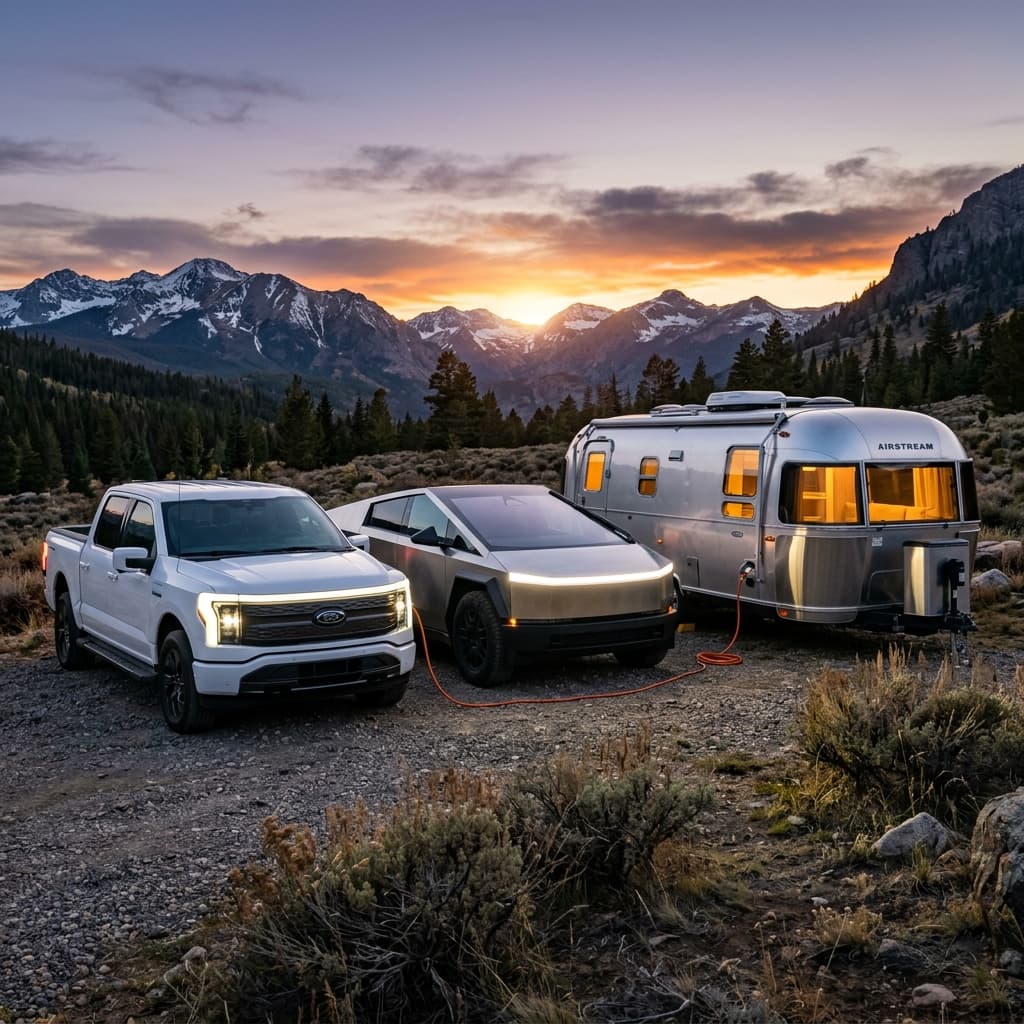
V2L Masterclass: How to Power Your RV with a Ford F-150 Lightning or Cybertruck (2026 Guide)
Unlock the potential of Vehicle-to-Load (V2L) technology. Learn how to use your EV truck as a silent, high-capacity mobile power plant for your RV without generators or fuel.
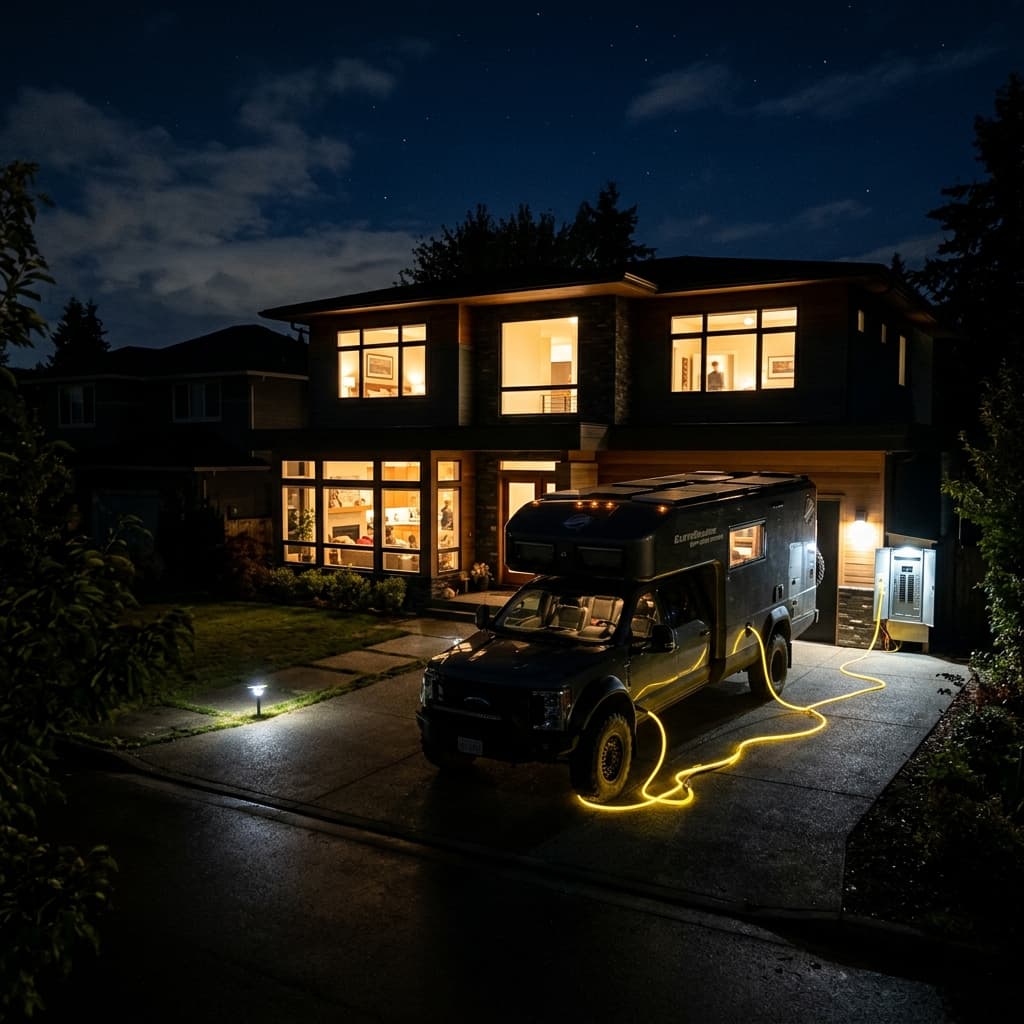
V2H (Vehicle-to-Home) RV Guide: Using Your Camper as a Backup Generator
Don't let your RV battery sit idle. Learn how to configure a V2H (Vehicle-to-Home) system to use your camper's massive solar and lithium bank as an emergency house backup generator.
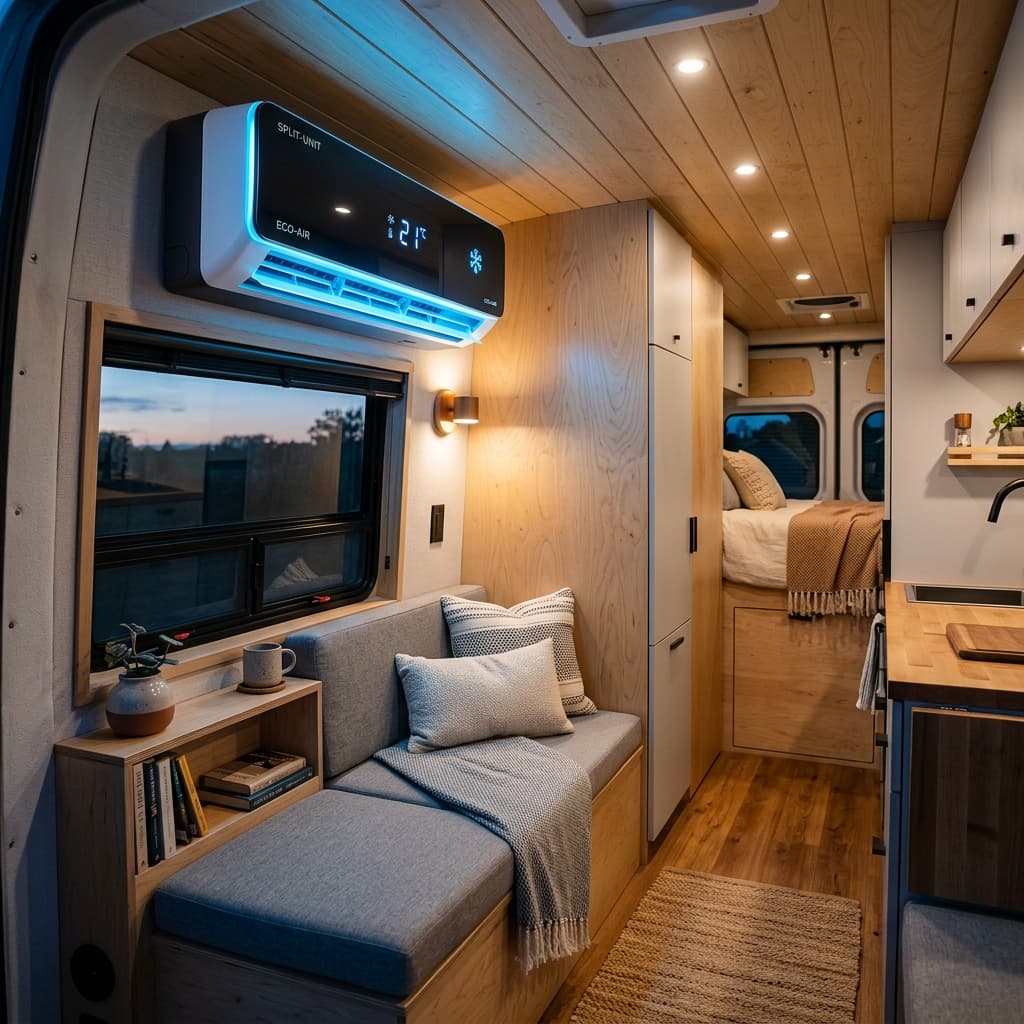
The Off-Grid A/C Masterclass: How to Stay Cool Without a Plug
Standard RV electrical systems were never engineered to run air conditioning off-grid. This extensive technical brief dissects the precise engineering challenge...