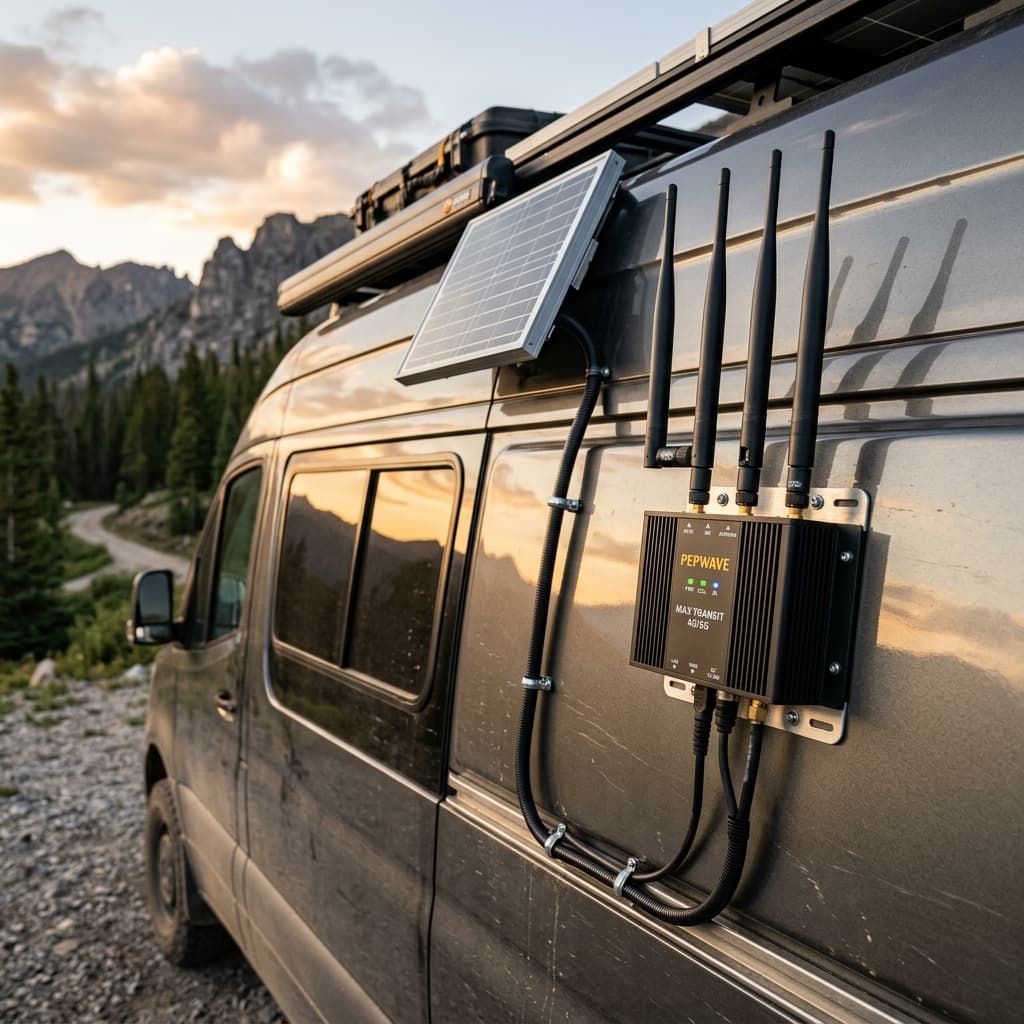
Solar panel for wifi router
In the evolving landscape of off-grid connectivity, a dedicated solar power system for your Wi-Fi router is no longer a luxury but a critical infrastructure component for remote work, safety, and entertainment. This guide provides a comprehensive, future-proof blueprint for designing and installing a resilient, high-efficiency solar setup tailored to power modern networking gear in RVs and nomadic environments, incorporating 2026 standards and emerging technologies.
As we approach 2026, the paradigm of off-grid living and recreational vehicle (RV) travel has been fundamentally reshaped by the necessity of constant, reliable internet connectivity. Whether for remote work, real-time navigation, system monitoring, or emergency communications, a Wi-Fi router has become as essential as lighting or refrigeration in a mobile habitat. However, powering this always-on digital lifeline from a finite battery bank or noisy generator presents unique challenges in efficiency, voltage stability, and energy budgeting. This guide moves beyond basic solar concepts to deliver a meticulous, step-by-step installation protocol for creating a dedicated, optimizer-enhanced solar circuit specifically for your router and associated networking equipment. We will integrate considerations for next-generation components like Gallium Nitride (GaN) converters, Perovskite solar cells, and Sodium-Ion batteries, ensuring your system is not only functional today but scalable for tomorrow's higher-efficiency, lower-footprint technologies.
The core challenge lies in the router's power profile: typically a low-wattage (5-30W) but constant DC load, often with sensitive electronics intolerant of voltage spikes or ripple. A poorly designed solar system can lead to reboots, data loss, or hardware failure. Therefore, this guide emphasizes precision engineering—from panel selection and MPPT charge controller programming to clean DC-DC conversion and strategic load management. We will dissect every component, provide detailed wiring schematics, and mandate safety procedures that meet professional marine and automotive electrical standards. The goal is to empower you, the technical installer, with the knowledge to build a system that delivers 99.9% uptime in a compact, maintainable, and safe package, whether installed in a camper van, a sailboat, or a remote cabin.
This article assumes a foundational understanding of basic electrical concepts (voltage, current, power, Ohm's Law) and safe DC wiring practices. We will build upon that foundation with advanced topics like maximum power point tracking (MPPT) efficiency under partial shading, battery chemistry selection for shallow-cycle applications, and the integration of smart monitoring via Bluetooth or CAN bus. The tools and techniques described are aligned with best practices from the RV, marine, and telecommunications industries, tailored for the resource-constrained but performance-demanding environment of nomadic life.
1. System Architecture and Component Selection for 2026
A dedicated router solar system is a simplified off-grid micro-system. Its primary components are: the energy source (solar panel), the energy regulator (charge controller), the energy reservoir (battery), and the load (router and modem). A critical addition is the voltage converter, as routers often require a stable 12V or 5V DC input, which must be derived cleanly from the battery voltage.
1.1 Solar Panel: Beyond Monocrystalline Silicon
For a router consuming, on average, 10-15 watts, a 50W to 100W solar panel provides a healthy surplus for cloudy days and battery inefficiencies. In 2026, while high-efficiency monocrystalline panels remain the standard, keep an eye on Perovskite solar cells. Emerging commercial products may offer higher efficiencies in low-light conditions and more flexible mounting options, though durability for mobile applications is still under evaluation. For now, select a rigid or semi-flexible monocrystalline panel with a high efficiency rating (22%+). Key specification: Open Circuit Voltage (Voc) and Short Circuit Current (Isc), which must be compatible with your charge controller.
| Component | Recommended Spec (2026) | Rationale | Next-Gen Watch |
|---|---|---|---|
| Solar Panel | 50W-100W, Monocrystalline, Voc < 25V | Adequate surplus for 24/7 operation; safe voltage for 12V controllers. | Perovskite-on-Silicon Tandem cells for >30% efficiency. |
| Charge Controller | MPPT, 10A-15A rating, with low-voltage disconnect (LVD) | Maximizes harvest; protects battery from over-discharge. | Integrated GaN-based high-frequency MPPT for smaller size. |
| Battery | 20Ah-50Ah Lithium Iron Phosphate (LiFePO4) | Long cycle life, stable voltage, safe for indoor use. Perfect for shallow cycling. | Sodium-Ion batteries for lower cost and improved low-temp performance. |
| Voltage Converter | DC-DC Buck Converter, 95%+ efficiency, 5V/12V adjustable | Provides clean, stable voltage from battery to router, minimizing noise. | Fully integrated GaN converters for near-zero standby loss. |
| Wi-Fi Router | DC-powered (12V), Low idle consumption (<5W) | Reduces conversion losses; extends battery life. | Routers with integrated low-power mesh networking. |
1.2 The Critical Role of the Charge Controller
A PWM controller is insufficient for this application due to its lower efficiency. An MPPT charge controller is non-negotiable for maximizing the solar harvest, especially in variable weather. It converts the higher panel voltage down to the battery voltage at optimal current, providing up to 30% more energy. Select a model with a programmable low-voltage disconnect (LVD) to automatically shut off the router load before the battery is critically depleted. Many modern MPPT controllers include Bluetooth for easy configuration and monitoring via smartphone—a valuable feature for troubleshooting.
1.3 Battery Chemistry: Why LiFePO4 and the Sodium-Ion Future
For a router load, which constitutes a shallow, continuous discharge, the battery's cycle life and round-trip efficiency are paramount. Lithium Iron Phosphate (LiFePO4) batteries excel here, offering 2000+ cycles, a flat voltage discharge curve (which aids stable router operation), and minimal maintenance. While more expensive upfront than lead-acid, their longevity and depth-of-discharge capability make them cost-effective. Looking ahead, Sodium-Ion batteries are emerging as a promising alternative, with potentially lower cost, better performance in cold climates, and abundant raw materials. By 2026, they may become viable for niche applications like this, though energy density may still lag behind LiFePO4.
1.4 Voltage Conversion and the GaN Revolution
Most routers accept 12V DC via a barrel jack, but the battery voltage can range from 14.4V (charging) to 12V (discharging). A high-quality DC-DC buck converter is essential to provide a rock-solid 12.0V output. This is where Gallium Nitride (GaN) technology is a game-changer. GaN-based converters operate at much higher frequencies than traditional silicon, resulting in smaller, cooler, and more efficient units (often >95%). This reduces standby losses—a critical factor for a 24/7 system. Specify a converter with adjustable output and over-current protection.
Pros of a Dedicated Solar Router System
- Independence: Internet access untethered from shore power or generator.
- Reliability: Clean, stable power reduces router crashes and hardware stress.
- Efficiency: Direct DC-to-DC path minimizes conversion losses vs. using an inverter.
- Scalability: System can be expanded to power other low-wattage DC loads (e.g., LED lights, fans).
- Quiet Operation: No generator noise; ideal for stealth camping or nature immersion.
Cons & Mitigation Strategies
- Upfront Cost: High-quality components have a premium price. Mitigation: Consider it a long-term investment in connectivity and productivity.
- Installation Complexity: Requires electrical knowledge. Mitigation: This guide provides detailed steps; consult an electrician if unsure.
- Weather Dependence: Extended cloudy periods can deplete the battery. Mitigation: Oversize the panel and battery, or have a backup charging plan.
- Space Requirement: Panels and batteries need real estate. Mitigation: Use flexible panels and compact LiFePO4 batteries.
- Maintenance: Connections can corrode, panels get dirty. Mitigation: Use corrosion inhibitor, install with access for cleaning.
2. Step-by-Step Installation Guide
This guide assumes a typical installation on a fiberglass or metal-roofed RV. Always disconnect all power sources before beginning work. We will proceed in a logical sequence from planning to final testing.
2.1 Step 1: Planning, Sizing, and Tool Gathering
Load Calculation: Measure your router's actual power consumption with a DC watt-meter. Let's assume it draws 0.5A at 12V = 6W. For 24 hours, that's 144 Watt-hours (Wh). Add 20% for the converter and controller inefficiency: ~173 Wh daily load.
Solar Sizing: Assuming 4 peak sun hours, you need at least 173 Wh / 4 h = 43W of solar. A 50W panel is the minimum; a 100W panel provides a 100%+ surplus for cloudy days and battery charging.
Battery Sizing: To cover one full day without sun, with a maximum 80% depth of discharge (DoD) for LiFePO4: 173 Wh / (12.8V * 0.8) ≈ 17Ah. A 20Ah battery meets this; a 50Ah offers multiple days of autonomy.
| Tool / Material | Specification | Purpose |
|---|---|---|
| Multimeter | Digital, True-RMS capable | Voltage, current, continuity checks |
| Wire Stripper/Crimper | 10-22 AWG range | Preparing and terminating wires |
| Heat Gun | With shrink tube nozzles | Sealing connections |
| Drill & Hole Saws | For roof/vapor barrier penetration | Creating pass-through for cables |
| MC4 Connector Tool | If panel has MC4 connectors | Making secure solar connections |
| Torque Screwdriver | 0.5-3 Nm range | Properly securing terminals |
| Marine-Grade Wire | 10 AWG (solar to controller), 12 AWG (controller to battery/load) | Low voltage drop, durable insulation |
| Fuses & Holders | ANL or MIDI for battery, inline for load | Over-current protection |
| Circuit Breaker | DC-rated, 15A-30A | Disconnect switch between panel and controller |
| Corrosion Inhibitor | Dielectric grease or NO-OX-ID | Preventing oxidation on terminals |
| Cable Management | Cable glands, conduit, zip ties | Securing and protecting wires |
2.2 Step 2: Safety Protocol
1. De-energize Everything: Cover the solar panel with an opaque cloth before connecting wires. Disconnect the battery.
2. Fuse Everything: Install a fuse within 18 inches of the battery positive terminal. Fuse the solar positive line before the charge controller. Fuse the load output if the controller lacks internal protection.
3. Mind the Polarity: Double-check positive (+) and negative (-) connections. Reversed polarity can instantly destroy electronic components.
4. Secure Mounting: Ensure all components are firmly mounted to withstand vehicle vibration. Use lock washers or thread-locker on screws.
5. Ventilation: While LiFePO4 batteries are safe, install them in a well-ventilated area, away from direct heat sources.
6. Waterproofing: Use IP67 or higher rated cable glands for roof penetrations. Seal all outdoor connections with self-amalgamating tape or liquid rubber.
2.3 Step 3: Mounting the Solar Panel
Location: Choose a roof area with minimal shading from vents, antennas, or air conditioners. Ensure it's clean and dry.
Method: For rigid panels, use aluminum Z-brackets. Drill mounting holes, apply a high-quality UV-resistant sealant (like Dicor) under the bracket footprint and around each screw. Do not overtighten. For flexible panels, use a bonding adhesive recommended by the manufacturer, ensuring the roof surface is perfectly clean.
Orientation: For a stationary RV, angle the panel towards the south (Northern Hemisphere). For a traveling RV, flat mounting is acceptable as the vehicle moves.
2.4 Step 4: Wiring Diagram and Connection Sequence
Follow this sequence to prevent voltage spikes and ensure controller safety: 1. Battery to Controller, 2. Solar to Controller, 3. Load to Controller.
        +-------------------+          +---------------------+          +-------------------+
        |   Solar Panel     |          |   MPPT Charge      |          |   LiFePO4        |
        |   50W-100W        |----------|   Controller       |----------|   Battery        |
        |   Voc < 25V       |  10AWG   |   (with LVD)       |  12AWG   |   20-50Ah        |
        +-------------------+          +---------------------+          +-------------------+
                |                               |                               |
                | [Circuit Breaker]             | [Load Output Terminal]        | [Main Fuse]
                |                               |                               |
                |                               v                               |
                |                       +---------------------+                  |
                |                       |   DC-DC Buck       |                  |
                |                       |   Converter        |                  |
                |                       |   (GaN-based)      |                  |
                |                       +---------------------+                  |
                |                               |                               |
                |                               | 12AWG                          |
                |                               v                               |
                |                       +---------------------+                  |
                |                       |   Wi-Fi Router/    |                  |
                |                       |   Modem            |                  |
                |                       |   (12V DC Input)   |                  |
                |                       +---------------------+                  |
Key: LVD = Low Voltage Disconnect. All positive lines must be fused as close to the source as possible. Use appropriate wire gauges to keep voltage drop below 3%.
Connection Details:
Solar to Controller: Run 10 AWG cable from the panel's MC4 connectors through a roof cable gland. Install a DC circuit breaker (e.g., 15A) in the positive line inside the vehicle, close to the controller. Connect to the controller's PV input terminals, observing polarity.
Battery to Controller: Connect 12 AWG wires from the battery to the controller's battery terminals. The POSITIVE line must have a fuse (e.g., 20A ANL) within 18 inches of the battery terminal. Use a shunt or busbar if connecting multiple systems.
Load to Converter to Router: From the controller's load terminals (which are protected by its LVD), run 12 AWG wire to the INPUT of the DC-DC buck converter. Set the converter's output to exactly 12.0V using a multimeter before connecting the router. Then, connect the router's power cable to the converter's output. If the controller lacks a load terminal, connect the converter directly to the battery via a fused line, but this bypasses the LVD protection—not recommended.
2.5 Step 5: System Testing and Commissioning
1. Continuity and Insulation Check: With all components disconnected, use the multimeter to ensure no short circuits between positive and negative lines.
2. Voltage Checks: Uncover the solar panel. Measure PV input voltage at the controller terminals—it should be near the panel's Voc. Connect the battery—controller should power on.
3. Controller Configuration: Via Bluetooth or buttons, program the controller for LiFePO4 battery type. Set the LVD to 12.0V (or per battery specs) to protect the battery.
4. Load Test: Connect the router. Monitor battery voltage and current flow. The system should stabilize. Use the multimeter to verify the converter output is a steady 12.0V with the router connected.
5. Long-Term Monitoring: Use the controller's app to log daily solar harvest and consumption. Verify the battery reaches full charge and the LVD engages if you simulate a low-battery condition.
2.6 Troubleshooting Common Issues
| Symptom | Potential Cause | Diagnostic Action |
|---|---|---|
| Router randomly reboots | Voltage sag or spike; faulty converter; LVD cycling. | Monitor battery and converter output voltage with a multimeter log. Check LVD setting. |
| Battery not charging fully | Shading on panel; wrong controller settings; undersized panel. | Check PV voltage/current at peak sun. Verify absorption voltage setting matches battery. |
| Controller showing error | Reverse polarity; over-temperature; battery over-voltage. | Consult manual. Check all connections. Ensure controller is in a cool location. |
| Excessive voltage drop | Wire gauge too small; loose connections; corroded terminals. | Measure voltage at source and load. Tighten all terminals, apply corrosion inhibitor. |
| No power to router | Blown fuse; tripped LVD; converter failure. | Check all fuses with multimeter. Measure battery voltage. Bypass converter temporarily to test. |
3. Future-Proofing and Next-Gen Integration
To ensure your system remains relevant, design with modularity and communication standards in mind.
3.1 The GaN (Gallium Nitride) Advantage
GaN semiconductors are revolutionizing power electronics. For your system, seek out GaN-based DC-DC converters and, soon, GaN-based MPPT charge controllers. They offer:
Higher Efficiency: Up to 98%, reducing wasted energy as heat.
Smaller Size: Higher switching frequencies allow tiny magnetic components.
Better Thermal Performance: Runs cooler, increasing reliability in confined RV spaces.
By 2026, expect integrated GaN power stages in many high-end charge controllers and converters, making them the default choice for efficiency-critical applications.
3.2 Sodium-Ion Batteries: The Emerging Contender
While LiFePO4 dominates today, Sodium-Ion (Na-Ion) battery technology is rapidly developing. By 2026-2027
Continue Your Solar Journey
Master the art of off-grid energy with our most recent expert-vetted guides and reviews.
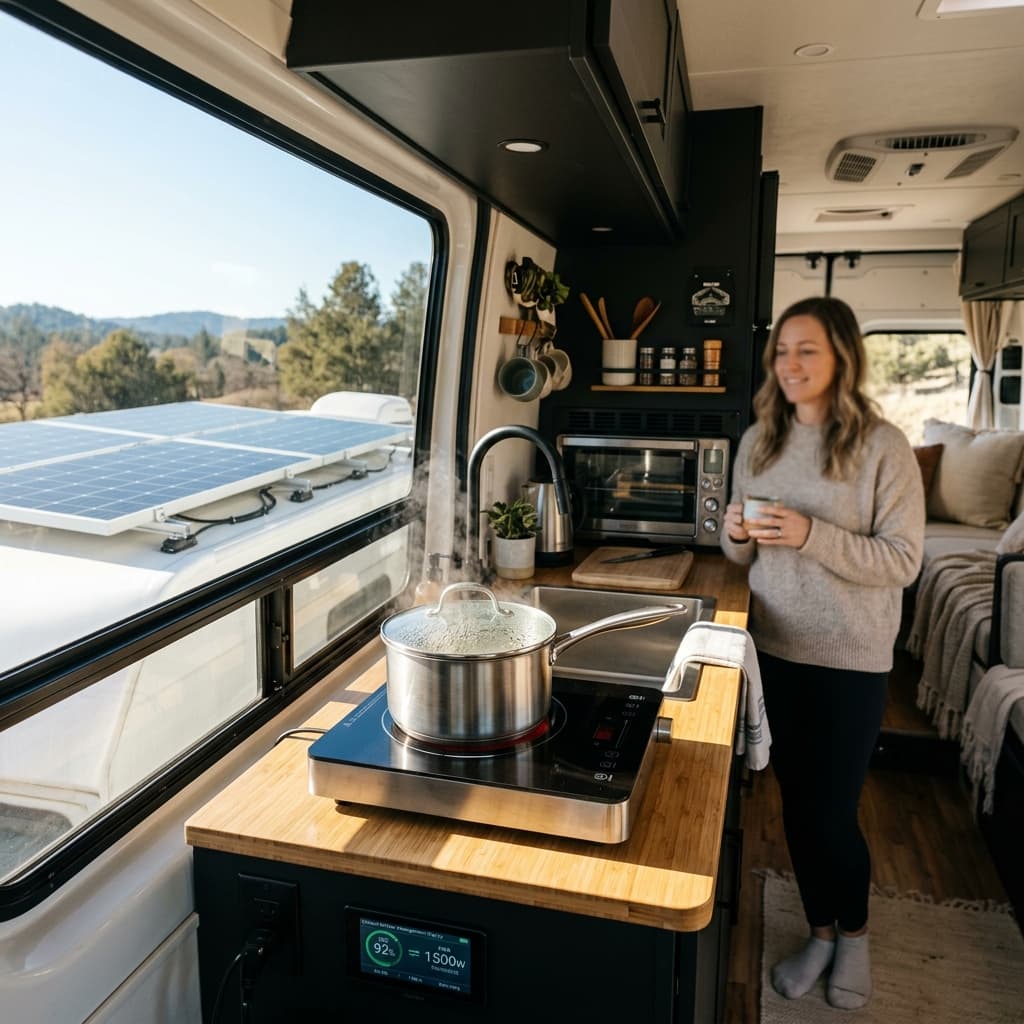
My batteries are full and I don't have anything that needs electricity
In the context of modern off-grid RV solar systems, the scenario "my batteries are full and I don't have anything that needs electricity" highlights a critical ...
Read Full Guide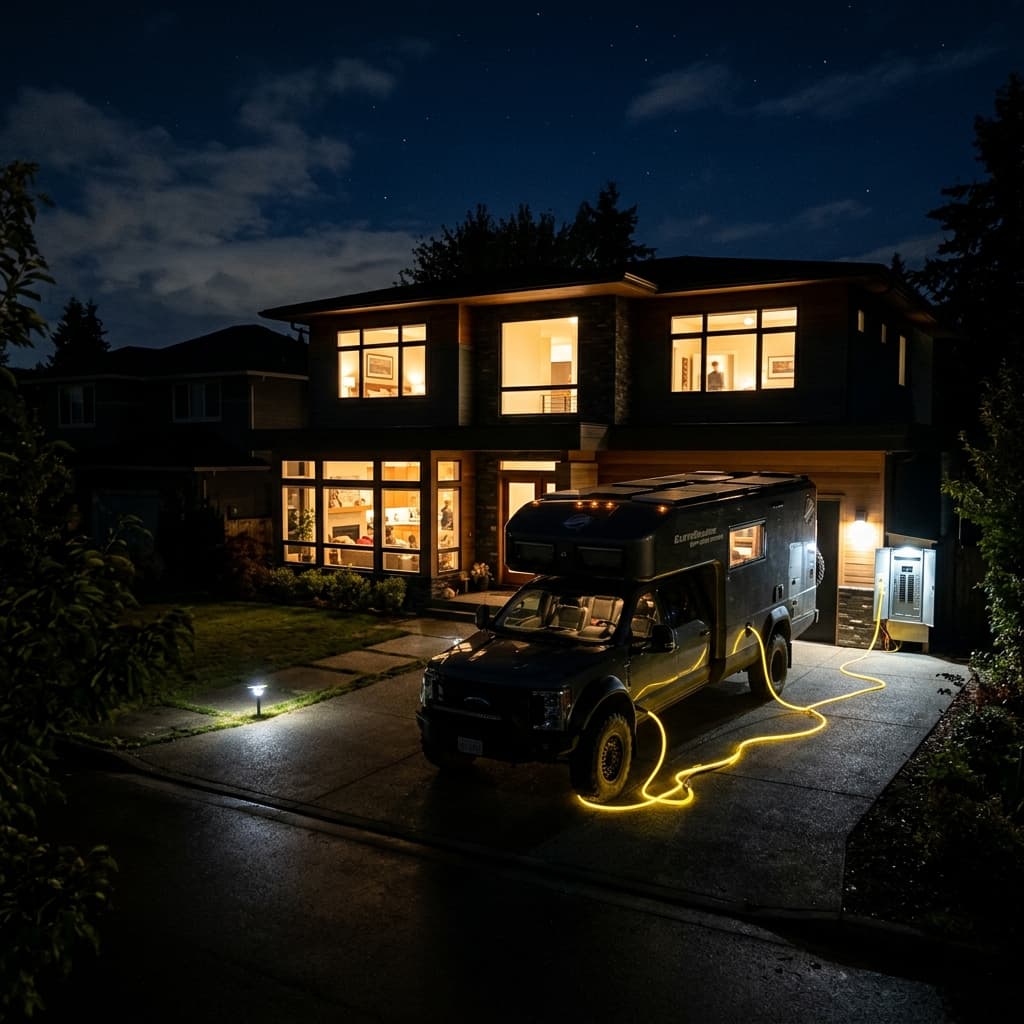
V2H (Vehicle-to-Home) RV Guide: Using Your Camper as a Backup Generator
Don't let your RV battery sit idle. Learn how to configure a V2H (Vehicle-to-Home) system to use your camper's massive solar and lithium bank as an emergency house backup generator.
Read Full Guide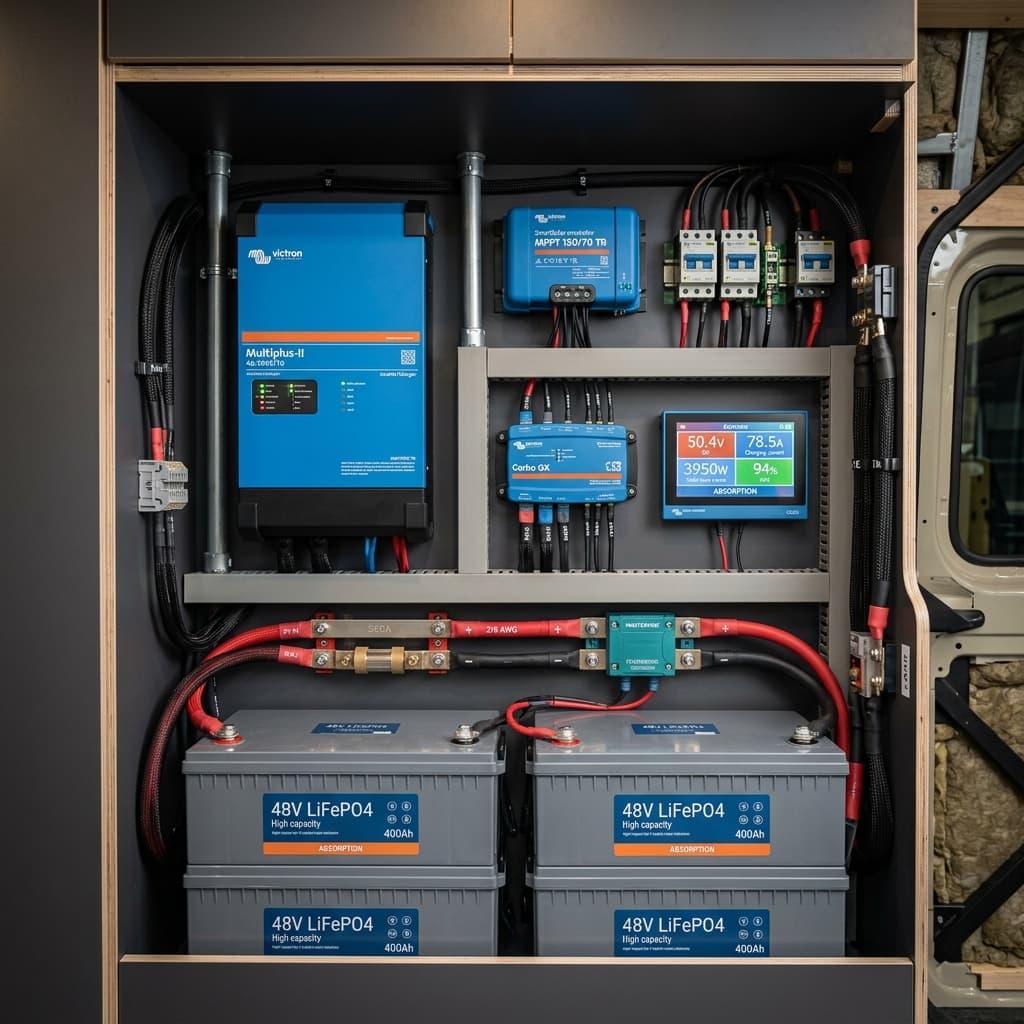
The 48V Architecture Revolution: Why Skipping 12V and 24V is the Right Choice for 2026 Installations
Stop struggling with thick 4/0 cables and overheating inverters. Discover why 48V is the only logical choice for high-demand RV systems in 2026.
Read Full Guide