12V to 24V Step-Up: Can You Safely Mix System Voltages?
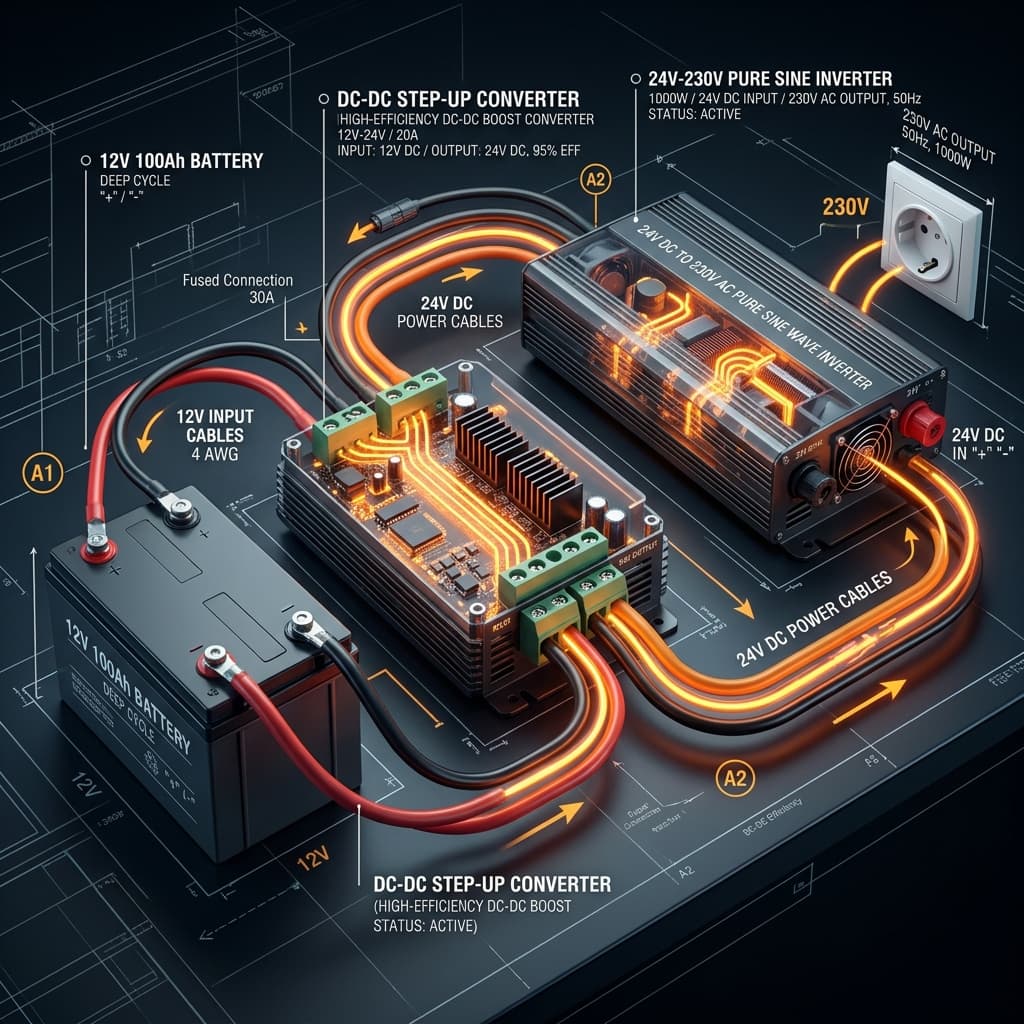
The Definitive Step-by-Step Guide to Safely Integrating a 24V Inverter into a 12V RV Solar System
You have a 24V 3kW inverter sitting unused; your existing system is 12V. Can you simply insert a 12V-to-24V step-up converter between the battery and the inverter? This comprehensive roadmap answers that question with wiring diagrams, component compatibility tables, safety checklists, and future-proof considerations for 2026 standards.
The transition from 12V to 24V systems in the RV and off‑grid world is accelerating. Higher voltage reduces current draw, enabling thinner cables, lower resistive losses, and more efficient inverter operation—especially when pushing 3kW of continuous AC power. Yet the majority of existing nomadic installations still rely on 12V battery banks, from flooded lead‑acid to LFP (LiFePO₄).
If you own a 24V 3kW inverter but your current setup is 12V, you face a classic mismatch. The naive fix—placing a DC‑DC step‑up converter in front of the inverter—is technically possible, but fraught with nuanced constraints. In 2026, with the proliferation of GaN (Gallium Nitride) power stages, sodium‑ion batteries, and perovskite solar cells, the integration options have evolved dramatically. This guide walks you through every step, from tool selection to final testing, ensuring your system remains safe, efficient, and upgrade‑ready.
1. Understanding the 12V → 24V Step‑Up Architecture
A step‑up converter (boost DC‑DC) takes your 12V battery voltage (10.5–14.6V depending on chemistry) and raises it to a regulated 24V (typically 24–28V). Your 24V inverter then operates as designed. However, the converter must handle the full power demand of the inverter – up to 3kW continuous. At 12V, that’s 250 amps input current. This immediately dictates cable sizing, fuse rating, and thermal management.
Pros of the Step‑Up Approach
- Utilises an existing 24V inverter without replacing the battery bank.
- Allows incremental upgrade; later you can swap to a native 24V battery.
- Boost converters with MPPT input regulation can better handle fluctuating solar input.
- Many modern boost modules include digital monitoring and load‑sharing features.
Cons & Critical Risks
- 250A input current demands heavy battery cables (≥2/0 AWG) and a massive fuse.
- Efficiency losses: typical boost converters are 85–92%; losing 8–15% is wasteful.
- Converter failure can expose the inverter to 12V (under‑voltage shutdown) or spikes.
- Additional component adds cost, complexity, and a single point of failure.
- Inrush current from inverter start‑up may trigger converter over‑current protection.
2. Pre‑Requisites: Tool & Component Checklist
Before touching any wires, gather the following equipment. Using sub‑spec components is the leading cause of meltdowns. All references assume a 3kW overhead; scale accordingly for smaller loads.
| Category | Item | Specification |
|---|---|---|
| Battery & Cabling | Battery interconnects | 2/0 AWG (AWG 00) copper, fine‑stranded, with 105°C insulation |
| Overcurrent Protection | Class T or ANL fuse + holder | 300A at 12V, interrupt rating ≥50kA |
| DC‑DC Boost Converter | Unit must be rated for continuous 3kW output | Input range 10–16V, output 24–28V adjustable, efficiency ≥90% |
| Inverter | Your existing 24V unit | Pure sine wave, 3kW continuous, low‑frequency design preferred |
| Monitoring | Battery monitor / shunt | 500A shunt, Bluetooth (Victron, Simarine) or wired display |
Essential Tool Kit
- Crimping tool for 2/0 AWG (hydraulic or heavy‑ratchet type)
- Heat gun and adhesive‑lined heatshrink tubing (3:1 ratio)
- Digital multimeter with true RMS AC and DC clamp meter (≥400A)
- Torque wrench (for battery terminal nuts: 8–12 N·m typical)
- IR temperature gun (for spot‑checking connections under load)
- Fuse puller and insulated screwdrivers (flathead / Phillips)
- Cable lugs (2/0 AWG ring terminals, 3/8″ hole on converter side)
- Battery disconnect switch (500A continuous, single‑pole)
- Wire markers and cable ties for routing
3. Step‑by‑Step Wiring Procedure
Step 0: Safety First – Disconnect Everything
Open all battery disconnects. If you have solar panels, cover them or shut off the PV breaker. Remove any fuse near the battery positive. Wear insulated gloves and safety glasses. Work in a well‑ventilated space—no sparks near lead‑acid batteries.
Step 1: Battery‑to‑Converter Cabling
Measure the distance from the battery positive terminal to the boost converter input. Add 10% for slack. Cut two pieces of 2/0 AWG cable (red for positive, black or yellow for negative). Strip exactly the length needed for the ring terminal, crimp, heat shrink, and torque to the battery posts. On the converter side, connect to the appropriately labeled input terminals (usually ‘DC IN +’ and ‘DC IN –’). Do not power on yet.
Step 2: Adding Overcurrent Protection
Place a 300A Class T fuse as close as physically possible to the battery positive terminal (within 12 inches). Use a fuse holder rated for 400V (DC) and 300A continuous. The fuse protects both the cable and the boost converter in case of a short. Do not rely on the converter’s internal protection alone—its fuses are typically sized for the output side.
Step 3: Converter‑to‑Inverter Connection
The output of the boost converter (24V side) now becomes the power source for your inverter. Use 4 AWG (or 2 AWG for longer runs) from converter output to inverter DC input. Install a second fuse (e.g., 150A on the 24V side) near the converter output. The inverter’s manual may specify a particular fuse rating—typically 125A–150A for a 3kW, 24V inverter.
Step 4: Remote & Ground Wires
Route the inverter’s remote on/off switch cable (if present) to an accessible location. Connect the system’s DC negative bus to chassis ground at a single point (avoid ground loops). The boost converter’s chassis should also be bonded to the common ground point.
Step 5: Verify Polarity & Voltage Before Power‑Up
Using your multimeter (set to DC volts), check at the converter input: should read battery voltage (≈12.6V for lead‑acid, ≈13.2V for LFP). At the converter output (with converter still off): 0V. At the inverter input: 0V. Confirm all connections are tight and no stray strands are exposed. Install the battery fuse last.
Step 6: Commissioning
Turn on the boost converter first. Listen for any whining or sparking—stop immediately if abnormal. Use the multimeter to verify 24V±0.5V at the converter output. If adjustable, set the output voltage to 24.0V (or 27.2V if using loads that need absorption voltage). Then turn on the inverter. It should power up, show a “Standby” or “Bulk” state, and emit a soft beep. Connect a small load (e.g., 100W incandescent bulb) to verify AC output.
4. Wiring Diagram
The physical layout is critical for safety and efficiency. Below is a schematic representation. Use the same color code: red for positive, black/yellow for negative.
Battery (+) –[300A Class T fuse]– ██ 2/0 AWG ██ –> [Boost Converter IN+]
Battery (-) – ██ 2/0 AWG ██ –> [Boost Converter IN–]

[Boost Converter OUT+] –[150A fuse]– ██ 4 AWG ██ –> [24V Inverter IN+]
[Boost Converter OUT–] – ██ 4 AWG ██ –> [24V Inverter IN–]

[Chassis Ground] ––– [Battery Neg Bus] ––– [Inverter Neg] ––– [Boost Neg]

                ┌─────────────┐
                │  12V Batt   │
                │ (LFP/LA)    │
                └──────┬──────┘
                       │
                    +  │  2/0 AWG
                       │  300A Fuse
                ┌──────▼──────┐
                │  Boost DC‑DC│
                │  12→24V     │
                │  3kW        │
                └──────┬──────┘
                       │
                    +  │  4 AWG
                       │  150A Fuse
                ┌──────▼──────┐
                │  24V Invert.│
                │  3kW        │
                └─────────────┘
                      AC Out
5. Critical Safety Tips for Off‑Grid Installers
Fire Hazard – Overcurrent
Never fuse the step‑up converter output at a value higher than its max rating. A 3kW converter outputting 125A must have a 150A fuse; using 200A risks fire during a fault.
Ventilation & Heat
Both the boost converter and inverter generate significant heat. Mount them on a vertical surface with 2″ clearance. Add a thermostatically controlled fan if ambient temperature exceeds 40°C (104°F).
Cable Resistance
Even with 2/0 AWG, a 15‑foot run at 250A drops ~0.6V. That’s 150W lost as heat. Keep battery‑to‑converter cables as short as possible (<6 feet).
Grounding
Bond the system negative to a dedicated chassis ground point. Floating systems can develop high‑voltage potentials that damage electronics. Use a single point to prevent ground loops.
6. Next‑Gen Perspective: GaN, Sodium‑Ion & Perovskite
By 2026, several emerging technologies will reshape how you approach this conversion:
Gallium Nitride (GaN) Inverters & Converters
GaN‑based DC‑DC converters now achieve 96–98% efficiency in half the footprint of silicon MOSFETs. If you replace your old step‑up converter with a GaN unit, the 12V‑to‑24V conversion loss drops from 10% to under 3%. Some GaN modules also integrate soft‑start circuitry that eliminates inrush tripping.
Sodium‑Ion Batteries – A Game Changer for Voltage Mismatch
Sodium‑ion cells have a nominal voltage of 3.0V (vs. 3.2V for LFP) and a wider operating range (2.0–3.6V). A 12V sodium pack can drop to 8V under load, making a conventional step‑up converter struggle. Conversely, a 24V sodium pack (8S) hits 32V at full charge, which many inverters accept. The trend toward modular battery voltages may make 12V/24V mismatches less common as plug‑and‑play 48V systems become standard.
Perovskite Solar Cells & High‑Voltage MPPT
Ultra‑efficient perovskite cells (now over 30% in lab) produce higher voltages per cell, making 24V or 48V batteries more natural. Future MPPT controllers will accept raw panel voltages up to 150V, further reducing the need for a 12V bank. Your step‑up converter may become a temporary bridge to a fully 24V native system.
7. Load Testing & System Validation
After commissioning, run the system under realistic loads to verify stability. Follow this procedure:
- No‑load test – Inverter idle: measure input current (should be <1A at 24V).
- Resistive load test – Connect a 1000W space heater. Monitor converter temperature every 10 minutes. Use IR gun on all cable lugs – they should stay below 50°C (122°F).
- Inductive load test – Run a small refrigerator or microwave (capacitive load). Watch for voltage sag on the 24V bus.
- Full power test – Apply 2500W (if load available) for 60 seconds. Verify battery voltage stays above 11V (12V side) and converter output remains within 23.5–24.5V.
- Thermal shutdown test – If the converter shuts down due to over‑temp, note the time; design ventilation accordingly.
8. Final Verdict: Is a Step‑Up Converter the Right Choice?
Using a 12V‑to‑24V step‑up converter to power a 24V inverter is safe and workable if you follow the cable gauge, fusing, and heat‑management rules outlined here. However, it’s not the most efficient long‑term solution. For a 3kW load, you’re wasting 200–400W in the conversion process. If this is a temporary setup while you assemble a 24V battery bank, it makes sense. For a permanent installation, consider replacing your 12V bank with a 24V LFP or future sodium‑ion system. Meanwhile, emerging technologies like GaN converters can push efficiency to 98%, narrowing the gap.
Always remember: a step‑up converter does not create power – it transforms it at a cost. Design conservatively, monitor temperatures, and leave room for the next‑gen components that are just now hitting the off‑grid market.
Disclaimer: This guide is for informational purposes and must be reviewed by a certified electrician before implementation. Working with high‑current DC systems can cause severe injury or fire. Always follow local regulations and manufacturer specifications.
Technical Expansion
Deepen your expertise with our most critical recent diagnostic reports.

V2L Masterclass: How to Power Your RV with a Ford F-150 Lightning or Cybertruck (2026 Guide)
Unlock the potential of Vehicle-to-Load (V2L) technology. Learn how to use your EV truck as a silent, high-capacity mobile power plant for your RV without generators or fuel.

V2H (Vehicle-to-Home) RV Guide: Using Your Camper as a Backup Generator
Don't let your RV battery sit idle. Learn how to configure a V2H (Vehicle-to-Home) system to use your camper's massive solar and lithium bank as an emergency house backup generator.

The Digital Nomad Power Audit: Calculating Solar for Starlink and Pro-Grade Gear in 2026
Digital nomad RV power audit: Running Starlink and high-end laptops 24/7. Learn the daily Ah math and native DC conversion physics.