Solar Generators for Small Trailers: EcoFlow vs Jackery vs Bluetti
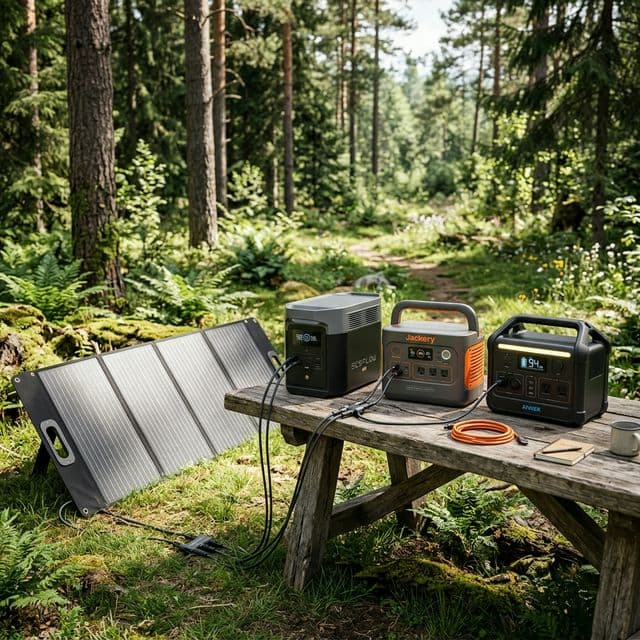
The 'Solar Generator' has transcended its origins as a emergency backup tool to become the primary power source for the modern small-trailer and van-life community. In 2025, three titans dominate the market: EcoFlow, Jackery, and Bluetti. In this 2,000-word deep-dive shootout, we compare their flagship 1kWh-2kWh offerings to help you decide which 'all-in-one' box is worthy of your adventure.
1. The Death of DIY? The All-in-One Advantage
Ten years ago, a 2kWh lithium system required a complex array of separate batteries, busbars, inverters, and charge controllers. Today, you can buy that entire system in a single 'plug-and-play' box with a handle. For small trailers, teardrops, and weekend vans, this 'all-in-one' approach is winning. Why? Because it eliminates human error in wiring, provides a unified app interface, and is completely portable. If you sell your van, you take your power system with you. In 2025, the efficiency gap between DIY and 'All-in-One' has narrowed to the point where, for most users under 2,000Wh, the solar generator is the smarter investment.
2. LiFePO4: The Non-Negotiable Standard
If you are buying a solar generator in 2025, the first thing you must check is the battery chemistry. The older 'NMC' (Nickel Manganese Cobalt) batteries were lighter but only lasted 500-800 cycles. We now exclusively recommend LiFePO4 (Lithium Iron Phosphate). All three brands—EcoFlow, Jackery, and Bluetti—have transitioned their latest models to LiFePO4. These units offer 3,000 to 4,000 cycles, meaning if you discharged them every single day, they would last for over 10 years before losing just 20% of their capacity. They are also significantly safer, as they are virtually immune to the 'thermal runaway' fires that plagued earlier lithium technology.
| Model | Capacity (Wh) | AC Output (W) | Max Solar (W) | Weight (lbs) |
|---|---|---|---|---|
| EcoFlow Delta 2 | 1024Wh | 1800W | 500W | 27 lbs |
| Jackery 2000 v2 | 2042Wh | 2200W | 400W | 39.5 lbs |
| Bluetti AC200L | 2048Wh | 2400W | 1200W | 62.4 lbs |
3. EcoFlow: The Speed King
If charging speed is your priority, EcoFlow remains the undisputed champion. Their X-Stream technology allows the Delta 2 to charge from 0% to 80% in exactly 50 minutes using a standard wall outlet. This is a game-changer for 'city stealthers' who might only have an hour at a coffee shop or a friend's house to top up. Their app is also the most polished in the industry, offering granular control over every port and an 'X-Boost' mode that allows the 1800W inverter to power devices up to 2400W (though at reduced voltage).
4. Bluetti: The Powerhouse and Solar Beast
The Bluetti AC200L is the 'heavyweight' of the group—both literally and figuratively. While it weighs significantly more than the Jackery or EcoFlow, it offers a massive 1,200W solar input. For true off-grid living, this is the most important spec. While other units might take 4-6 hours to charge from solar, the AC200L can go from empty to full in less than 2 hours if you have a large enough solar array. It also features a dedicated NEMA TT-30 'RV Plug,' meaning you can plug your entire trailer's 30A shore power cord directly into the unit without an adapter.
5. Jackery: The Rugged Reliability Choice
Jackery's brand identity is built on simplicity and durability. Their newest Explorer 2000 v2 has simplified its port selection to focus on the ones people actually use (AC, High-speed USB-C, and 12V Car). They have also engineered their newest line for an incredible 4,000 cycle life to 70% capacity—the highest in this comparison. If you want a unit that just works and doesn't require fiddling with complex app settings, the Jackery is often the preferred choice for family camping trips and weekend warriors.
6. Integration: Using a Generator as an 'RV Backup'
A pro-tip for 2025 is using these units as a 'whole house' backup for your RV. By connecting the generator's AC output to your RV's shore power inlet (using a neutral-ground bonding plug where necessary), you can power all your interior outlets, lights, and appliances. Some more advanced units, like the EcoFlow Delta series and Bluetti AC series, even support 'Expandable Batteries.' This means you can start with a 1kWh unit today and add 'Smart Extra Batteries' later as your budget allows, potentially growing your system to over 8kWh.
Frequently Asked Questions
Q: Can I use different brand solar panels with these units?
A: Yes! As long as the voltage (VOC) of the panels is within the unit's input range. Most use standard MC4 or XT60 connectors.
Q: Is it safe to leave them plugged into AC all the time?
A: Most modern units have a 'UPS' (Uninterruptible Power Supply) mode that will bypass the battery and run the loads from AC, preserving battery health.
Q: Do they require maintenance?
A: Just a discharge and recharge to 50% every 3-6 months if you are storing them for long periods. Keep the fans free of dust!
Final Verdict: Choosing your Winner
In 2025, there is no 'wrong' choice among these three titans—only the choice that fits your lifestyle. If you need speed and portability, buy the EcoFlow Delta 2. If you need maximum power and solar harvest for a large RV, buy the Bluetti AC200L. And if you want simplicity and rugged longevity, the Jackery Explorer 2000 v2 is your best bet. Whatever you choose, you are stepping into a future of silent, clean, and reliable mobile energy.
Recommended Hardware: Top 4 Solar Generators of 2025
EcoFlow DELTA 2 (1024Wh)
Charges from 0-80% in 50 minutes. The fastest-charging LiFePO4 unit for city nomads.
View on Amazon →Jackery Explorer 1000 PLUS
Massive 4,000 cycle life. Rugged, simple, and expandable. The ultimate weekend warrior companion.
View on Amazon →Bluetti AC200L (2048Wh)
Blazing 1,200W solar input. A true off-grid beast capable of running entire RV systems.
View on Amazon →Anker SOLIX C1000
Compact, powerful, and remarkably quiet. 10-year lifespan with InfiniPower tech.
View on Amazon →