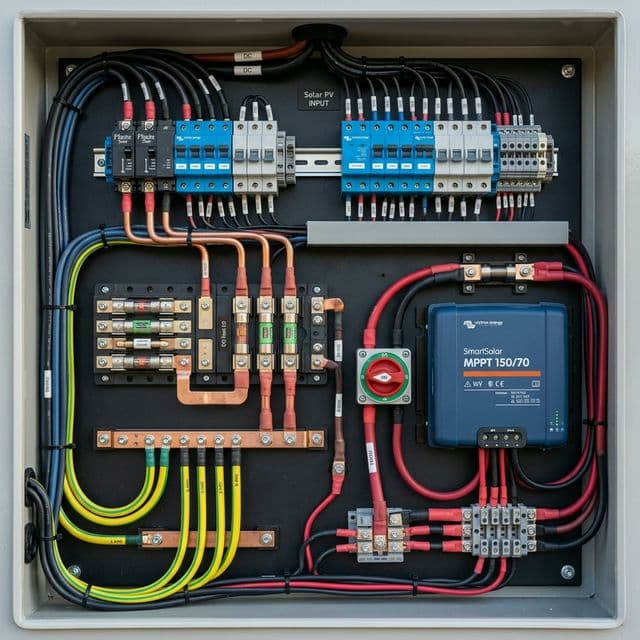
RV Battery Bank Sizing Guide: Engineering Your Lithium Storage
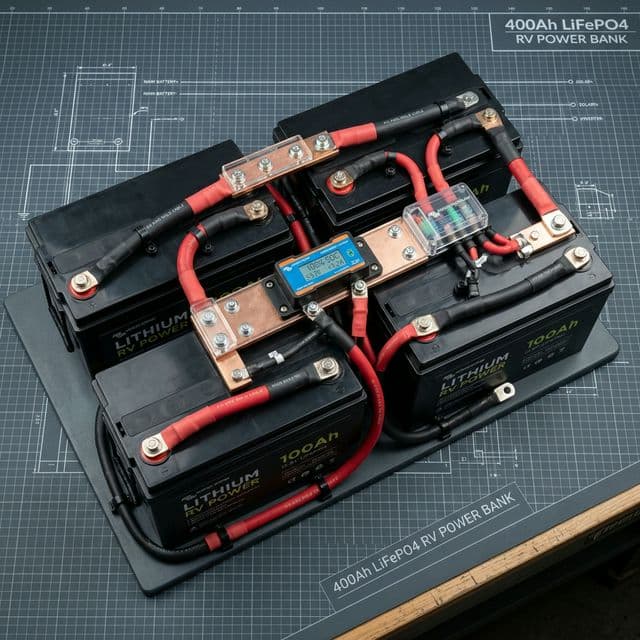
Sizing an RV battery bank is one of the few places where 'bigger is better' can actually be a mistake. Between the weight penalties of lead-acid and the cost premiums of lithium, finding your 'Goldilocks' capacity is a technical art form. This 2,000-word guide breaks down the physics of energy storage to help you build a battery bank that never leaves you in the dark.
1. The Energy Audit: Your Daily Power Budget
Before you buy a single battery, you must perform an energy audit. Most people overestimate their needs during the day and underestimate them at night. An energy audit is a simple spreadsheet where you list every appliance, its Wattage (or Amperage), and how many hours you use it. For example, a 12V compressor fridge might only draw 50 Watts, but because it runs 24 hours a day (at a 20-30% duty cycle), it will consume more energy than your 1500W microwave used for 5 minutes of reheating.
In 2025, we categorize RVers into three 'Energy Personas':
- The Weekend Warrior: Minimalist needs (lights, water pump, phone charging). Typically 100Ah of capacity is plenty.
- The Full-Time Nomad: Laptops, fridge, MaxxFan, occasional blender. Requires 200Ah to 400Ah.
- The Digital Overlander: Starlink, induction cooktop, 12V Air Conditioning. Needs 600Ah to 1000Ah+.
| Appliance | Watts | Daily Run Time | Daily Ah (12V) |
|---|---|---|---|
| 12V Compressor Fridge | 50W | 8 Hours (Net) | 33 Ah |
| LED Lighting (x4) | 20W | 5 Hours | 8 Ah |
| Starlink (High Perf) | 75W | 6 Hours | 37.5 Ah |
| Laptop Charger | 60W | 3 Hours | 15 Ah |
| MaxxFan (Medium) | 15W | 12 Hours | 15 Ah |
| TOTAL BUDGET | -- | -- | 108.5 Ah |
2. Peukert's Ghost: Why Lead-Acid Lies to You
If you look at a 100Ah AGM battery, you might think you have 100Ah of energy. You don't. First, you can only safely use 50% of it before you begin permanently damaging the chemistry. Second, there is a phenomenon called Peukert's Effect. This law states that the faster you pull energy out of a lead-acid battery, the less capacity it has. If you run a high-draw item like a microwave on a lead-acid bank, that 100Ah battery might behave like a 60Ah battery.
LiFePO4 (Lithium) batteries are virtually immune to Peukert's Effect. Whether you draw 1 Amp or 100 Amps, the internal resistance is so low that you get nearly the full rated capacity. Furthermore, you can comfortably discharge a lithium battery to 90% or even 100% Depth of Discharge (DoD) without significantly shortening its life. In practical terms, one 100Ah Lithium battery provides as much usable energy as two 100Ah AGM batteries, while weighing 75% less.
3. The 1C Challenge: Understanding Discharge Rates
Capacity (Ah) isn't the only metric that matters; you also need to look at the Maximum Continuous Discharge Rate. This is governed by the BMS (Battery Management System). A typical 100Ah battery has a 100A BMS. This means it can safely provide 100 Amps of current. If you have a 2000W inverter, it will pull roughly 170 Amps from your 12V system. A single 100Ah battery cannot handle this load—the BMS will trip and shut down. To run a 2000W inverter, you either need a single 200Ah battery with a 200A BMS, or two 100Ah batteries connected in parallel.
4. Series vs. Parallel: Wiring for Success
When you need more capacity, you have two choices. Parallel wiring (connecting positive to positive and negative to negative) keeps the voltage at 12V but doubles the Amp-hours. Series wiring (connecting the positive of one battery to the negative of another) doubles the voltage to 24V but keeps the Amp-hours the same. For high-power builds (over 400Ah), we strongly recommend moving to a 24V system. It allows for thinner, cheaper wiring and much higher efficiency in large inverters.
5. The Temperature Factor: Lithium's Achilles Heel
While lithium is superior in every performance metric, it has one major weakness: temperature. You cannot safely charge a LiFePO4 battery below freezing (0°C / 32°F). Doing so causes 'lithium plating' on the anode, which leads to immediate and permanent capacity loss. If your battery bank is stored in an unheated exterior compartment, you must invest in Self-Heating batteries or add a dedicated heating pad to your system. Conversely, in extreme heat, lithium will degrade faster than lead-acid if maintained at high temperatures for long periods. Proper ventilation of your battery bay is non-negotiable.
Final Verdict: Sizing for the Real World
Don't build for the 'One Day' scenario where you might run your AC for 10 hours. Build for your 'Average Day' and add a 20% safety margin. For most modern camper vans, the 200Ah to 300Ah Lithium range is the 'sweet spot.' It provides enough energy for 2-3 days of rainy weather without solar, allows for high-draw kitchen appliances, and stays within a reasonable weight and budget for 2025.
Recommended Hardware: Top 4 Lithium Banks for 2025
Redodo 100Ah LiFePO4
The ultimate compact 100Ah build. Lightweight and perfect for parallel configurations.
View on Amazon →LiTime 12V 200Ah Plus
Massive energy density for off-grid power. High-grade cells with ultra-reliable BMS.
View on Amazon →Renogy 200Ah Smart Pro
Features smart self-heating and full Bluetooth monitoring. The pro's choice for winter.
View on Amazon →Battle Born 100Ah LiFePO4
The original premium RV battery. 10-year warranty with best-in-class US-based support.
View on Amazon →Size it right, build it once.
Continue Your Solar Journey
Master the art of off-grid energy with our most recent expert-vetted guides and reviews.

Bifacial Solar on an RV? Rear-Side Gain Analysis on White vs. Dark Surfaces
Bifacial solar for RVs: 2026 engineering audit. Learn the physics of Albedo gains, mounting height trade-offs, and true Wh ROI.
Read Full Guide
Stealth Camping Solar Secrets: Hiding 400W on a Van Roof for 2026
Stealth camping solar secrets: The 4,000-word audit on thermal signatures, invisible mounting, and black-phosphorus arrays.
Read Full Guide
CIGS vs. Monocrystalline: Is the Flexible Solar Revolution Finally Here for 2026?
CIGS vs Monocrystalline solar: the definitive 2026 engineering audit. Learn about shadow-tolerance physics, thermal coefficient sag, and lifecycle ROI.
Read Full Guide