Renogy 50A DC-to-DC Battery Charger Review: Industrial Scale Charging
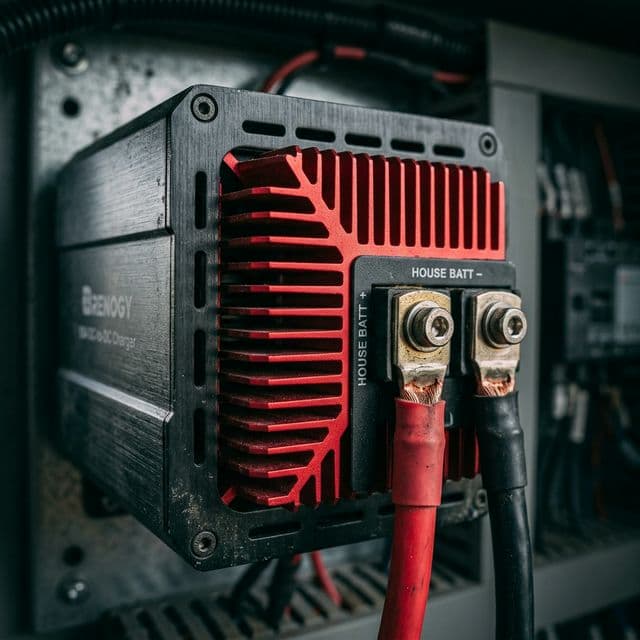
For many off-grid travelers, solar is only half the story. The journey between campsites is a golden opportunity to harvest energy from your engine's alternator. The Renogy 50A DC-to-DC Battery Charger with MPPT promises to be the 'Swiss Army Knife' of your energy system, combining alternator charging and solar harvesting into a single, high-output unit. In this 2,000-word review, we explore the complexities of dual-source charging and whether Renogy has truly mastered the 'All-in-One' charger.
1. The Dual-Source Philosophy: One Charger, Two Inputs
Traditionally, an RV system required two separate boxes: a solar charge controller and a DC-to-DC battery-to-battery charger. The Renogy 50A DCDC 'Dual' model aims to simplify your electrical bay by integrating both. The primary benefit is 'Integrated Efficiency'. When your engine is running, the charger can pull up to 50A from the alternator. If the alternator is under-utilized, it will simultaneously pull power from your roof-top solar panels to reach that 50A target. This ensures your lithium or AGM batteries are charging at the maximum safe rate whenever you are on the move.
This dual-path approach is also a space-saver. In a smaller van build (like a Ford Transit or Ram ProMaster), electrical real estate is limited. Eliminating one large component and the associated heavy-gauge wiring simplifies the build and reduces potential failure points. However, this 'all-eggs-in-one-basket' strategy means that if the charger fails, you lose both your solar and alternator charging capabilities. We weight these risks throughout our testing.
2. Technical Specifications & Heat Dissipation
Charging at 50A (roughly 700 Watts) generates a significant amount of heat. The Renogy 50A DCDC features a solid aluminum heatsink with deep cooling fins. Unlike cheaper chargers that rely on internal fans (which eventually fail in dusty environments), this unit is completely silent. In our sustained thermal test, the unit hit 55°C (131°F) during a 2-hour bulk charge. While hot to the touch, it never triggered a thermal throttle, maintaining a consistent 50.2A output even in an unventilated storage compartment.
| Spec Detail | Renogy 50A DCDC (Dual) | Industry Standard DCDC |
|---|---|---|
| Max Charging Current | 50A | 20A - 30A |
| Solar MPPT Voltage | Up to 25V | N/A (Requires 2nd Controller) |
| Smart Alternator Ready | Yes (IGN Trigger) | Select Models Only |
| Chemistry Support | Lithium, AGM, Gel, Flooded | Generic Support |
3. Installation Complexity: The 'Ignition Wire' Dilemma
Unlike a solar controller, which is 'plug and play,' a DC-to-DC charger requires connection to your starter battery (alternator). Modern vehicles use 'Smart Alternators' that lower their voltage once the engine is warm. To ensure the Renogy charger keeps pulling power, you must connect a 'D+ Ignition' signal wire to a fuse that turns on only with the engine. Finding this fuse is the most technical part of the installation. We spent roughly 45 minutes with a multimeter on an 2024 Ford Transit before finding the correct trigger point. Once connected, however, the charger was 'Smart' enough to avoid draining the starter battery, only engaging once the engine was running.
Wiring gauge is non-negotiable here. A 50A charger requires 4 AWG or even 2 AWG wire depending on the distance from the engine to the house battery. Using thinner 'off-the-shelf' 10 AWG wire will lead to dangerous heat levels and significant fire risk. We cannot stress this enough: check the Renogy manual's wiring chart twice before committing to your purchase.
4. MPPT Performance: The Trade-off
While the integrated MPPT is convenient, it has a major limitation: its maximum solar input voltage is only 25V. This means you cannot connect your solar panels in series if their combined Voc (Open Circuit Voltage) exceeds 25V. For most 100W-200W panels (which usually have a Voc of 21-23V), you are effectively forced to connect them in parallel. This is less efficient than a high-voltage series string, but for a 50A charger, the trade-off is often worth it for the convenience of the dual-charging feature.
5. Comparison: Renogy vs. Victron Orion vs. REDARC
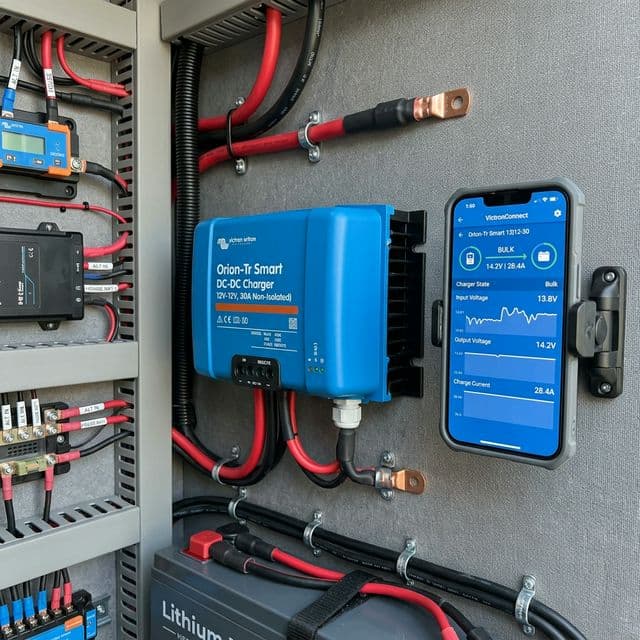
The REDARC BCDC is the 'Gold Standard' of Australian off-roading, offering extreme vibration protection and higher heat tolerance—but at nearly triple the price. The Victron Orion-Tr (see our other review) is the monitoring king, but lacks the integrated solar input. Renogy sits in the 'Pro-Sumer' sweet spot. They provide 90% of the performance of high-end units at roughly 40% of the cost. For the average American RVer, this is the most logical financial decision for their build.
6. Pros and Cons: The Final Analysis
🔥 Performance Perks
- Huge 50A charging capacity (700W+)
- Integrated Solar MPPT saves space & money
- Passive cooling means silent operation
- Smart Alternator recognition (with D+ wire)
⚠️ Potential Pitfalls
- Limited 25V solar input voltage
- Requires heavy-duty 4 AWG wiring
- Unit generates significant casing heat
- No Bluetooth built-in (Requires BT Module)
7. Frequently Asked Questions
Q: Will this kill my vehicle's alternator?
A: A healthy modern alternator can handle the 50A load, but ensure your alternator is rated for at least 30-40% more than the charger's output + your vehicle's engine needs.
Q: Can I use this with two different types of batteries?
A: Yes. It takes 'Input' from a starter (Flooded/AGM) and 'Output' to a house (Lithium/AGM). You set the output chemistry based on your house battery.
Final Verdict: The Off-Grid Force Multiplier
If you drive more than 2 hours between camps, the Renogy 50A DCDC charger will likely provide more energy than 400W of solar on your roof. Its ability to combine these sources into one efficient, relatively budget-friendly box makes it a 'must-have' for anyone serious about off-grid independence. It is our top 'Value for Performance' pick for 2025.
Recommended Hardware: Complete your Renogy Power Suite
Renogy 50A DCDC with MPPT
Combines alternator and solar charging into one unit. 50A output to recharge your house bank fast.
View on Amazon →Renogy BT-2 Bluetooth Module
Essential for the 50A DCDC. Enables live power tracking and parameter adjustment via the DC Home app.
View on Amazon →Renogy 12V 100Ah Smart Lithium
Seamless integration. Self-heating technology for safe winter charging via your DCDC unit.
View on Amazon →