Perovskite/Silicon Tandem Solar Cells: The Future of RV Solar (2026)
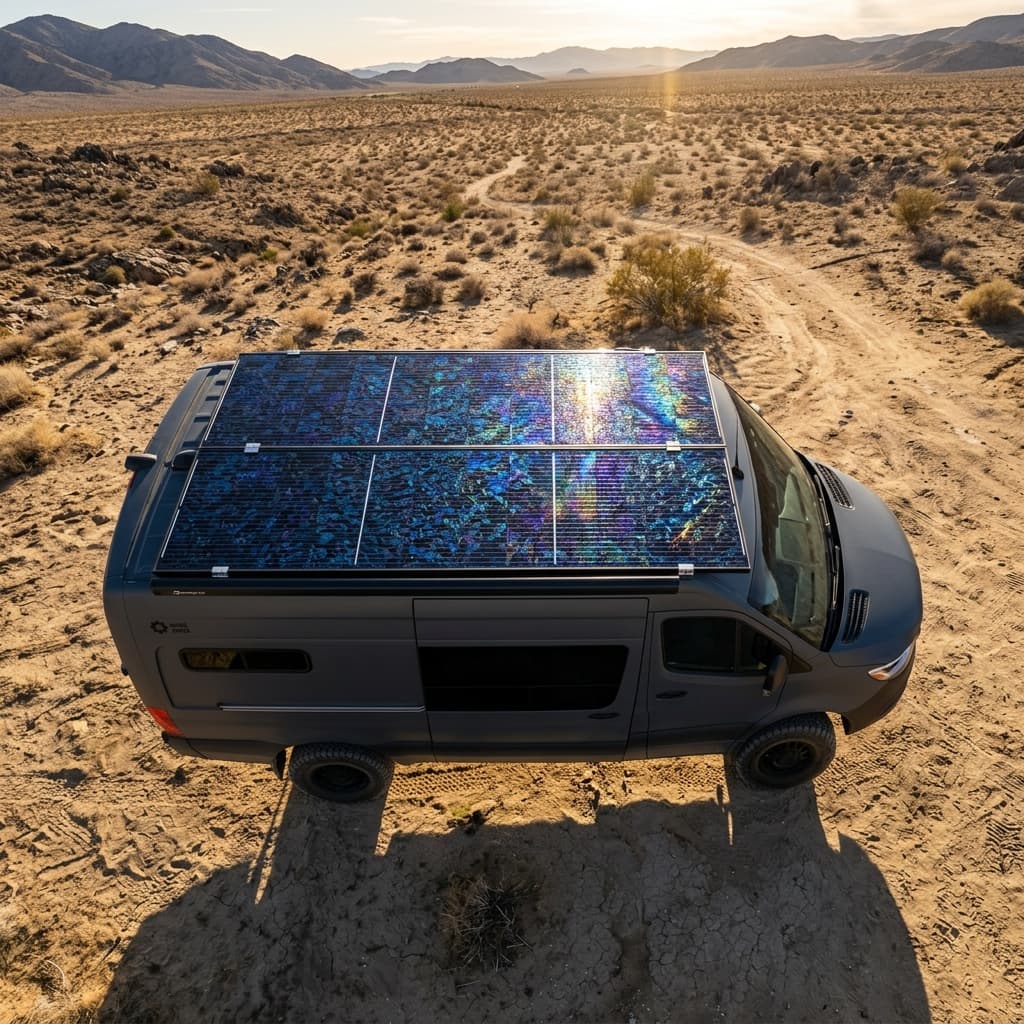
For decades, physicists have wrestled with the Shockley-Queisser limit, a mathematical law stating that standard silicon solar cells can theoretically never exceed roughly 33% efficiency. Real-world commercial panels hover frustratingly around 21-23%. But the arrival of commercial Perovskite Tandem cells has unequivocally shattered this ceiling, promising to change the architectural mathematics of RV solar forever. This comprehensive technical audit explores the materials science, the real-world performance metrics, and the strategic implications for off-grid vehicle design in 2026 and beyond.
If you are building an off-grid Skoolie, a massive 5th-wheel trailer, or a hyper-stealthy Ford Transit camper, your most finite and valuable resource isn't money, it is roof real estate. Between MaxxAir fans, air conditioning units, and Starlink dishes, squeezing enough solar panels to run an induction stove and heavy-duty heating loops feels like playing a high-stakes game of Tetris. Every square inch must earn its keep. For years, the only way to increase total wattage was to add more panels, forcing builders into agonizing compromises: delete a vent fan, downsize the AC, or mount panels on cumbersome tilt brackets that ruin the stealth profile.
Perovskite Tandem technology changes this calculus entirely. Instead of adding *more* panels, you add *better* panels. A single 300W-class panel in the same physical footprint suddenly delivers 420W or more. For a typical van roof that can accommodate two panels, that's the difference between a marginal 600W system and a robust 840W system, a 40% increase in total harvest without sacrificing a single inch of roof space. This isn't an incremental improvement; it's a paradigm shift that enables true energy independence for vehicles that previously had to rely on alternator charging or generator backups.
The Shockley-Queisser Limit: Why Silicon Alone Was Never Enough
To appreciate the magnitude of the Tandem breakthrough, we must first understand the fundamental physics that has constrained solar energy for half a century. The Shockley-Queisser limit, derived in 1961, calculates the maximum theoretical efficiency of a single-junction solar cell. It's based on two inescapable loss mechanisms: spectral losses and thermalization losses.
Sunlight is a broad spectrum of photons, ranging from low-energy infrared to high-energy ultraviolet. A silicon solar cell has a fixed bandgap of 1.1 electron volts (eV). Any photon with energy *less* than 1.1 eV (infrared) passes straight through the silicon without generating electricity, it's wasted. Any photon with energy *greater* than 1.1 eV (blue and UV) generates an electron, but the excess energy above 1.1 eV is instantly dissipated as heat. This is thermalization loss. The combination of these two factors places an absolute ceiling of 33.7% efficiency for a perfect single-junction silicon cell under standard sunlight.
Real-world silicon panels, with imperfections, resistive losses, and reflection, top out around 26-27% in laboratory settings and 21-23% in mass production. We have been asymptotically approaching the Shockley-Queisser wall for decades, squeezing out fractions of a percent through better passivation and surface texturing. To break through the wall, we needed a fundamentally different architecture: stacking multiple junctions with different bandgaps, each tuned to a specific slice of the solar spectrum. This is the essence of multi-junction or "Tandem" cells.
What Exactly is a "Tandem" Cell? The Perovskite Advantage
Traditional monocrystalline silicon panels are excellent at absorbing the red and infrared spectrum of sunlight, but they waste an immense amount of high-energy blue and ultraviolet light (which dissipates as useless heat). Perovskite is a brilliant, highly-tunable crystalline material that excels spectacularly at gobbling up that exact blue spectrum. Unlike silicon, which has a fixed bandgap dictated by its atomic structure, Perovskite's bandgap can be precisely tuned during manufacturing by adjusting its chemical composition, typically by varying the ratio of halides like iodine, bromine, and chlorine.
A Tandem Cell literally stacks a microscopically thin, translucent layer of Perovskite directly on top of a traditional Silicon base. The Perovskite acts as an optical filter, stripping the blue light and generating massive electricity, while allowing the red light to pass straight through to the silicon layer underneath, which harvests the rest. The result is two engines running simultaneously off the same ray of sunlight. The theoretical maximum efficiency for a two-junction Perovskite-on-Silicon tandem is over 43%, far beyond the single-junction limit. In the lab, researchers at KAUST and Helmholtz-Zentrum Berlin have already demonstrated cells exceeding 33.7%, and commercial panels in 2026 are shipping with certified efficiencies of 28-30%.
The manufacturing process is also remarkably compatible with existing silicon production lines. The Perovskite layer is deposited using solution-based processes, essentially "printing" the crystal onto the silicon wafer using slot-die coating or inkjet printing. This means the incremental cost of adding the Perovskite junction is relatively low compared to the massive efficiency gain. As production scales, the cost per watt of Tandem panels is projected to fall below that of premium monocrystalline panels, potentially as early as 2028.
📈 High-Density Output & Voltage Advantages
- • Efficiency Breakthrough: Breaks the 30% barrier, pushing commercial panels easily toward 28-32% real-world efficiency, compared to 21-23% for premium PERC panels.
- • Footprint Transformation: Transforms a standard footprint 300W panel into a staggering 420W+ output monster without altering the aluminum chassis dimensions. This means more power from the same roof area.
- • Higher Open-Circuit Voltage (Voc): Because the two junctions are electrically in series, the combined Voc is roughly the sum of the individual junctions. A Tandem panel might have a Voc of 50-55V, compared to 40-45V for a standard 400W residential panel. This higher voltage reduces current for the same power, minimizing resistive losses in long wire runs from roof to charge controller.
- • Better Low-Light Performance: Perovskite's broad absorption spectrum and high external quantum efficiency at low irradiance mean Tandem panels wake up earlier in the morning and continue producing usable power later into the evening, extending the effective solar day.
🔧 Stealth, Shadow, and MPPT Synergy
- • Higher Voltage per Square Inch: Because the panels generate exceptionally high voltage per square inch, they require fewer units linked in series to wake up an MPPT controller in the morning and keep it above the battery voltage threshold.
- • Stealth Optimization: Incredibly beneficial for low-profile Stealth vans trying to hide hardware from street view. A single 420W Tandem panel can replace two 200W panels, reducing visual clutter and improving aerodynamics.
- • Partial Shade Tolerance: The dual-junction architecture, combined with advanced bypass diode layouts, makes Tandem panels more resilient to partial shading. A shadow from a roof vent that might knock out 30% of a standard panel's output may only reduce a Tandem panel's output by 15-20%, because the unaffected junction continues to produce.
- • MPPT Compatibility: Most high-quality MPPT controllers (Victron SmartSolar, Midnight Solar, EG4) can handle the higher Voc of Tandem panels without issue. The key is ensuring the controller's maximum input voltage rating provides sufficient cold-weather headroom.
The Durability Question: Are They Ready for the Vibrating, Baking Roof?
Historically, early Perovskite lab modules degraded rapidly when exposed to humidity and high temperatures. The crystal structure is sensitive to moisture, which causes the organic cations (typically methylammonium or formamidinium) to decompose, leading to a rapid drop in efficiency. This was the primary barrier to commercialization, a solar panel that lasts only a few months is useless.
However, 2026 manufacturing technologies employ heavy-duty encapsulation, sealing the delicate crystal matrix between impermeable industrial glass and aerospace-grade polymer backsheets. The front glass is typically 3.2mm tempered anti-reflective glass, identical to standard silicon panels. The edges are sealed with butyl rubber and silicone, creating a hermetic barrier against moisture ingress. The Perovskite layer itself is now stabilized with inorganic cesium and rubidium additives, dramatically improving thermal and moisture stability.
For the extreme vibrational and thermal environment of an RV roof, modern rigid Tandem panels are proving as robust as legacy silicon hardware. Independent accelerated aging tests (IEC 61215 and IEC 61730) show that 2026 Tandem panels pass the same rigorous standards as silicon panels: 1,000 hours of damp heat (85°C / 85% relative humidity), 200 thermal cycles (-40°C to +85°C), and mechanical load testing of 5,400 Pa. Leading manufacturers are offering 25-year linear power output warranties, matching the industry standard for premium silicon panels.
One remaining consideration is Potential-Induced Degradation (PID), a phenomenon where high system voltage causes sodium ions from the glass to migrate into the cell, reducing performance. Because Tandem panels operate at higher string voltages, careful system grounding and the use of PID-resistant encapsulants are essential. Reputable manufacturers address this with PID-free certified designs.
Case Study: Retrofitting a Class B Van with Tandem Panels
Let's examine a concrete example to illustrate the real-world impact. Consider a 2026 Mercedes Sprinter 144" wheelbase high-roof van. The usable roof area, after accounting for a MaxxAir fan, a rooftop AC unit, and a Starlink Mini dish, is approximately 60 inches wide by 80 inches long, enough for two standard 200W panels (each roughly 58" x 26") mounted side-by-side. Total array wattage: 400W.
With Tandem technology, the owner can install two 420W panels in the exact same footprint. Total array wattage: 840W. This is a 440W increase, more than double the original capacity. What does this extra power enable?
- Induction Cooking: A single induction burner draws 1,800W. With 400W of solar, running the burner for 20 minutes consumes 600Wh, nearly a third of the daily solar harvest. The 840W array can replenish that energy in under an hour of peak sun, making induction cooking practical for daily use without generator support.
- Air Conditioning Margin: A 12V rooftop AC unit draws 600-800W continuously. A 400W array can't keep up with daytime AC use; the battery slowly depletes. An 840W array can run the AC *and* still have a surplus to charge the battery, extending comfortable boondocking in hot climates.
- Redundancy on Cloudy Days: On a heavily overcast day, a 400W array might produce only 80-100W. An 840W array will produce 160-200W, enough to run the fridge and keep the battery from discharging, buying precious extra days of autonomy without sun.
The value proposition is clear: Tandem panels effectively "unlock" the roof space that was previously considered unusable. They allow smaller vehicles to achieve the energy independence previously reserved for large RVs with expansive roofs.
| Specification | Standard Mono PERC (2025) | Premium N-Type TOPCon (2026) | Perovskite Tandem (2026) |
|---|---|---|---|
| Typical Efficiency | 19% - 21.5% | 22% - 23.5% | 28% - 32% |
| Power per 1.6m² Panel (~17 sq ft) | 320W - 340W | 360W - 380W | 460W - 510W |
| Temperature Coefficient (Pmax) | -0.39% / °C | -0.29% / °C | -0.26% / °C |
| Relative Cost per Watt (2026) | $0.90 - $1.10 | $1.10 - $1.30 | $1.60 - $2.00 |
| Low-Light Performance | Good | Very Good | Excellent |
Integration with High-Voltage MPPT Controllers
The higher voltage output of Tandem panels requires careful attention to MPPT controller selection. A single 420W Tandem panel might have a Voc (Open Circuit Voltage) of 52V and a Vmp (Voltage at Maximum Power) of 44V. Two panels in series yield 104V Voc and 88V Vmp. In cold weather (0°C / 32°F), the Voc increases by approximately 15-20%, pushing it to 120-125V.
For a two-panel series string, a 150V-rated MPPT controller (like the Victron SmartSolar 150/35 or 150/45) provides adequate headroom. For three panels in series (which would be rare on an RV due to space constraints), a 250V controller is mandatory. The alternative is to wire panels in parallel, keeping voltage at ~52V but doubling or tripling the current. This is safer for lower-voltage controllers but requires thicker wire to handle the higher amperage and minimizes voltage drop.
The higher Vmp also means that the MPPT will start charging earlier in the morning and continue later in the evening, as the array voltage stays above the battery voltage for a longer portion of the solar day. This "shoulder hour" harvesting is a subtle but meaningful contributor to the Tandem panel's overall yield advantage.
Price vs. Performance ROI: The Strategic Calculus
As of 2026, Perovskite Tandem panels command a significant price premium, often 40% to 60% higher per watt than traditional premium N-Type panels. If you possess a giant 40-foot flat roof on a Class A motorhome, it remains far cheaper to simply lay out inexpensive, massive 500W residential silicon panels and call it a day. The value of Tandem is not in raw dollars per watt; it's in watts per square inch.
Tandem technology is reserved for those who are critically space-constrained and possess disposable capital to achieve maximum technological density. For a stealth van, a truck camper, or a small travel trailer where every square foot of roof is contested territory, the premium is justified. The alternative to Tandem is not "cheaper silicon"; it's "no more power at all." You've literally run out of roof.
Furthermore, the total system cost must be considered. Adding a second alternator, a larger battery bank, or a backup generator to compensate for insufficient solar can easily exceed $2,000-$4,000. Upgrading two panels from standard to Tandem costs an incremental $500-$800. In many builds, the Tandem panels are the *cheaper* path to energy independence when all system components are factored in.
The Future Roadmap: Triple-Junction and Beyond
The Perovskite Tandem panel is not the end of the road; it's the opening salvo. Research labs are already demonstrating Triple-Junction cells that stack a high-bandgap Perovskite, a mid-bandgap Perovskite, and a low-bandgap Silicon cell. These have achieved efficiencies over 35% in laboratory settings. The challenge is manufacturing complexity and cost, but the trajectory is clear.
Another promising avenue is All-Perovskite Tandems, which eliminate silicon entirely. These lightweight, flexible cells could be integrated directly into RV roof membranes or awnings, turning the entire vehicle skin into a power generator. Durability remains the primary hurdle, but the potential to harvest kilowatts from surfaces that are currently passive is tantalizing.
For the 2026 RV builder, the Perovskite Tandem panel represents the cutting edge of commercially available technology. It's a strategic investment in energy density that future-proofs the vehicle against evolving power demands. As electric RV powertrains become more common and as digital nomads demand ever more power for their mobile offices, the ability to harvest 800W, 1000W, or even 1500W from a limited roof will transition from a luxury to a necessity.
Conclusion: Density is Destiny
The Shockley-Queisser limit has governed solar efficiency for over 60 years. With the commercialization of Perovskite Tandem cells, that limit is no longer a ceiling but a stepping stone. For the RV community, this breakthrough arrives at a pivotal moment, when the demand for off-grid power is exploding and roof space is at an all-time premium. Tandem panels offer a clear path to higher energy autonomy without requiring a larger vehicle or sacrificing essential roof accessories.
The premium price is real, and the technology is not for every budget. But for those who view their RV as a long-term platform for exploration and remote work, the investment in Tandem solar is an investment in freedom. It's the difference between monitoring the battery monitor with anxiety and running the air conditioner with impunity. The future of RV solar is stacked, literally, and it's brighter than ever.
Technical Expansion
Deepen your expertise with our most critical recent diagnostic reports.

Winter RVing & Lithium: Survival Guide for Freezing Temps
Technical guide to lithium plating, battery heaters, and low-angle winter solar harvesting.
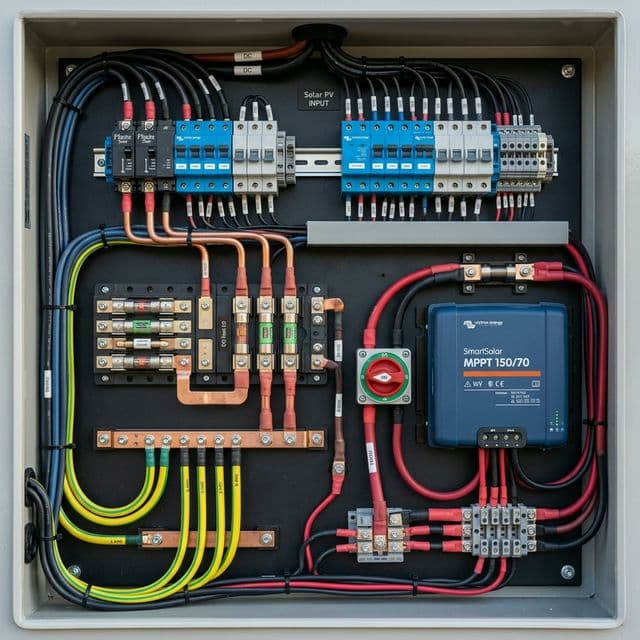
Top 10 RV Solar Mistakes: How to Avoid Burning Your Camper Down
The final word on solar safety: Fusing, grounding, and roof penetration best practices.

The Ultimate Guide to Portable Solar Panels for Van Life (2026 Edition)
technical deep-dive into portable solar technology, including N-Type and Bifacial cell innovations.