GaN (Gallium Nitride) Inverters for RVs: Maximum Efficiency Reviewed
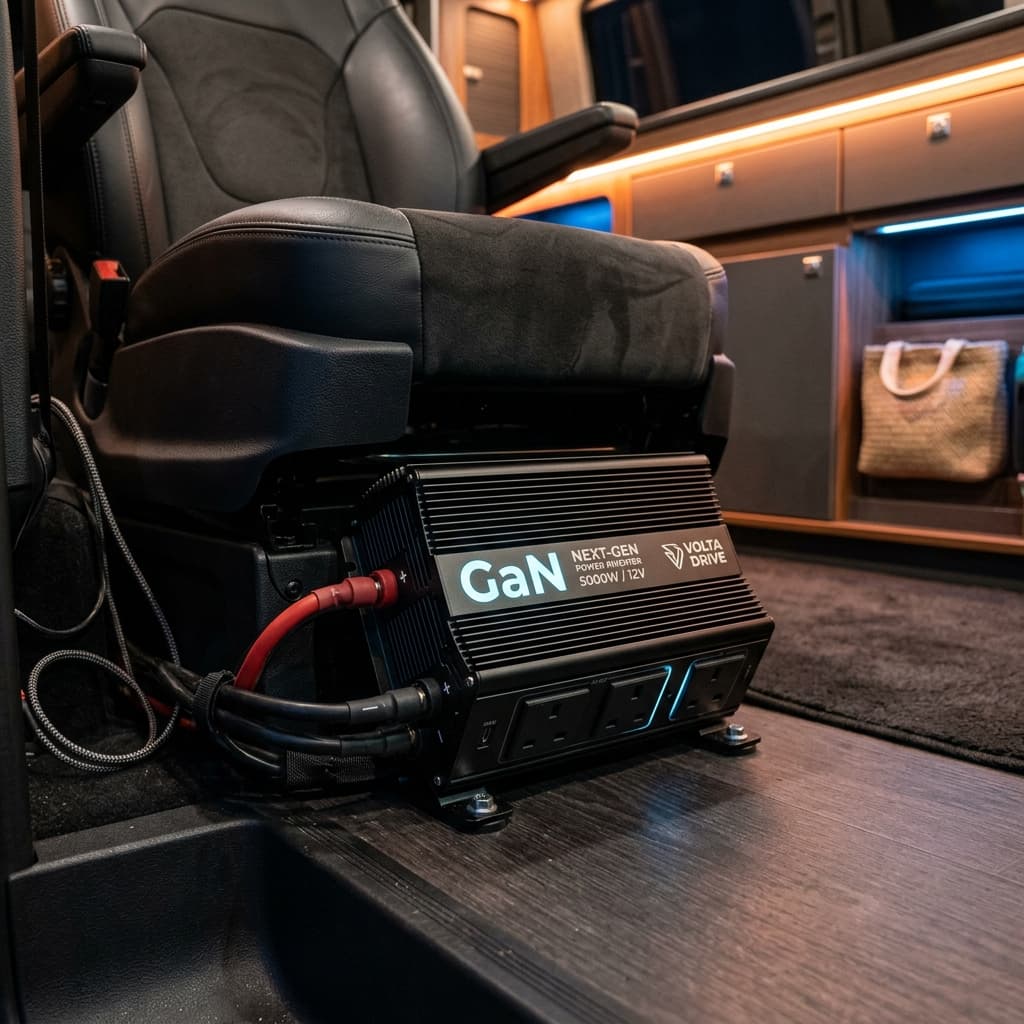
You certainly remember how smartphone and laptop chargers suddenly shrunk from massive, heavy bricks into tiny, hyper-efficient cubes in 2023. That physical miracle was powered by the deployment of Gallium Nitride (GaN) semiconductors. Now, this revolutionary material science has finally impacted the heavy-duty RV appliance sector, dramatically miniaturizing thousands of watts of pure sine wave power. This comprehensive technical audit explores the physics behind GaN, its transformative impact on inverter design, and what it means for the future of mobile off-grid energy systems.
Traditional high-frequency and low-frequency inverters, the backbone of the RV community for decades, rely on aging silicon MOSFETs wrapped around gigantic, heavy copper toroidal transformers. These legacy systems are remarkably heavy, demand enormous ventilation clearances, and notoriously waste precious battery power through thermal heat dissipation when under heavy loads. For the van lifer struggling to find space for a 3000W inverter in a cramped electrical cabinet, or the full-timer watching their battery monitor tick down due to inverter idle consumption, these limitations are daily frustrations.
The introduction of Gallium Nitride (GaN) power transistors changes the equation entirely. GaN is a wide-bandgap semiconductor material that outperforms silicon in nearly every metric relevant to power conversion: higher electron mobility, higher breakdown voltage, lower on-resistance, and faster switching speeds. These fundamental material properties translate directly into inverters that are smaller, lighter, cooler-running, and more efficient. For the RV community, this is not an incremental improvement; it's a paradigm shift that will redefine where and how we install power electronics.
The Physics of Silicon vs. Gallium Nitride
To appreciate the magnitude of the GaN disruption, we must first understand the limitations of silicon. Silicon has been the workhorse of the electronics industry for over 70 years. It's abundant, well-understood, and cheap to manufacture. However, as a power semiconductor, silicon is approaching its theoretical limits. The key metric is the bandgap, the energy required to move an electron from the valence band to the conduction band. Silicon has a bandgap of 1.1 electron-volts (eV). Gallium Nitride has a bandgap of 3.4 eV, over three times wider.
A wider bandgap confers several critical advantages for power conversion. First, it allows the device to operate at much higher temperatures without suffering from thermal runaway or increased leakage current. Silicon devices typically derate significantly above 100°C, while GaN devices can operate reliably at junction temperatures exceeding 200°C. Second, the higher critical electric field of GaN (3.3 MV/cm vs. 0.3 MV/cm for silicon) means that GaN transistors can be made much smaller for a given voltage rating. This reduces parasitic capacitances, enabling faster switching.
Faster switching is the secret sauce. In an inverter, the DC voltage from the battery is chopped into a high-frequency AC waveform by rapidly switching transistors on and off. This switching frequency, typically 20 kHz to 100 kHz in silicon inverters, determines the size of the magnetic components (transformers and inductors). Higher switching frequency allows for smaller magnetics. Silicon transistors have significant switching losses, each transition wastes energy as heat. GaN transistors switch so fast (nanoseconds vs. tens of nanoseconds) that these losses are drastically reduced. This is why a GaN inverter can be both smaller *and* more efficient than its silicon counterpart.
The Gallium Nitride (GaN) Disruption in RV Inverters
Basing the power output stage of a 3000W inverter exclusively on Gallium Nitride (GaN) architectures eliminates the necessity for archaic thermal topologies. GaN conducts electrons phenomenally faster and with less resistance than silicon. It can sustain massively higher voltages and temperatures without failing, which paradoxically means the inverter generates significantly less internal heat. This reduction in waste heat cascades through the entire design: smaller heatsinks, smaller or no cooling fans, and tighter component spacing.
Let's examine the specific components that shrink. In a traditional low-frequency inverter, the dominant component is the massive toroidal transformer, which can weigh 30-40 lbs alone. In a high-frequency silicon inverter, the transformer is smaller but still substantial, and the output filter inductors are sizable. With GaN, the switching frequency can be pushed from 20 kHz to 200 kHz or even 500 kHz. The required inductance scales inversely with frequency, a 10x increase in frequency allows for a 10x reduction in inductance. The magnetic core can be a tiny ferrite bead instead of a heavy iron donut. This is the primary driver of the 60% weight reduction observed in GaN inverters.
⚖️ Weight and Dimensional Revolution
A standard 3000W silicon-based inverter/charger (like the Victron MultiPlus-II 12/3000) routinely weighs between 41 and 45 pounds, consuming vast amounts of wall space in a storage bay. Installation requires careful planning for structural support and adequate airflow clearance (typically 4-6 inches on all sides).
Emerging GaN inverters effectively slash these dimensions by up to 60%, yielding sleek, lightweight units (sub-20 pounds) that can literally slip underneath a swiveling passenger seat in a Sprinter van unnoticed. This radical miniaturization unlocks new installation locations, behind cabinetry, inside a dinette bench, or even mounted vertically on a narrow wall.
⚡ The Efficiency Leap Across the Load Curve
The best legacy inverters peak around 89% to 92% conversion efficiency at their optimal load (typically 30-50% of rated power), bleeding the remaining energy away as wasted radiant heat. At low loads (under 100W), efficiency often plummets to 70-80%.
GaN units astonishingly sustain 95% to 96% efficiency during peak transients, and critically, they maintain high efficiency (>90%) even at very low loads. This "flat efficiency curve" is a game-changer for RVers who spend most of their time running small loads like a laptop or Starlink. Saving an extra 5% efficiency on a massive 2000W microwave load essentially buys you a free lighting array overnight without utilizing extra solar energy.
Thermal Management and the Silence Dividend
One agonizing side effect of sleeping inches away from a robust RV electrical bay is the relentless shrieking of cooling fans kicking on during the hot summer. In a silicon inverter, waste heat is a constant companion. A 3000W inverter running at 90% efficiency and delivering 1000W to loads is dissipating 100W of heat, equivalent to a small incandescent light bulb baking inside the chassis. Over time, this heat soaks the surrounding compartment, raising the ambient temperature and forcing the inverter to work even harder.
GaN inverters flip this thermal equation. At 96% efficiency, that same 1000W load generates only 40W of waste heat, a 60% reduction. Because GaN transistors can safely operate at higher junction temperatures, the thermal management system can be less aggressive. Many GaN inverters are implementing completely silent, passive-cooling heat sinks for all but the most extreme loads. When fans are required, they can be oversized, incredibly slow-spinning models that activate rarely and at barely audible noise levels. For the acoustically sensitive digital nomad who edits video or records podcasts from their van, this silence represents worth its weight in gold. No more fan noise bleeding into audio recordings, and no more interrupted sleep when the inverter decides to cool down at 3 AM.
Reliability and Longevity: Fewer Failure Points
The reduction in component count and thermal stress has a direct impact on reliability. A traditional inverter contains numerous electrolytic capacitors, which are notoriously sensitive to heat. For every 10°C increase in operating temperature, the lifespan of an electrolytic capacitor is halved. By running cooler, GaN inverters extend the life of these ancillary components significantly.
Furthermore, the absence of a massive transformer eliminates a common source of mechanical hum and vibration. The 60 Hz hum from a low-frequency inverter is caused by magnetostriction in the transformer core, the iron physically expands and contracts with the magnetic field. This vibration can loosen mounting screws over time and is an audible nuisance. GaN inverters, operating at frequencies far above human hearing, are inherently silent in their magnetic components.
Early field data from marine and RV installations of first-generation GaN inverters shows a significant reduction in warranty claims related to overheating and fan failure. The Mean Time Between Failures (MTBF) is projected to be 2-3x that of comparable silicon inverters. For a full-time RVer whose livelihood depends on reliable power, this increased reliability translates directly to peace of mind and reduced downtime.
Audio and RF Interference: Cleaner Power for Sensitive Electronics
The high switching speeds of GaN transistors, while beneficial for efficiency, introduce a new challenge: electromagnetic interference (EMI). The sharp voltage transitions (high dV/dt) can radiate noise that interferes with sensitive electronics like ham radios, GPS receivers, and even the touchscreens on modern RV control panels. This is a solvable engineering problem, but it requires careful attention to PCB layout, shielding, and filtering.
Reputable GaN inverter manufacturers are addressing this by integrating advanced spread-spectrum modulation techniques and multi-stage EMI filters. The result is an output waveform that is actually *cleaner* than many silicon inverters, with lower total harmonic distortion (THD). For audio professionals and radio enthusiasts, this is a critical consideration. A poorly designed GaN inverter could wreak havoc on HF radio reception; a well-designed one provides pristine, noise-free power.
Cost Trajectory and Market Adoption in 2026
As with any new technology, GaN inverters currently command a price premium. The cost of GaN transistors is higher than silicon MOSFETs on a per-unit basis, though this is offset by the reduced cost of magnetics, heatsinks, and enclosures. In 2026, a 3000W GaN inverter/charger retails for approximately 30-50% more than a premium silicon equivalent. For example, a Victron MultiPlus-II 12/3000 is around $1,400, while a comparable GaN unit from an emerging brand might be $1,900-$2,100.
However, the total cost of ownership must be considered. The space savings can eliminate the need for a custom electrical cabinet, saving hundreds in fabrication costs. The efficiency gains can reduce the required battery capacity or solar array size, potentially saving thousands. And the increased reliability means fewer service calls and less downtime. For a high-end build, the GaN premium is easily justified by these system-level savings.
The market is evolving rapidly. While elite, bleeding-edge startup brands (such as Firman and certain OEM suppliers) command premium prices for early-adopter GaN models, the technology is cascading downhill. Industry insiders confirm that major players like Victron Energy, Xantrex, and Magnum are actively developing GaN-based product lines, with expected releases in late 2026 or early 2027. Expect traditional giants to fully overhaul their massive blue-and-white plastic rectangular boxes with sleeker, smaller GaN guts, effectively rewriting the layout of every modern campervan electrical blueprint.
Installation Considerations for GaN Inverters
While GaN inverters are more forgiving thermally, they still require proper installation. Key considerations include:
- DC Cable Sizing: Despite the smaller chassis, the DC current demands are unchanged. A 3000W inverter at 12V still pulls up to 250A. Use appropriately sized cables (4/0 AWG) and keep cable runs as short as possible.
- Ventilation: Even though heat generation is lower, some airflow is still beneficial. Avoid sealing the inverter in a completely airtight compartment.
- EMI Awareness: Keep sensitive antenna cables and audio interconnects routed away from the inverter and its DC input cables. Use ferrite chokes on DC cables if noise is observed.
- Firmware Updates: GaN inverters are software-defined power platforms. Manufacturers frequently release firmware updates that improve efficiency, add features, or refine the control algorithms. Stay current.
The Future: Integrated GaN Power Modules
Looking beyond discrete GaN transistors, the next frontier is integrated GaN power modules. These system-in-package (SiP) devices combine the GaN transistor, gate driver, and protection circuitry into a single chip-scale package. This further reduces parasitic inductances, improves reliability, and simplifies the inverter design. We can envision a future where a 3000W inverter is not a separate box at all, but a small circuit board integrated directly into the RV's main power distribution panel. The boundaries between battery, inverter, and solar charge controller will blur, leading to unified, software-defined energy routers that manage all power flows intelligently.
For the RV owner in 2026, the emergence of GaN inverters is a clear signal: the era of bulky, hot, noisy power electronics is ending. When planning a new build or a major electrical upgrade, prioritizing GaN technology, or at least ensuring your system architecture is ready to accept GaN components in the future, is a strategic move that will pay dividends in space, efficiency, and tranquility for years to come. The revolution that shrunk your phone charger is now ready to power your entire home on wheels.
Technical Expansion
Deepen your expertise with our most critical recent diagnostic reports.
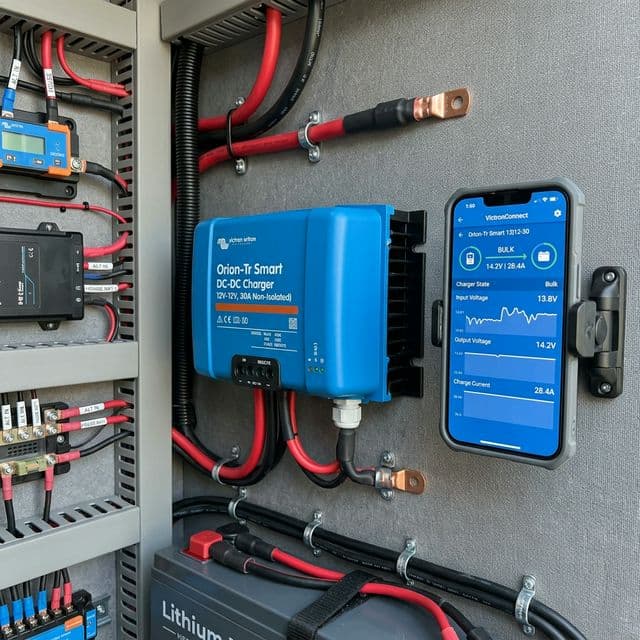
Victron Orion-Tr Smart DC-DC Review: Precision and Monitoring
Why the smart version of the Orion-Tr is essential for high-end technical builds.
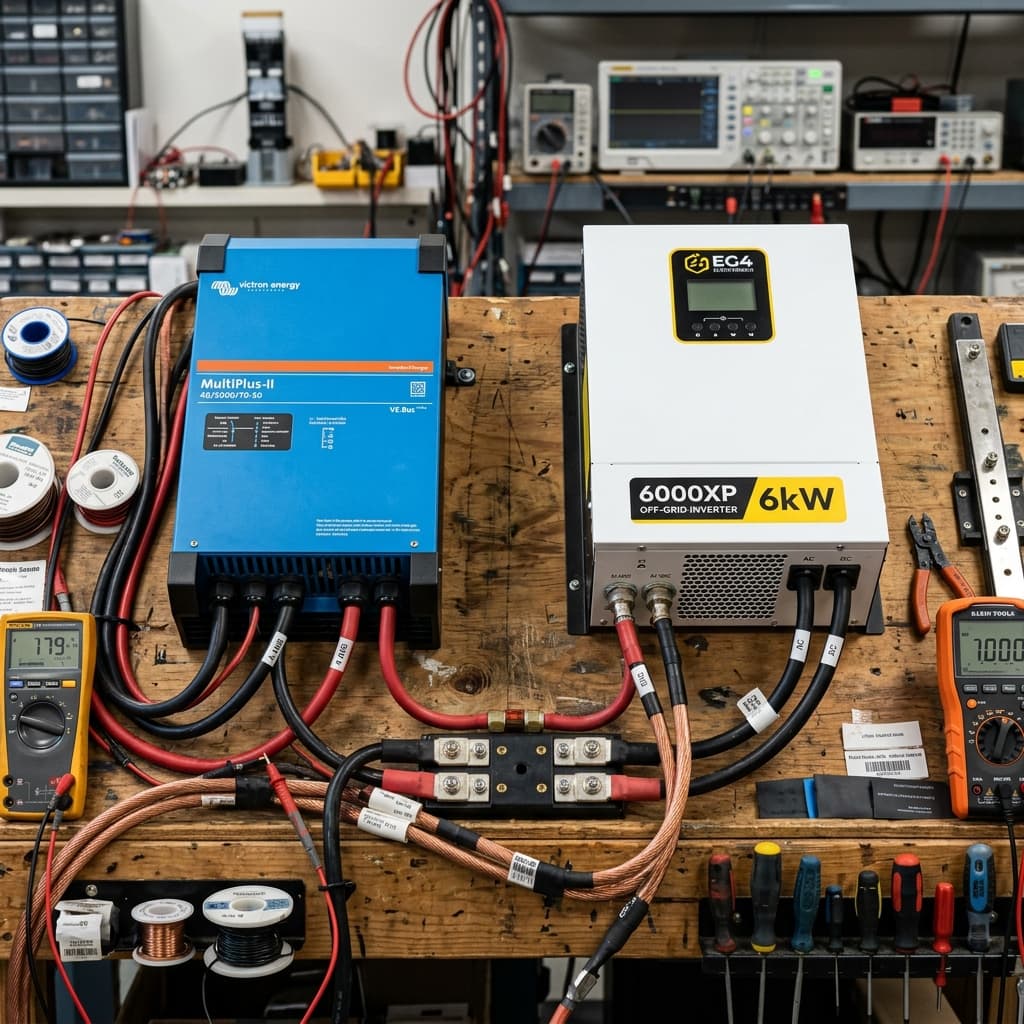
Victron MultiPlus-II vs. EG4 6000XP: Has the 'Blue King' Been Dethroned in 2026?
We benchmark the legendary Victron MultiPlus-II against the disruptive EG4 6000XP. Discover which 6000W-class inverter dominates in surge capacity, idle draw, and off-grid reliability.
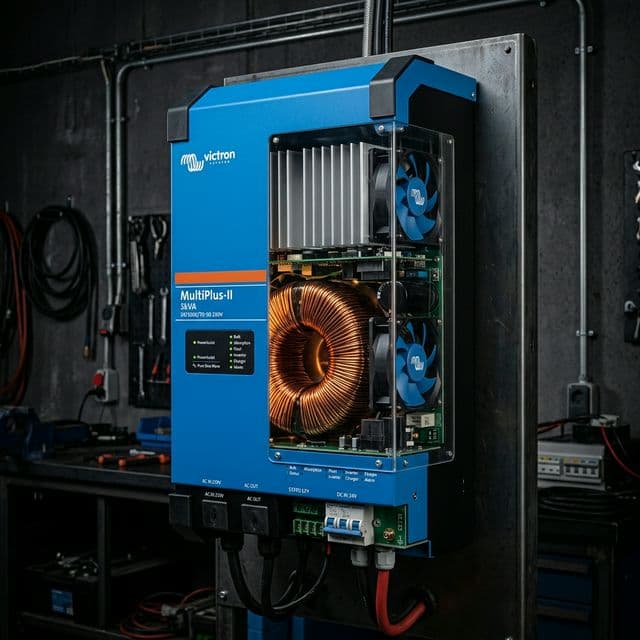
Victron MultiPlus-II 3kVA: The 'King' of RV Inverters Analyzed
Victron MultiPlus-II 3kVA inverter/charger: 2026 industrial audit. Learn about PowerAssist, toroidal transformer physics, and system reliability.