Step-by-Step: Installing Flexible Solar Panels on Curved RV Roofs
Flexible solar panels are the 'holy grail' for aerodynamic camper van builds and curved roof RVs. They offer a sleek, low-profile aesthetic that traditional rigid panels simply cannot match. However, the internet is littered with horror stories of flexible panels failing after just 18 months. In this 2,000-word step-by-step masterclass, we reveal the engineering secrets—including the critical 'air gap' technique—that will ensure your flexible setup lasts for a decade, not a season.
1. The Flexible Choice: ETFE vs. PET
The most common mistake made by budget-conscious builders is choosing a PET-laminated panel. PET (Polyethylene Terephthalate) is essentially a cheap plastic film that eventually yellows and cracks under the relentless UV radiation of the sun. Once the film cracks, moisture enters the cells, leading to delamination and total failure. To build a system that lasts, you must choose ETFE (Ethylene Tetrafluoroethylene). ETFE is a high-strength polymer that is naturally UV-stable and has a self-cleaning surface. While ETFE panels cost roughly 20-30% more, their lifespan is 5x longer than PET. If the product description doesn't explicitly state 'ETFE,' assume it is PET and look elsewhere.
2. Physics of Failure: The Heat Problem
Solar panels work by capturing photons, but they also capture a massive amount of heat. A rigid panel has 1.5 inches of air underneath it to keep the cells cool. A flexible panel glued directly to a metal van roof has nowhere for that heat to go. As the cells heat up, their efficiency drops significantly—a phenomenon called 'Thermal De-rating.' Worse, the constant thermal expansion and contraction between the panel and the roof will eventually break the internal electrical connections. This is why 'flush mounting' is the primary cause of flexible panel failure.
3. The Engineering Secret: The 4mm Air Gap
To solve the heat problem on a curved roof, pro builders use Twinwall Polycarbonate sheets (often used for greenhouse roofing). By adhering your flexible panel to a 4mm or 6mm polycarbonate sheet first, you create micro-channels for air to flow underneath the silicon. This simple 'sandwich' construction keeps the panel 15-20°C cooler during peak sun hours. This layer also provides a consistent, semi-rigid backing that prevents the panel from 'fluttering' at highway speeds, which is another common cause of cell micro-cracking.
| Installation Variable | The 'Best Practice' Way | The 'Amazon Beginner' Way |
|---|---|---|
| Top Layer Material | ETFE (UV Stable) | PET (Yellows/Cracks) |
| Mounting Method | Polycarbonate + Air Gap | Direct Glue-To-Roof |
| Adhesive Choice | Sikaflex 252 or VHB 5952 | Cheap Silicone Sealant |
| Surface Prep | Iso-Propyl + Primer | Unwashed Paint |
4. Adhesion Science: Bonding to Paint and Plastic
When you are flying at 70mph down the interstate, you are essentially flying a massive solar wing. If your adhesive fails, the results are catastrophic. We recommend a hybrid approach: Use 3M VHB 5952 Tape around the perimeter of your polycarbonate sheet for immediate 'tack,' then fill the interior with 'snakes' of Sikaflex 252 structural adhesive. This combination provides both high initial grab and long-term mechanical strength. Crucial Tip: You must clean both the roof and the panel with 90% Isopropyl alcohol. If you skip this step, the adhesive will bond to the dust and wax, not the vehicle.
5. Step-by-Step Installation Guide
- Dry Fit: Position your panels on the roof. Check for cable clearance and ensure they don't block transition seams in your roof structure.
- The Poly Sandwich: Adhere the panels to your twinwall polycarbonate sheets using VHB tape. Ensure the 'channels' of the polycarbonate run front-to-back for maximum airflow.
- Surface Prep: Thoroughly clean the mounting area with soap and water, followed by Isopropyl alcohol. Use a specialized '3M Tape Primer 94' for the absolute best bond.
- Final Adhesion: Apply your Sikaflex and VHB tape to the polycarbonate backing. Carefully lower the panel into place. You only have one shot at this—VHB tape is unforgiving.
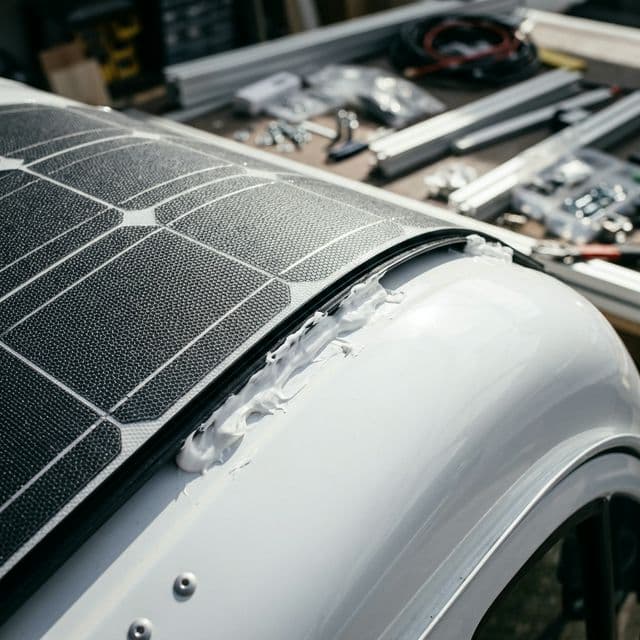
- Seal the Edges: Use Dicor Self-Leveling Sealant around the leading edge of the panel to prevent wind from 'getting under' the panel and lifting it.
6. Wiring on a Curve: The Entry Point
Wiring flexible panels presents a unique challenge: the junction boxes are often on the top surface. Use an IP68 Cable Entry Gland directly through the roof as close to the panel as possible. To keep the look 'stealthy,' hide the wiring beneath the panel itself or using low-profile cable trunking. Ensure all exterior wiring is UV-rated, or it will become brittle and crack within two years of salt and sun exposure.
Frequently Asked Questions
Q: Can I walk on flexible panels?
A: Some manufacturers claim you can, but we strongly advise against it. The micro-flexing of the panel under your weight can cause micro-cracks in the silicon cells, permanently reducing efficiency.
Q: How do I remove them if they fail?
A: This is the downside: Sikaflex is permanent. You will likely need a 'cheese wire' or an oscillating multi-tool to cut the adhesive bond. Plan your layout carefully!
Q: Is one big panel better than two small ones?
A: On a curved roof, two smaller panels (e.g., 2 x 100W) are much easier to install than one large 200W panel because they have less 'tension' on the curve.
Final Verdict: Style Meets Science
Flexible solar is the perfect choice for the aesthetics-focused van builder, provided you don't take the lazy path. By choosing ETFE panels and implementing a proper polycarbonate air gap, you can enjoy a sleek, efficient, and long-lasting system that would make any professional upfitter proud. It is a true 'Pro-Builder' secret that pays for itself in longevity.
Recommended Hardware: Top 4 Flexible Solutions of 2025
Renogy 100W Flexible Monocrystalline
Features high-transparency ETFE coating for superior UV resistance and 248-degree arc flexibility.
View on Amazon →BougeRV 100W CIGS Thin Film
The ultimate shade-resistant panel. Extremely durable and continues to generate power even when partially obscured.
View on Amazon →Lensun 100W Black Flexible
Ultra-low profile with black cells for maximum stealth camping effectiveness on dark van roofs.
View on Amazon →Jackery SolarSaga 100W
If you decide against permanent mounting, this is the most reliable folding panel on the market.
View on Amazon →