DIY RV Solar Cabling: Selecting Wire Gauges Like a Pro
ArticlesMarch 3, 2026

DIY RV Solar Cabling: Selecting Wire Gauges Like a Pro

You can buy the most expensive solar panels and the highest-grade lithium batteries, but if your wiring is undersized, your system will never reach its potential. In 12V DC systems, electrical resistance is a silent thief that steals your energy and turns it into dangerous heat. In this 2,000-word masterclass, we teach you the science of wire gauge selection, the art of the hydraulic crimp, and how to eliminate 'Voltage Drop' from your build forever.

1. The Invisible Leak: Understanding Voltage Drop

In a standard 120V AC home system, a 2-volt loss is negligible. In a 12V DC RV system, a 1-volt loss is nearly 10% of your total electrical potential. This is 'Voltage Drop.' Every foot of wire adds resistance, and that resistance consumes energy before it ever reaches your appliances. If your solar charge controller thinks the battery is at 14.4V because of thin wires, but the battery is actually at 13.6V, your batteries will never fully charge. In a professional build, we aim for a maximum of 3% voltage drop for critical charging circuits and 5% for general loads like lights and fans.

2. AWG vs. The World: Decoding Wire Gauges

American Wire Gauge (AWG) is a counter-intuitive system: the smaller the number, the thicker the wire. For RV solar, you will typically work with 10 AWG (for individual panels), 4 AWG (for charge controllers), and 2/0 or 4/0 AWG (for the massive cables connecting your battery bank to your inverter). When selecting wire, you must consider both Ampacity (will the wire melt?) and Voltage Drop (will the device work?). Often, a wire is thick enough to be safe, but too thin to be efficient. In 2025, with the cost of lithium so high, 'over-wiring' with thicker-than-necessary cable is the cheapest insurance policy you can buy.

Load (Amps)Length (10ft Round Trip)12V Choice (3% Drop)24V Choice (3% Drop)
20A (Lights/Fans)10 ft10 AWG14 AWG
50A (DC-DC Charger)10 ft4 AWG8 AWG
150A (2000W Inverter)10 ft2/0 AWG2 AWG

3. Stranded vs. Solid: The Vibration Factor

Never use solid-core household wire (Romex) in an RV for DC circuits. An RV is a rolling earthquake. Solid wire will eventually develop microscopic fractures from vibrations, leading to high-resistance 'hot spots' or complete failure. You must use highly-stranded copper wire, ideally with an 'RV' or 'Marine' grade rating (UL1426). Stranded wire is significantly more flexible and distributes the mechanical stress across hundreds of tiny copper filaments, ensuring a connection that lasts for decades of off-road washboard travel.

4. The Art of the Hydraulic Crimp

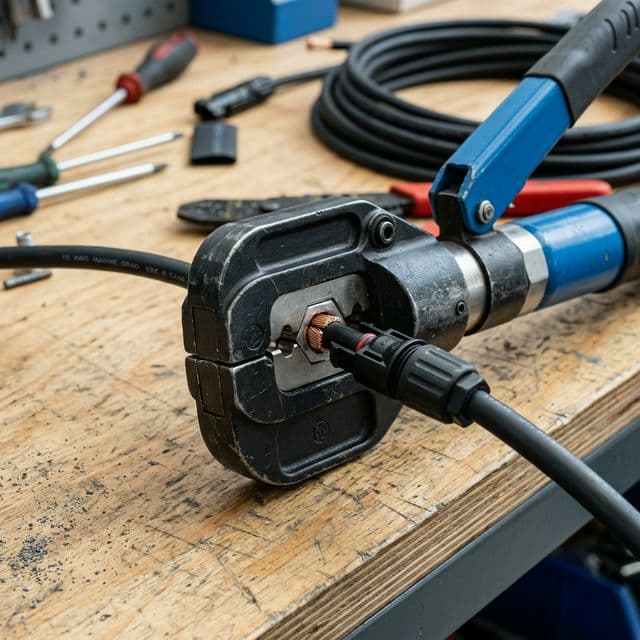
The most controversial topic in van building is Crimp vs. Solder. Professional standards (like ABYC) strongly favor mechanical crimping. A proper crimp using a Hydraulic Lug Crimper creates a 'cold weld,' where the copper of the wire and the copper of the lug are fused into a single solid mass. Soldering, while creating a good electrical connection, makes the wire 'brittle' where the solder ends. In a high-vibration environment, this produces a 'stress riser' that causes the wire to snap right at the joint. For any cable thicker than 10 AWG, buy or rent a hydraulic crimper. It is the only way to ensure a low-resistance, high-strength connection.

5. Protection: Loom, Grommets, and Fuses

Unprotected wire is a fire hazard waiting to happen. Every wire that passes through a metal bulkhead or furniture wall must use a Rubber Grommet to prevent the sharp edges from sawing through the insulation over time. Furthermore, all wires should be encased in Split Loom or braided sleeving. This provides an extra layer of abrasion resistance. Most importantly: Every single wire connected to your battery must be Fused within 7 inches of the battery terminal. The fuse protects the wire, not the device. If a 4 AWG cable shorts to the chassis without a fuse, it will become a glowing heating element that can ignite your van in seconds.

6. The 'Busbar' Philosophy: Cleaning up the Spaghetti

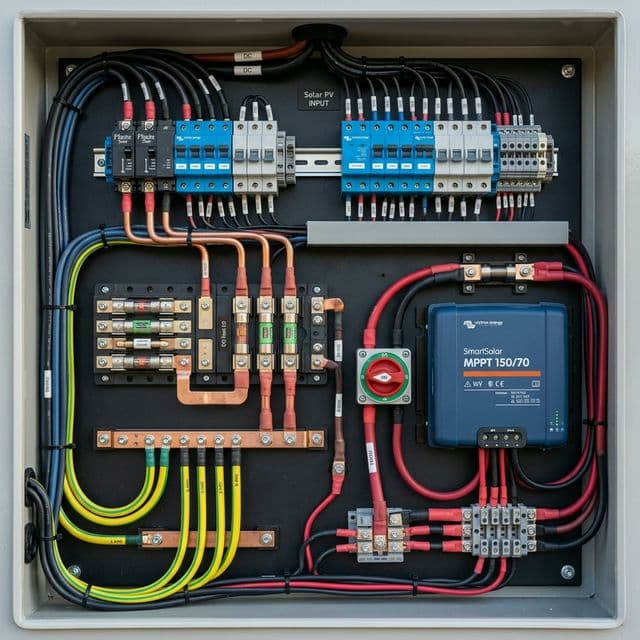
As you add more components, a single battery terminal can quickly become a 'bird's nest' of wires. This is dangerous and difficult to troubleshoot. Use high-quality Solid Copper Busbars to consolidate your connections. Not only does this look professional, but it ensures that every device has a consistent, low-resistance path to power. Pair your busbars with a 'Power Distribution Block' or a 'Blue Sea Systems Fuse Block' to centralize your circuit protection in one accessible, labeled location.

Frequently Asked Questions

Q: Can I use aluminum wire to save money?
A: NO. Aluminum has higher resistance and is prone to corrosion in RV environments. Stick to 'Tinned Copper' for the best results.

Q: Do I really need a hydraulic crimper?
A: For battery and inverter cables (4 AWG and up), yes. Hammer crimpers are inconsistent and often result in high-resistance connections.

Q: What color wire should I use?
A: Standard RV DC convention: Red for Positive (+), Black or Yellow for Negative (-). Never use Green for anything other than Chassis Ground.

Final Verdict: Treat your Wires like Arteries

In your RV's 'body,' the batteries are the heart and the wires are the arteries. If the arteries are clogged (high resistance) or leaking (bad connections), the whole system suffers. By spending an extra $200 on thicker, high-quality copper wire and a proper crimping tool, you are guaranteeing that your solar panels can actually deliver the power you paid for. Don't be the builder who buys a $2,000 battery and chokes it with $2.00 wires.

Recommended Hardware: Top 4 DIY Cabling Essentials

The Pro Crimper

IWISS Solar Tool Kit (MC4)

Ratchet-style crimper ensures perfect pressure every time. Includes wire stripper and MC4 wrenches.

View on Amazon →
High-Capacity Cable

WindyNation 2/0 Gauge (10ft)

Ultra-flexible pure copper for massive inverter loads. Tinned for superior corrosion resistance.

View on Amazon →
Panel Extensions

BougeRV 10 AWG Solar Cable (30ft)

Heavy-duty UV resistant insulation. Verified for 30A solar circuits with pre-attached IP67 connectors.

View on Amazon →
Secure Connections

Sunyee MC4 Connectors (20 Pairs)

High-grade PPO material with heavy-duty metal pins. The standard for water-tight roof connections.

View on Amazon →

Wire it once, wire it right.