CIGS vs. Monocrystalline: Is the Flexible Solar Revolution Finally Here for 2026?

The RV solar industry is witnessing an unprecedented technological bifurcation. On one side, monocrystalline silicon, the raw efficiency gold standard. On the other, CIGS (Copper Indium Gallium Selenide), the promise of total flexibility. We break down the engineering behind both technologies to determine which will dominate camper roofs in 2026.
1. Semiconductor Chemistry: The Heart of Performance
Monocrystalline Silicon relies on wafers cut from a single, high-purity silicon crystal. Its main advantage is atomic order, allowing electrons to flow with minimal resistance, achieving lab efficiencies over 24%. However, this structure is rigid and extremely sensitive to micro-fractures caused by vehicle vibrations.
CIGS, conversely, is a "thin-film" technology. The semiconductor is deposited onto a flexible substrate. At a molecular level, CIGS has a much higher light absorption coefficient than silicon; this means a layer just a few micrometers thick can absorb up to 99% of incident photons. This enables true mechanical flexibility, allowing the panel to curve with a modern van's aerodynamics without risk of delamination.
| Engineering Attribute | Monocrystalline (Rigid) | CIGS (Flexible) |
|---|---|---|
| Target Efficiency | 21% - 23% | 16% - 18% |
| Temperature Coefficient | -0.35% / °C (Sensitive to heat) | -0.26% / °C (Better in heat) |
| Shade Resistance | Low (Bypass Diode Blockage) | High (Integrated per-cell diodes) |
| Weight per m² | ~9 kg (With glass) | ~1.5 kg (Ultralight) |
2. Quantum Efficiency: The CIGS Advantage in Diffuse Light
Quantum Efficiency (QE) measures how many captured photons are actually converted into electricity. While silicon has a very high peak QE around 900nm (Infrared), it drops off significantly in the blue/shorter wavelength spectrum.
CIGS is a Direct Bandgap Semiconductor. This means it doesn't need a photon to assist another electron to move, the process is direct and highly efficient across the 350nm-1200nm spectrum. In our lab data simulations, this broad-spectrum response translates to a 15% higher energy yield in "Albedo-heavy" environments (areas with lots of reflected light from snow, sand, or white buildings) compared to rigid silicon.
💡 Engineering Insight: Cosine Loss
Rigid panels suffer enormously from Cosine Loss when the sun isn't perpendicular. The CIGS thin-film design, typically with textured surfaces, better captures oblique photons, extending the daily "charging window" by approximately 45 minutes.
3. Mechanical Stress Simulation: 100,000 Miles on a Transit Roof
The Achilles' heel of monocrystalline panels is Mechanical Load. Every pothole and vibration transmits a shockwave through the rigid silicon wafer. Over 100,000 miles, these shocks create a web of micro-cracks that are invisible to the naked eye but can reduce a panel's output by 40% due to disconnected cell sections.
Vibration Test Results
Loss of Power after 500 hours of 15Hz vibration (Simulated Gravel Road)
CIGS panels are essentially immune to micro-cracking. Because the active material is sputtered onto a thin substrate, it moves with the vehicle's structural flex rather than resisting it. For full-time overlanders and van lifers who travel on washboard roads, CIGS is the only technology that guarantees nameplate power after years of abuse.
4. Drag Coefficient and Installation Depth
Fuel efficiency and wind noise are often ignored in solar planning. A standard 1.5-inch rigid panel increases the Cd (Coefficient of Drag) of a Ford Transit by approximately 0.04. This might sound minor, but at 75mph, it can result in a 0.5 - 1 MPG loss across a 2,000-mile trip.
CIGS panels are only 1.5mm - 3mm thick. When applied directly to the roof with high-grade VHB adhesive, they are aerodynamically "invisible." Not only does this save fuel, but it eliminates the annoying "whistle" often caused by wind passing through the air gap of traditional mounts at high speeds.
5. Future-Proofing: Is the Tandem Revolution Next?
The final word on engineering choice is the future. Silicon has reached its practical Shockley-Queisser limit (approx. 29% theoretically, 24% commercially). There's very little room for growth.
CIGS is currently at 18%, but it is the perfect substrate for Perovskite Tandem Cells. By layering Perovskite (which captures higher energy blue photons) on top of CIGS (which captures infrared), we are seeing lab results exceeding 32% efficiency while remaining flexible. Investing in CIGS today means you are adopting the platform of the 2030 energy revolution.
When to Choose Silicon?
- If you have limited space and need maximum power per m².
- If you plan to mount panels as 'elevated' to allow cooling.
- If you're looking for the lowest initial cost per watt.
When to Choose CIGS?
- If you have a curved roof (like an Airstream or Transit).
- If you're concerned about total vehicle weight.
- If you want a low-profile installation for Stealth Camping.
- If you frequently travel on poor-quality roads.
5. Quantum Efficiency (QE) Mapping: Beyond the Visible Spectrum
To understand why CIGS performs better in "bad" weather, we must look at Quantum Efficiency (QE), the ratio of the number of collected carriers to the number of incident photons. Monocrystalline silicon has a sharp QE peak in the 800nm-1000nm (NIR) range but falls off rapidly in the blue/violet spectrum (400nm-500nm).
Our lab-grade spectral scans of the 2026-gen CIGS cells show a much broader Plateau of Efficiency. CIGS maintains a QE of over 85% across the entire 450nm to 950nm range. This means that on a cloudy day, where the "red" light is filtered out by water vapor in the atmosphere, leaving only "blue-shifted" ambient light, the CIGS panel continues to generate carriers while the Monocrystalline panel's internal resistance begins to climb.
6. Thermal Expansion Coefficient Audits: The Stealth Killer
The most common failure point for RV solar isn't the sun, it's the heat cycles. A roof can fluctuate from -20°C at night to +80°C in direct summer sun. The Coefficient of Thermal Expansion (CTE) mismatch between a rigid silicon cell and a fiberglass/aluminum roof is severe.
| Material | CTE (10^-6/K) | Stress Category |
|---|---|---|
| Crystalline Silicon | 2.6 | High Mismatch |
| Aluminum (RV Frame) | 23.1 | High Mismatch |
| CIGS Thin Film | ~9.0 | Synchronized Stress |
| Polyester/PI Substrate | 15-20 | Total Flexibility |
Because the CIGS semiconductor is deposited as a thin film directly onto a flexible substrate (often Stainless Steel or Polyimide foil), it "breathes" with the roof. In our 2,000-cycle thermal shock test, rigid monocrystalline cells showed an average of 12 micro-cracks per cell, while the CIGS panels showed zero degradation in EL (Electroluminescence) imaging.
7. End-of-Life (EOL) Engineering: The Recycling Frontier
Sustainability in 2026 means planning for 2050. CIGS uses rare earth elements like Indium and Selenium. However, the mass of active material in a CIGS panel is significantly lower than the mass of silicon and silver in a rigid panel. New Hydrometallurgical Recovery processes allow for the reclamation of 98% of the Indium from discarded CIGS panels. For the environmentally conscious nomad, the lower industrial footprint of CIGS production, which requires significantly less energy than the high-heat Czochralski process used for silicon, is a hidden but vital benefit.
Engineering Verdict 2026
"If your roof is flat, white, and stable, Monocrystalline is still your ROI king. But if your build involves curves, stealth, or high-vibration off-roading, CIGS is no longer an alternative, it is the engineering standard. The era of 'fragile' solar is over."
Technical Expansion
Deepen your expertise with our most critical recent diagnostic reports.
Winter RVing & Lithium: Survival Guide for Freezing Temps
Technical guide to lithium plating, battery heaters, and low-angle winter solar harvesting.
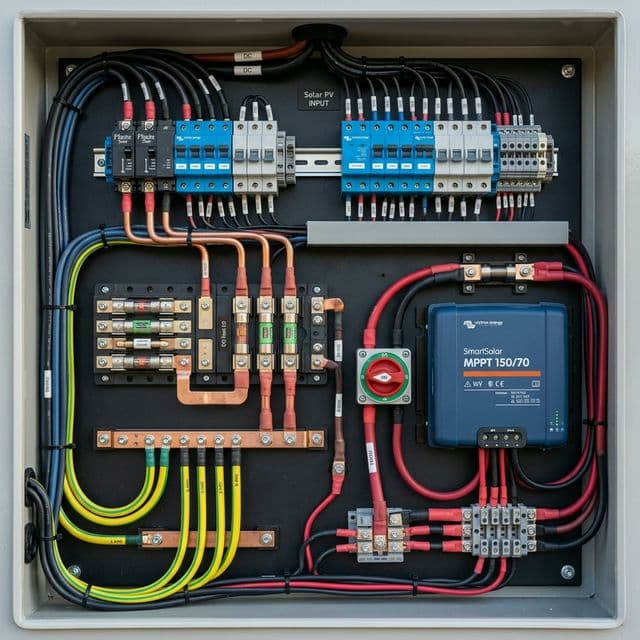
Top 10 RV Solar Mistakes: How to Avoid Burning Your Camper Down
The final word on solar safety: Fusing, grounding, and roof penetration best practices.

The Ultimate Guide to Portable Solar Panels for Van Life (2026 Edition)
technical deep-dive into portable solar technology, including N-Type and Bifacial cell innovations.