Budget Box Truck Build: Professional Carpet Installation Secrets

The 2026 Solar-Powered Nomad: Physics, Trends & Socio-Economic Revolution
Examining the 2026 RV solar landscape through the lens of a budget box truck conversion reveals a critical synthesis: the democratization of off-grid living is no longer driven by cost alone, but by unprecedented gains in photovoltaic efficiency, next-generation battery chemistry, and a fundamental socio-economic shift towards energy-autonomous mobility. This analysis decouples the physics from the hype, projecting the tangible impact of GaN, Sodium-Ion, and Perovskite technologies on the nomadic builder.
As we stand in 2026, the concept of the recreational vehicle has undergone a silent but profound metamorphosis. It is no longer merely a vehicle for leisure but has emerged as a primary vessel for energy-independent living, remote work, and sustainable mobility. This shift is catalysed not by luxury, but by necessity and innovation. The archetype of the modern nomad is increasingly mirrored in builds like the referenced '$4000 30-year-old box truck'—a paradigm where 'poor' and 'quick' are not constraints, but design philosophies that prioritize function and accessibility. Within this context, solar energy transitions from an auxiliary convenience to the absolute cornerstone of the system's viability.
The technical landscape of RV solar in 2026 is defined by a convergence of factors: the maturation of high-efficiency cell technologies trickling down from the utility-scale market, a radical rethinking of energy storage beyond lithium, and the miniaturization of power electronics. This article will dissect these trends, grounding them in the fundamental physics that govern energy harvest and consumption in a mobile, space-constrained environment. We will move beyond simplistic component lists to explore how the interplay between photovoltaic physics, battery electrochemistry, and socio-economic drivers is forging a new era of off-grid capability, making robust energy independence achievable even within the framework of a budget-conscious, rapid deployment build.
I. The Physics of Photovoltaic Harvest in a Mobile Environment
The efficacy of an RV solar system is not measured in watts-peak (Wp) on a datasheet, but in consistent watt-hours delivered to the battery bank under real-world, suboptimal conditions. This delta between laboratory rating and on-road performance is governed by immutable physical laws.
1.1 The Angle of Incidence & Spectral Response
The photovoltaic effect is maximised when photons strike the semiconductor junction at a perpendicular angle. On a stationary roof, this is a fixed compromise. On a vehicle, the angle of incidence changes constantly with travel direction, time of day, and parking orientation. Monocrystalline silicon cells, the 2026 mainstream standard for high-end mobile applications, have a spectral response peak in the near-infrared. However, morning/evening light and diffuse light on cloudy days are richer in blue wavelengths, where their response is lower. This explains the critical importance of over-sizing the array in a budget build—a 400W array may only yield a 250W average harvest across a typical day of mixed conditions and non-ideal positioning.
1.2 Thermal Coefficients & The Rooftop Heat Sink
A rarely discussed but critical factor is the negative temperature coefficient of power for silicon cells. For every degree Celsius above 25°C (STC rating temperature), panel output drops by approximately -0.3% to -0.5%. A dark RV roof in direct summer sun can elevate panel temperatures to 70°C+, incurring a 13-22% power loss. Physics dictates two mitigation strategies: active airflow under the panel (a raised mounting system, as seen in many professional van builds) and selecting panels with a superior temperature coefficient. This is a direct trade-off for the budget builder: cheaper panels often have poorer coefficients and are mounted flat, silently sacrificing peak performance.
II. The 2026 Component Ecosystem: From Silicon to Socket
2.1 Solar Panels: Monocrystalline, Polycrystalline, and The Perovskite Horizon
The market stratification is clear. Monocrystalline (mono) panels, with efficiencies now routinely above 22% for tier-1 manufacturers, dominate the space-constrained RV roof. Their higher cost-per-watt is justified by higher yield per square metre. Polycrystalline panels remain a budget option for larger roofs (like a box truck) where space is less critical but cost is paramount.
Next-Gen Perspective: Perovskite Solar Cells.
As of 2026, perovskite-on-silicon tandem cells are transitioning from lab to limited commercial pilot lines. These cells stack a perovskite layer, excellent at capturing blue light, atop a silicon layer tuned for red/infrared, pushing theoretical efficiencies beyond 33%. For the nomad, the future promise is twofold: dramatically higher output from the same footprint, and the potential for lightweight, flexible panels that can conform to curved RV roofs. However, current challenges with long-term stability under UV exposure and humidity mean they are not yet a reliable choice for a full-time, mobile installation.
| Panel Type | Avg. Efficiency (2026) | Temp. Coefficient (%/°C) | Cost Index (per W) | Ideal RV Use Case |
|---|---|---|---|---|
| Monocrystalline | 22-24% | -0.30 to -0.35 | 1.0 (Baseline) | High-demand vans, limited roof space |
| Polycrystalline | 17-19% | -0.40 to -0.45 | 0.7 - 0.8 | Budget builds, box trucks with ample flat roof |
| PERC Monocrystalline | 24-26% | -0.29 to -0.32 | 1.2 - 1.4 | Premium builds maximizing harvest |
2.2 The Charge Controller: MPPT Dominance & GaN Revolution
Pulse Width Modulation (PWM) controllers are largely obsolete for all but the smallest systems. Maximum Power Point Tracking (MPPT) controllers, by employing DC-DC conversion, can often harvest 30% more energy than PWM, especially in non-ideal thermal and irradiance conditions. Their efficiency, typically 94-98%, is a key system multiplier.
Next-Gen Perspective: Gallium Nitride (GaN) FETs.
The silent revolution is in the semiconductor switches within these controllers. By 2026, GaN transistors are becoming standard in premium MPPTs. Compared to traditional silicon MOSFETs, GaN devices switch faster with significantly lower resistive losses. This translates to: 1) Higher efficiency (gains of 1-2%, crucial when every watt-hour counts), 2) Smaller size and weight due to reduced need for heat sinking, and 3) Higher possible switching frequencies, allowing for smaller, lighter magnetic components (inductors, transformers). For the nomad, this means more powerful controllers can be integrated into ever-smaller spaces with less self-consumption of precious harvested energy.
2.3 Energy Storage: The Lithium-Ion Hegemony & The Sodium-Ion Disruption
Lithium Iron Phosphate (LiFePO4) is the unequivocal standard for RV deep-cycle storage in 2026. Its safety profile, cycle life (3000+ cycles to 80% capacity), and tolerance for partial state-of-charge use make it ideal. The socio-economic impact is clear: while initial cost is higher than lead-acid, the total cost of ownership over the life of a vehicle build is lower, reinforcing its adoption in even budget-conscious plans.
Pros: LiFePO4 Dominance
- Longevity: 5-10x the cycle life of AGM.
- Depth of Discharge: Can routinely use 80-90% of rated capacity without damage.
- Efficiency: Charge/discharge efficiency >95%, minimizing solar waste.
- Weight & Space: 60% less weight and volume per kWh than lead-acid.
Cons & Emerging Challenges
- Upfront Cost: Still a significant barrier for ultra-low-budget builds.
- Battery Management System (BMS) Criticality: A single point of failure; quality is paramount.
- Supply Chain & Cobalt/Nickel: Ethical and geopolitical concerns around raw materials.
- Low-Temperature Charging: Requires internal heaters or management to charge below 0°C.
Next-Gen Perspective: Sodium-Ion (Na-Ion) Batteries.
By 2026, Sodium-Ion batteries have moved from research to early commercial production. Their chemistry, using abundant sodium instead of lithium, promises: 1) Lower material cost, 2) Improved safety (less thermal runaway risk), and 3) Better low-temperature performance. While their energy density by volume is currently lower than LiFePO4, their energy density by weight is competitive. For the nomadic builder, especially in a box truck with less space constraint, Na-Ion could become the ultimate budget-friendly, high-cycle-life battery within the next 3-5 years, further lowering the entry barrier to energy independence.
III. Socio-Economic Impact: Redefining "Affordable" Mobility
The proliferation of advanced, yet increasingly affordable, solar technology is not just changing RVs; it's reshaping demographics and labour mobility. The '$4000 box truck' archetype is a microcosm of this shift.
3.1 The Decoupling from Fixed Infrastructure
Reliable solar power, coupled with Starlink-class satellite internet, has severed the tether to traditional RV parks and campgrounds. This "boondocking" capability translates directly to significant monthly cost savings (often $500-$1500+), redirecting funds towards vehicle upgrades, travel, or savings. It enables a professional class—digital nomads, remote consultants, content creators—to maintain high productivity from truly remote locations, merging a lower cost of living with a high-quality lifestyle. The economic model of nomadic living shifts from one of compromise to one of strategic advantage.
3.2 The DIY Ethos & Knowledge Democratization
Platforms showcasing builds, from high-end Sprinters to budget box trucks, have created a global knowledge commons. The complexity of integrating a modern solar system has been mitigated by modular, consumer-friendly components with standardised connectors and Bluetooth-enabled monitoring. This democratisation of technical knowledge lowers the barrier to entry, empowering individuals to undertake their own conversions. The socio-economic result is an asset-based approach to housing and travel—the vehicle is both home and a user-maintainable, depreciating asset, contrasting with the non-recoverable cost of rent.
3.3 Environmental Consciousness as Economic Driver
The choice for solar is increasingly driven by a convergence of environmental and economic factors. Reducing generator use saves on fuel costs and maintenance while minimizing noise and emissions—a benefit to the individual and the communal boondocking environment. This creates a positive feedback loop: consumer demand for more efficient solar products drives industry R&D, which yields better products, further accelerating adoption. The nomadic community becomes an early adopter market and a proving ground for distributed renewable energy technologies.
IV. Synthesis for the 2026 Builder: A Strategic Framework
For the individual embarking on a build—whether a $400,000 coach or a $4,000 box truck—the 2026 solar landscape offers unprecedented opportunity but requires strategic planning grounded in physics and economics.
4.1 The Hierarchy of Investment
The most effective system design follows a cascading priority: 1) Energy Efficiency First (LED lighting, efficient 12V DC appliances, high-insulation), 2) Accurate Consumption Audit, 3) Battery Bank Sizing to cover daily needs with appropriate depth of discharge, 4) Solar Array Sizing to reliably recharge the bank in an average day of poor light, and 5) Controller and Inverter Selection to match. Neglecting this hierarchy leads to overspending on solar to compensate for inefficient loads.
4.2 The Budget Build Philosophy
Referencing the '$4000 box truck' ethos, the strategic approach is to allocate funds where they yield the most long-term reliability and safety. This often means: investing in a quality, name-brand LiFePO4 battery and MPPT controller from the outset, while potentially saving on panels (using reputable but less expensive polycrystalline) and by self-fabricating mounts and wiring. The battery and brain are the heart of the system; compromising here leads to frustration and early replacement costs.
V. Conclusion: Autonomy as the Ultimate Currency
The evolution of RV solar technology by 2026 represents far more than incremental product improvements. It is the enabling engine for a broad socio-economic movement towards flexible, sustainable, and empowered living. The physics of photovoltaics, the chemistry of next-generation batteries, and the economics of total cost of ownership are aligning to make energy independence a realistic goal across a wide financial spectrum. From the minimalist box truck builder to the luxury coach owner, the common thread is the valuation of autonomy—the ability to generate one's own power, control one's own environment, and navigate the world untethered. This shift, powered literally and metaphorically by the sun, is redefining the very concept of home, mobility, and freedom in the 21st century. The future nomadic build will not ask "if" it can go off-grid, but "for how long," with the answer stretching ever further thanks to the silent, relentless harvest of light.
Technical Expansion
Deepen your expertise with our most critical recent diagnostic reports.
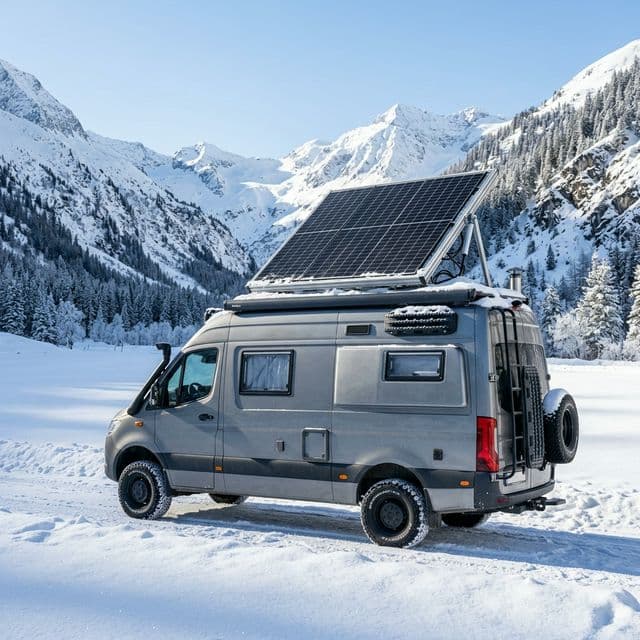
Winter RVing & Lithium: Survival Guide for Freezing Temps
Technical guide to lithium plating, battery heaters, and low-angle winter solar harvesting.
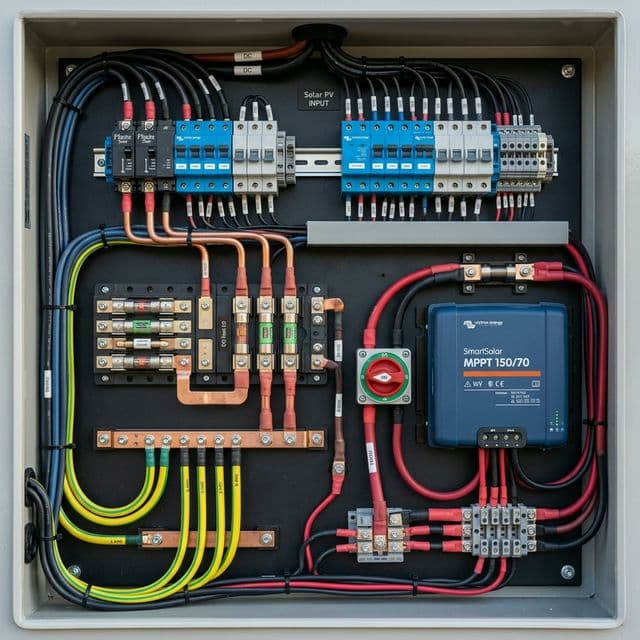
Top 10 RV Solar Mistakes: How to Avoid Burning Your Camper Down
The final word on solar safety: Fusing, grounding, and roof penetration best practices.
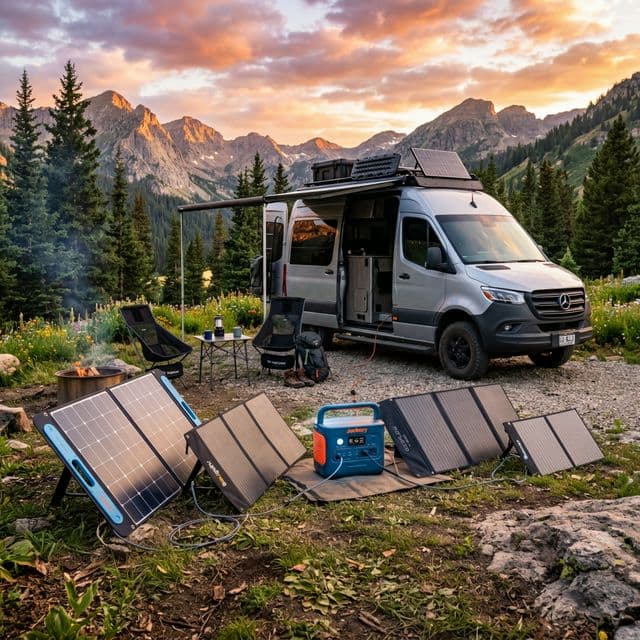
The Ultimate Guide to Portable Solar Panels for Van Life (2026 Edition)
technical deep-dive into portable solar technology, including N-Type and Bifacial cell innovations.