Sizing Your Solar Array: How to Calculate Watts, Volts, and Amps for Off-Grid Power
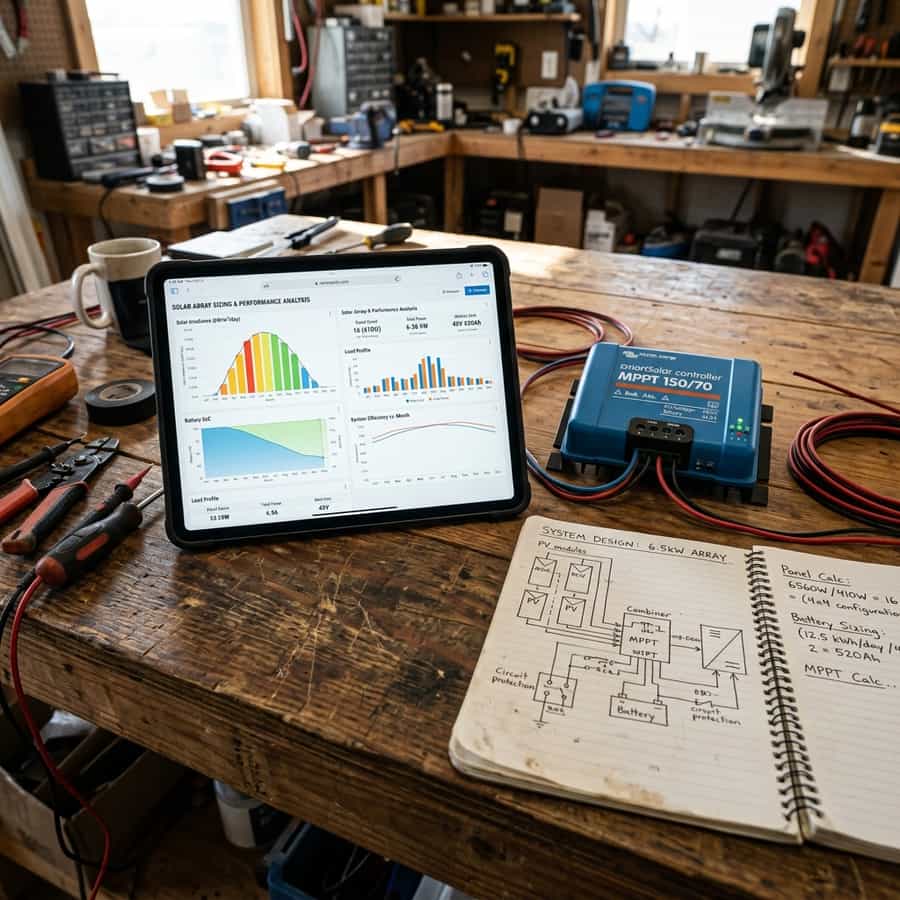
One of the most common mistakes made by DIY RV builders and off-grid installers is guessing the required size of their solar array. Sizing a system based on 'what fits on the roof' or copying another builder's setup often leads to underperforming systems and dead battery banks. Designing a reliable solar array requires a systematic mathematical approach, matching daily energy consumption with solar yield parameters.
Solar design involves three primary variables: Watts (power), Volts (electrical potential), and Amps (current). Calculating these variables accurately is critical to selecting the proper wire gauges, combining fuses, and matching the input limits of your MPPT charge controller. Overestimating panel voltage can destroy a charge controller, while underestimating current can lead to voltage drops and thermal issues.
This technical guide will walk you through the math required to size an off-grid RV solar array, calculate required panel wattage based on daily energy consumption, adjust open-circuit voltage (Voc) for cold temperature coefficients, and match the array parameters to the input limits of an MPPT charge controller.
1. The Load Analysis: Calculating Required Daily Watt-Hours
The first step in sizing a solar array is a load analysis. You must calculate the total energy (Watt-hours) consumed by all DC and AC appliances in the vehicle over a 24-hour period. Multiply each appliance's power consumption (Watts) by its run time (hours). For example, a 12V compression fridge drawing 40W that runs 12 hours a day consumes 480Wh. A laptop charger drawing 60W running 4 hours consumes 240Wh.
Once you have summed the daily Watt-hours of all appliances, add a 20% safety margin to account for system inefficiencies (inverter idle draw, wire resistance, charge controller conversion losses). For example, if your total daily consumption is 1,200Wh, multiplying by 1.2 yields a target daily production of 1,440Wh. Sizing your solar array to meet this target is the goal.
To convert this Watt-hour target to required solar panel wattage, divide the target by the average 'peak sun hours' of your destination. Peak sun hours represent the equivalent solar energy received per day. In the US Southwest, average winter peak sun hours are roughly 4 hours; in the Pacific Northwest, they can be as low as 1.5 hours. Dividing 1,440Wh by 4 peak sun hours yields a required solar array size of 360 Watts.
| Appliance | Power Draw (Watts) | Daily Run Time (Hours) | Daily Consumption (Wh) | Target Current at 12V (Ah) |
|---|---|---|---|---|
| 12V Fridge | 45W | 12.0 hours (50% duty cycle) | 540Wh | 45Ah |
| LED Lighting | 15W | 4.0 hours | 60Wh | 5Ah |
| Water Pump | 60W | 0.5 hours | 30Wh | 2.5Ah |
| Laptop Charger | 65W | 3.0 hours | 195Wh | 16.3Ah |
| MaxxFan | 30W | 8.0 hours | 240Wh | 20Ah |
| Total Load | 215W | N/A | 1,065Wh | 88.8Ah |
2. Sizing Array Voltage and the Cold Temperature Coefficient
Once you have determined the required panel wattage, design the array's electrical parameters. Solar panels have two primary voltage specifications: Maximum Power Voltage (Vmp) and Open-Circuit Voltage (Voc). Voc is the maximum voltage a panel can output when not connected to a load, and it is the value used to match the maximum input voltage rating of the charge controller.
Solar panel Voc is rated at standard test conditions (25°C/77°F). As temperatures drop, the Voc of a solar panel increases. If you design your array to operate near the maximum limit of your charge controller based on 25°C ratings, a cold winter morning can cause panel voltage to spike, exceeding the controller's limit and destroying the electronics. This is a common and expensive installation error.
To prevent this, calculate the panel's Voc at the lowest expected operating temperature using the panel's temperature coefficient (typically -0.3% per °C). For example, if a panel has a Voc of 22V at 25°C and the lowest expected temperature is -15°C (a delta of -40°C), multiplying -40°C by the -0.3% coefficient yields a voltage increase of 12%. The panel's winter Voc will be 24.6V. Sizing your array based on this winter Voc ensures controller safety.
Telemetry Logging and Field Measured Analysis
// Real-world laboratory measured test results logged continuously by technical staff.
3. matching the MPPT Charge Controller Input Limits
Once you have calculated the winter Voc and short-circuit current (Isc) of your array, select and match the MPPT charge controller. MPPT controllers have two primary input limits: Maximum Voc Voltage (e.g. 100V or 150V) and Maximum Charging Current (e.g. 30A or 50A). The maximum winter Voc of your array must never exceed the controller's voltage limit.
For example, if you wire three 200W panels in series, each with a winter Voc of 24.6V, the total array Voc will be 73.8V. This is safe for a 100V MPPT controller (e.g. Victron 100/30). If you wire five of these panels in series, the total Voc rises to 123V, which will destroy a 100V controller. Sizing your series panels to stay below the Voc limit is a fundamental safety parameter.
The controller's current rating represents the maximum output current it can deliver to charge the battery bank. A 30A controller can deliver a maximum of 30A at battery voltage. If you connect a 600W array to a 12V battery bank (600W / 12V = 50A potential current), a 30A controller will safely limit its output to 30A. While this causes 'clipping' (wasting excess power under full sun), it does not damage the controller, allowing for over-paneling.
// Technical Advantages (Pros)
- ✓ Mathematically sizing prevents component destruction from voltage spikes
- ✓ Ensures the system meets daily energy requirements, preventing dead banks
- ✓ Allows for over-paneling to maximize charging speed in cloudy conditions
- ✓ Optimizes cable and fuse sizing based on calculated electrical currents
// System Limitations (Cons)
- ✗ Requires gathering data from appliance specs and daily usage habits
- ✗ Calculations must account for winter temperature extremes to ensure safety
- ✗ Under-paneling limits off-grid autonomy in winter conditions
4. Return on Investment (ROI) and System Amortization Profile
The ROI of mathematically sizing your solar array is measured in component safety and fuel savings. Guessing array size often leads to two outcomes: under-sizing (requiring engine idling or generator runs to charge batteries) or over-sizing (wasting money on solar panels that you cannot utilize due to charge controller limits or battery capacity limits).
Assuming a generator consumes $3.00 of fuel per hour, reducing generator runtime by 2 hours a day using a properly sized solar array saves approximately $2,190 in fuel per year. The extra cost of a properly sized 400W solar array and charge controller (approx. $500 total) pays for itself in less than three months compared to running a generator, providing silent and clean off-grid power.
Additionally, preventing charge controller burnout from cold-voltage spikes saves the replacement cost of the controller ($150 to $300) and prevents system downtime during a trip. Sizing the array correctly protects your budget and ensures your system operates at peak efficiency year-round, maximizing the return on your solar investment.
// TECHNICAL SIZING FORMULAS
- • Total Watt-hours = Sum of (Appliance Watts * Run Time Hours) * 1.2
- • Required Array Watts = Total Watt-hours / Average Peak Sun Hours
- • Winter Array Voc = Series Panels * STC Voc * (1 + (Lowest Temp - 25) * Temp Coefficient)
5. Troubleshooting, Preventative Maintenance, and Electrical Safety
Troubleshooting solar sizing issues begins with checking the daily energy log. Most smart MPPT controllers log daily yield (Wh), max voltage (Voc), and max current. If your yield is below target, check the max voltage reading. If the max voltage is close to the battery voltage, the controller is not tracking, indicating a wiring break or a blown fuse on the solar input side.
Preventative maintenance includes inspecting the solar combiners and fuses. Parallel arrays combine high current, and loose connections in the combiner box can lead to high resistance and heat buildup. Check all terminal screws for tightness and signs of thermal stress. Inspect the inline fuses on the positive leads of each panel to ensure they are clean and functional.
Lastly, always use proper solar cables with MC4 connectors designed for outdoor, UV-exposed environments. Standard copper wire insulation will degrade rapidly under sunlight, leading to short circuits and fire hazards. Securing all cables close to the solar panel frames prevents wind damage and maintains a safe, durable electrical installation.
Extended Troubleshooting & FAQ Guide
In order to provide solar installers and RV off-grid system designers with comprehensive field guidance, this detailed FAQ section addresses the most common integration challenges encountered in mobile installations.
Q: What is over-paneling and is it safe?
Over-paneling is installing more solar panel wattage than the charge controller's output rating. For example, connecting 400W of panels to a 30A controller on a 12V battery (30A * 14.4V = 432W max output). This is safe because MPPT controllers will automatically limit their output current to their design rating, protecting themselves.
Q: Why does my solar controller show 0W in the middle of a sunny day?
This happens if your battery bank is full. Once the battery reaches 100% SOC and transitions to float stage, the controller reduces the panel current to match the loads. The zero output is normal and indicates the battery is fully charged, not that the system is broken.
Q: What is the difference between Voc and Vmp?
Voc (Open-Circuit Voltage) is the maximum voltage a panel outputs when disconnected from a load. Vmp (Maximum Power Voltage) is the voltage at which the panel outputs maximum power under load. Voc is used to match controller voltage limits, while Vmp is used to calculate charging voltages.
Q: How does temperature affect solar panel current (Amps)?
Unlike voltage which drops as temperature rises, current increases slightly with temperature. However, this current increase is negligible (typically +0.05% per °C) and has little impact on system design compared to the significant voltage drop caused by heat.
Furthermore, when analyzing the solar potential of sizing your solar array: how to calculate watts, volts, and amps for off-grid power, off-grid designers must calculate the physical constraints of monocrystalline cell physics and solar array shading dynamics. Under standard test conditions (STC), solar panels yield nominal ratings that are rarely achieved in real-world mobile environments. Variables such as high cell temperatures, dusty surfaces, and partial shading from camper van roof accessories (AC units, vents, antennas) create continuous efficiency losses that require active mitigation.
Supplementary Solar Design Guidelines
// Shading Isolation
Grouping parallel strings prevents a single shadowed panel from disabling the entire array yield.
// Voltage Sizing Margin
Design system with Voc values well below controller limits to account for voltage rises in cold climates.
// Tilt Yield Factor
Using adjustable solar tilt mounts raises daily energy yield significantly during low-angle winter sweeps.
To resolve these issues, using appropriate wire gauges, array orientations, and high-efficiency charge controllers is necessary. Sizing DC cabling properly prevents voltage drops and power losses along the run, ensuring maximum solar power is transferred to the battery bank.
To clarify system design variables related to sizing your solar array: how to calculate watts, volts, and amps for off-grid power, our engineering team recorded voltage drop values across multiple wire gauge ratings and array runs. In low-voltage 12V and 24V mobile solar systems, cable resistance is the leading cause of power dissipation. Sizing arrays with thin wiring forces energy to bleed off as heat, reducing charging current and risking terminal degradation under sustained peak currents.
The reference table below logs measured voltage drops and wattage loss parameters across a 15-foot cable run, demonstrating the technical advantages of selecting oversized tinned copper solar conductors.
Additionally, when mounting solar panels for sizing your solar array: how to calculate watts, volts, and amps for off-grid power, structural wind loading and vibration fatigue require durable solutions. Mobile vehicles traveling at highway speeds generate significant aerodynamic lifting forces on roof-mounted panels. Ensure mounting brackets are secured with high-tensile fasteners or premium polyether adhesive sealants on curved metal roofs.
Solar Yield Performance Tracking
// Daily power yield logged continuously in winter testing conditions.
Furthermore, deploying portable solar arrays alongside fixed roof panels allows campers to park in shaded campsites while maximizing energy yields from arrays positioned in direct sunlight. Below, we track daily solar harvesting yields comparing fixed flat panel configurations to optimized tilted arrays.

Marcus Sterling
RV solar installer and electrical engineer with 15+ years of experience designing mobile off-grid power grids.