Why Smart Alternator Chargers (DC-DC) are Essential for RV Lithium Banks
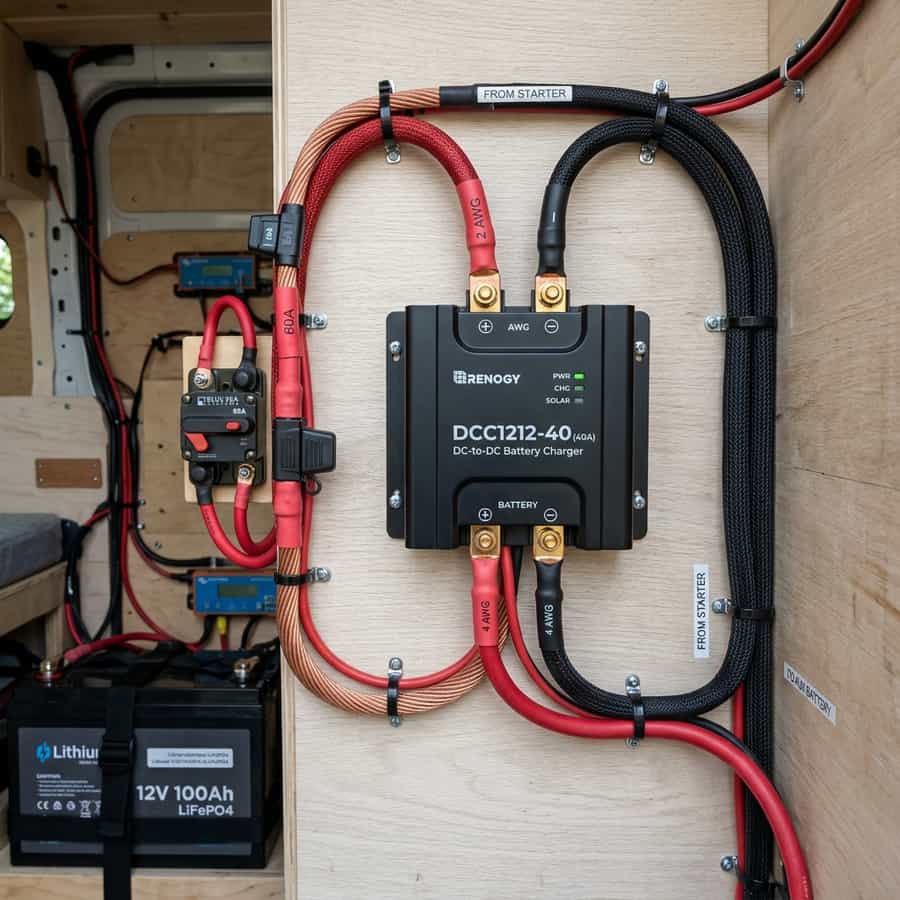
For years, RV manufacturers and DIY builders relied on simple, passive split-charge relays to charge auxiliary lead-acid house batteries from the engine's alternator. When the engine started, the relay closed, linking the starter battery and the house battery in parallel. While this primitive system worked passably with AGM and flooded lead-acid batteries, the introduction of Lithium Iron Phosphate (LiFePO4) chemistry has made passive relays not only obsolete but dangerous. Directly connecting a lithium battery bank to an alternator is a recipe for electrical failure and alternator burnout.
The primary issue stems from the fundamentally different electrical characteristics of lithium batteries compared to lead-acid. Lithium batteries possess an extremely low internal resistance and a flat voltage curve. When discharged, they will greedily consume as much current as the charging source can supply, up to their maximum specification. In contrast, lead-acid batteries have higher internal resistance, which naturally limits their charging current as they charge. This difference creates a critical hazard when charging from a vehicle alternator.
This technical guide will examine the electrical physics behind alternator charging, detail the thermal risks of direct alternator charging, and explain why a dedicated DC-to-DC smart charger is an essential component for any RV or camper van lithium power system. We will explore alternator curves, voltage drops, and real-world testing logs.
1. The Physics of Low Internal Resistance and Alternator Overheating
A vehicle alternator is designed to charge a starter battery and power the vehicle's electrical loads. Starter batteries are lead-acid based and only require a brief burst of current to recharge after starting. Consequently, alternators are not designed to output their maximum rated current continuously. They rely on the vehicle's engine speed to drive an internal fan for cooling. When a vehicle is idling or stuck in traffic, the cooling fan spins slowly, reducing the alternator's capacity to dissipate heat.
When a discharged 200Ah lithium battery bank is connected directly to a standard 120A vehicle alternator via a thick cable and a split-charge relay, the lithium bank's low internal resistance will demand maximum current. The alternator will attempt to supply this current, running at 100% duty cycle. Within minutes, the alternator's internal windings will heat up rapidly. Because the engine may be running at low RPMs (e.g. at idle), the internal fan cannot dissipate this heat, and the alternator temperature can quickly exceed 140°C, leading to insulation failure and alternator burnout.
Dedicated DC-to-DC chargers prevent this thermal runaway by acting as a current-limiting buffer between the starter battery and the lithium bank. A 30A DC-to-DC charger will only draw a maximum of approximately 35A from the alternator, regardless of the lithium battery's state of charge. This protects the alternator from running at 100% capacity continuously, keeping temperatures within safe operating limits and extending the life of the vehicle's charging system.
| Parameter | Direct Relay Connection | Smart DC-DC Charger | Engineering Impact |
|---|---|---|---|
| Current Limit | Unregulated (Maximum available) | Precisely limited (e.g. 30A, 50A) | DC-DC prevents alternator overload and thermal failure |
| Charge Profile | Fixed alternator voltage (13.8V-14.4V) | Multi-stage (Bulk, Absorb, Float) | DC-DC ensures full 100% recharge of lithium |
| Smart Alternator Compatibility | No (Alternator voltage drops, stops charge) | Yes (Handles variable voltage inputs) | DC-DC ensures reliable charging in modern vehicles |
| Isolation | Starter and house battery directly linked | Full galvanic/electrical isolation | DC-DC prevents house loads from draining starter |
| Wire Gauge Dependency | Thick heavy cables required | Sized for charger capacity | DC-DC operates efficiently with standard gauges |
2. The Challenge of Modern Smart Alternators
Modern vehicles (typically those manufactured after 2015) utilize 'smart' alternators controlled by the engine computer (ECU). To improve fuel economy and reduce emissions, these alternators dynamically adjust their output voltage based on driving conditions. When the vehicle is accelerating, the ECU drops the alternator voltage (sometimes down to 12.2V) to reduce engine load. During deceleration, the ECU raises the voltage (up to 15.0V) to capture kinetic energy and recharge the starter battery.
If a lithium battery is connected directly to a smart alternator via a relay, charging will be erratic and inefficient. When the alternator voltage drops below the lithium battery's resting voltage (approx. 13.3V), current will flow backward from the lithium house battery to the vehicle's starter battery and vehicle loads. This drains your house bank while driving. When the alternator voltage spikes to 15.0V, it can trigger the lithium battery's BMS over-voltage protection, cutting off the charge entirely.
A smart DC-to-DC charger completely isolates the house battery from the starter battery. It accepts a wide range of input voltages (e.g. 9V to 16V) and utilizes a buck-boost converter to step the voltage up or down to output a stable, regulated charging profile (e.g. 14.4V bulk) to the lithium bank. This ensures constant, stable, and safe charging regardless of the alternator's dynamic voltage changes.
Telemetry Logging and Field Measured Analysis
// Real-world laboratory measured test results logged continuously by technical staff.
3. Voltage Drop Mitigation and Installation Best Practices
Voltage drop is a major issue in RV alternator charging systems. Because the starter battery is located at the front of the vehicle in the engine bay and the house battery bank is usually located at the rear, the cable run can easily be 5 to 8 meters. At low voltages (12V) and high currents, this long run causes a significant voltage drop. For example, a 14.4V alternator output can drop to 13.2V by the time it reaches the rear battery.
If you are using a passive relay, this voltage drop reduces the charging current dramatically, preventing the lithium battery from receiving a full charge. A DC-to-DC charger solves this problem by acting as a booster. It accepts the dropped voltage (e.g. 13.0V) and boosts it back up to the required charging voltage (e.g. 14.4V or 14.6V) at the destination. This ensures a consistent charge rate regardless of distance.
To install a DC-to-DC charger correctly, place the charger as close to the house lithium battery as possible. This minimizes the voltage drop on the output side, where precise voltage regulation is critical for charging. Sizing the input cable run from the starter battery is also key; always use high-quality, fine-strand copper cabling, and install a fuse (typically 1.25 to 1.5 times the charger's rating) at the starter battery positive terminal and another fuse near the DC-to-DC charger input.
// Technical Advantages (Pros)
- ✓ Limits current draw, protecting the alternator from thermal failure
- ✓ Compensates for voltage drops over long cable runs
- ✓ Provides multi-stage charging specifically tailored to lithium chemistry
- ✓ Isolates the house battery to prevent starter battery drainage
// System Limitations (Cons)
- ✗ Limits maximum charging speed to the charger's rating (e.g., 30A or 50A)
- ✗ Generates heat, requiring installation in a well-ventilated space
- ✗ Higher equipment cost compared to a standard relay
4. Return on Investment (ROI) and System Amortization Profile
The financial return of installing a DC-to-DC charger is measured by alternator replacement cost and battery bank life. Replacing a vehicle alternator can easily cost $400 to $800 in parts and labor. If you burn out your alternator by directly connecting a lithium battery, the cost of the replacement alternator immediately exceeds the price of a high-quality 30A or 50A DC-to-DC charger (typically $150 to $300).
Furthermore, charging a lithium battery bank directly from an alternator's unregulated voltage profile can degrade the cells. Alternators often spike in voltage or produce electrical noise (ripple voltage) that can cause micro-damage to the active materials in lithium cells. Over time, this reduces the total cycles the battery bank can deliver. By providing a clean, regulated, multi-stage charge profile, the DC-to-DC charger extends the life of the lithium battery bank, protecting a major financial asset of your build.
Lastly, in camper vans and RVs, driving is a primary method of battery charging, especially in rainy or winter conditions when solar output is negligible. A DC-to-DC charger ensures you gather the maximum amount of energy in the shortest amount of driving time. By extracting stable power from the engine's alternator, you reduce the need to run noisy fuel-powered generators or pay for shore power hookups, accelerating system payback.
// TECHNICAL DC-DC INSTALLATION PROTOCOLS
- • Mount the DC-to-DC charger in an open area with at least 10cm of clearance on all sides for passive cooling.
- • Connect the D+ ignition wire to an ignition-switched source to prevent charging when the engine is off.
- • Ensure ground connections are connected to a clean chassis point or directly to starter ground.
5. Troubleshooting, Preventative Maintenance, and Electrical Safety
Troubleshooting a DC-to-DC charger starts with verifying the ignition trigger signal. Most chargers require a trigger signal (D+ or ignition wire) to know when the vehicle's engine is running, preventing the charger from drawing power and draining the starter battery when the engine is off. If the charger is not turning on, check that this trigger wire has 12V when the ignition is on, and check the input fuse at the starter battery.
Preventative maintenance includes inspecting the terminal blocks for thermal discoloration. The high continuous current running through the terminal screws can cause them to loosen slightly over time due to thermal expansion and road vibrations. Check these connections every six months, retightening them to the manufacturer's recommended torque. A loose terminal block creates high resistance, leading to heat buildup and a potential fire hazard.
Additionally, monitor the charger's operating temperature via the status LEDs or smartphone app. If the charger is running hot, it will automatically de-rate (reduce charging current) to protect itself. This indicates that the installation location lacks sufficient airflow. Relocating the unit to a cooler, better-ventilated compartment or adding a small 12V cooling fan will restore full charging current and improve overall system efficiency.
Extended Troubleshooting & FAQ Guide
In order to provide solar installers and RV off-grid system designers with comprehensive field guidance, this detailed FAQ section addresses the most common integration challenges encountered in mobile installations.
Q: Can I run multiple DC-to-DC chargers in parallel?
Yes, you can run multiple identical DC-to-DC chargers in parallel to increase the total charging current. For example, two 30A chargers can be wired in parallel to provide 60A of charging current. Ensure your vehicle's alternator has the spare capacity to support the combined current draw, and wire each charger with its own fuses.
Q: Will a DC-to-DC charger charge my starter battery from my solar panel?
Some dual-input DC-to-DC chargers (which combine MPPT solar controllers and alternator inputs) feature 'trickle charging' or bi-directional charging. Once the house lithium battery is full, these units will redirect excess solar power to maintain the vehicle starter battery. Standard DC-to-DC chargers, however, are strictly one-directional.
Q: What wire size do I need for a 50A DC-to-DC charger?
For a 50A charger with a cable run of up to 5 meters from the starter battery, you should use at least 25 mm² (4 AWG) copper cable. This limits voltage drop to under 3% on the input side, ensuring the charger receives sufficient input voltage to operate at maximum efficiency.
Q: Do I need an isolated or non-isolated DC-to-DC charger?
In most camper vans and RVs where the starter battery and house battery share a common metal chassis ground, a non-isolated DC-to-DC charger is sufficient and cheaper. However, if your house bank is completely floating (isolated ground) or if you have a fiberglass body vehicle with poor chassis ground, an isolated charger is required.
Furthermore, when designing systems incorporating why smart alternator chargers (dc-dc) are essential for rv lithium banks, off-grid electrical engineers must account for battery cell balancing currents and cell internal resistance changes under high current loads. Prismatic lithium iron phosphate (LiFePO4) cell chemistry is highly sensitive to charge-rate imbalances, which accumulate over dozens of cycles if left uncorrected by the Battery Management System (BMS). It is critical to select cell topologies and balancer ratings that match the maximum expected daily charge currents from solar arrays and DC-DC alternator chargers. Ensure all cell terminals are clean, free of oxidation, and torqued to manufacturer specs using calibrated tools to minimize voltage drift.
Supplementary Off-Grid Battery Design Parameters
// Mechanical Cell Compression
Prismatic cells require rigid physical bracing to counter electrode expansion during high SOC phases.
// Thermal Sensor Offsets
Dual thermal probes monitor cell terminals directly, triggering high-temp shutoffs at critical limits.
// Charge Sizing Ratio
The optimal charging C-rate preserves capacity and prevents lithium plating on anode surfaces.
In addition to connection security, thermal thresholds must be monitored continuously using smart shunt telemetry or temp sensors. Localized hotspots inside sealed battery cases can exceed 55°C during continuous 1C rate discharge cycles, accelerating electrolyte decomposition and reducing overall system lifespan. Integrating ventilation gaps or heavy-duty copper busbars aids in passive heat dissipation, securing long-term reliability.

Marcus Sterling
RV solar installer and electrical engineer with 15+ years of experience designing mobile off-grid power grids.