The Complete Guide to AGM vs. LiFePO4 for Cold Climate Off-Grid Setup
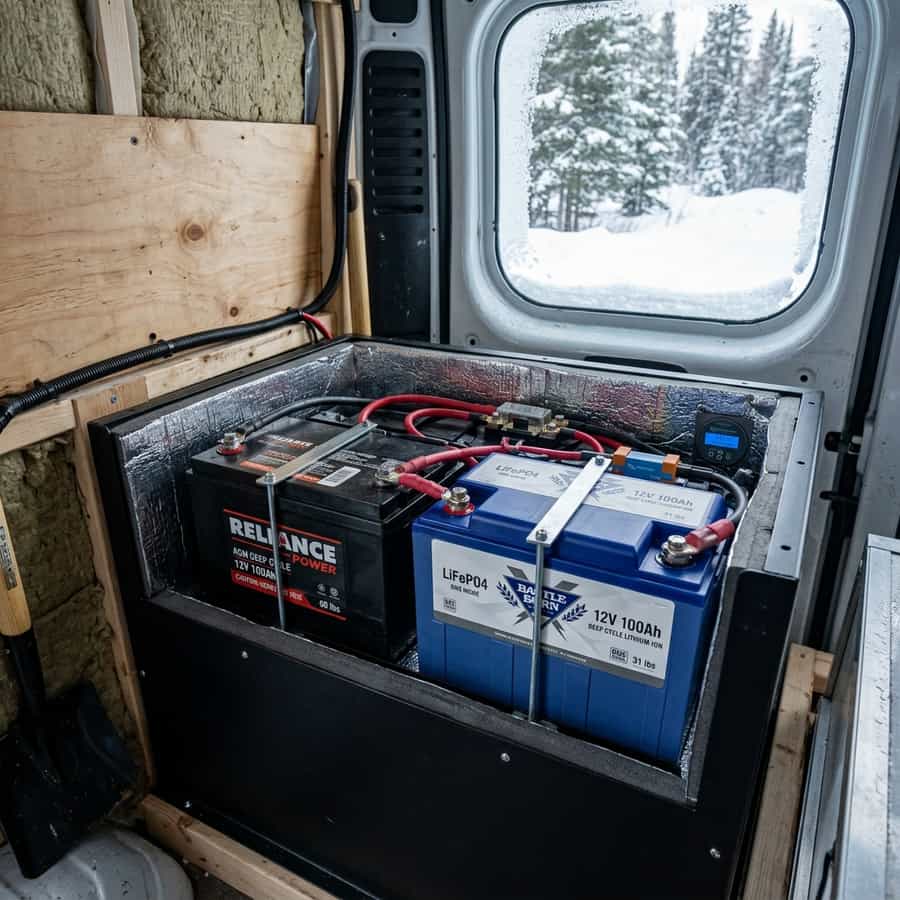
Off-grid adventurers and winter vanlifers face a unique set of challenges when temperatures drop. While solar panels actually become more efficient in cold weather, battery chemistries perform significantly worse. The chemical reactions that allow batteries to store and release energy slow down as the temperature drops, affecting discharge capacity, internal resistance, and charging safety. For cold-climate installations, choosing the right battery chemistry is a critical decision.
For years, Absorbed Glass Mat (AGM) lead-acid batteries were favored for winter cabins and camper vans because of their tolerance to cold-weather charging. AGM batteries can be charged at temperatures down to -20°C (-4°F) without damage. However, Lithium Iron Phosphate (LiFePO4) batteries have become the new off-grid standard, boasting higher energy density, longer lifespans, and flat discharge curves. But lithium chemistry possesses a critical weakness: charging a lithium cell below freezing (0°C/32°F) can destroy it in just a few cycles.
This technical guide will compare the behavior of AGM and LiFePO4 batteries in sub-zero environments, analyze capacity degradation curves, explore the physics of low-temperature lithium charging, and outline the design parameters for installing a reliable cold-climate battery system.
1. The Chemical Physics of Cold-Weather Battery Degradation
In AGM batteries, cold temperatures increase the viscosity of the sulfuric acid electrolyte and slow down the diffusion of ions. This dramatically increases the battery's internal resistance. The practical result is that the voltage under load drops much faster, triggering low-voltage disconnects prematurely. In sub-zero temperatures (-20°C), a standard 100Ah AGM battery can lose up to 50% of its usable capacity when discharged at moderate rates, meaning you are carrying heavy, expensive lead-acid weight that you cannot utilize.
In contrast, lithium batteries are much less affected on the discharge side. A LiFePO4 battery will still deliver up to 80% to 90% of its rated capacity at -20°C, and its voltage curve remains stable. However, the critical danger occurs on the charging side. At temperatures below freezing, the carbon anode in a lithium cell cannot easily absorb lithium ions during charging. Instead, the ions accumulate on the surface of the anode, forming metallic lithium plating. This plating is permanent, increases internal resistance, and can grow dendritic structures that pierce the cell separator, causing an internal short circuit and fire hazard.
BMS units in modern lithium batteries incorporate a low-temperature charge cutoff to block charging current when cell temperatures drop below 0°C. While this protects the battery from damage, it presents a problem for off-grid systems: if the battery is cold, it cannot accept charge from solar or alternator sources, rendering your system powerless once the existing capacity is depleted.
| Parameter | AGM Lead-Acid Battery | LiFePO4 (Standard) | LiFePO4 (Self-Heating) |
|---|---|---|---|
| Charging Temp Limit | Down to -20°C (-4°F) | 0°C (32°F) | Down to -20°C (-4°F) (Via heaters) |
| Usable Capacity at -20°C | 50% of nominal rating | 80% - 90% of nominal rating | 90% - 95% of nominal rating |
| Internal Resistance rise | Very High (Severe voltage sag) | Moderate | Low (Internal heater warms cells) |
| Lifespan in Cold Cycles | 200 - 400 cycles | 1500+ cycles | 3000+ cycles |
| Self-Discharge Rate | 5% - 15% per month | 1% - 3% per month | 1% - 3% per month |
2. The Engineering Solution: Self-Heating Lithium Batteries
To overcome the low-temperature charging limit of LiFePO4, manufacturers have introduced self-heating lithium batteries. These batteries contain thin, flat heating pads wrapped around the internal cell assembly, controlled by the BMS. When a charging current (from solar, alternator, or shore power) is detected and the cell temperature is below 0°C, the BMS diverts the incoming current to the heating pads rather than the cells.
The heating pads consume approximately 50W to 100W of power, warming the cells at a rate of roughly 5°C to 10°C per hour. Once the internal cell temperature reaches a safe threshold (typically 5°C or 10°C), the BMS switches the current path back to the cells, allowing charging to proceed safely. This process is fully automated, protecting the cells from damage while ensuring the battery bank can recharge even in extreme winter conditions.
For DIY builders, external heating pads can be installed around a custom cell block. These pads can be controlled by a simple thermostat switch connected to the load side of the solar controller or a dedicated relay output. When designing a heating system, always insulate the battery box using rigid foam (such as extruded polystyrene) to retain heat and reduce the energy required to keep the cells warm.
Telemetry Logging and Field Measured Analysis
// Real-world laboratory measured test results logged continuously by technical staff.
3. Installation, Cabin Design, and Location Best Practices
In cold-climate RV design, battery location is a critical layout decision. Mounting the battery bank in external compartments (such as on the vehicle chassis, in front of a travel trailer, or in an uninsulated rear garage) exposes the cells to ambient winter temperatures. This will result in frequent low-temperature charge cutoff events and reduced discharge efficiency.
Instead, install the house battery bank inside the vehicle's insulated cabin—ideally under a passenger seat, under the bed, or inside a dinette bench. By locating the battery bank inside the living space, you allow the vehicle's heater (whether a diesel heater, propane furnace, or heat pump) to keep the battery warm alongside the occupants. This simple layout decision completely eliminates low-temperature cutoff issues under normal use.
Furthermore, when building the battery enclosure, include a layer of insulation around the box to protect the cells from cold drafts coming through the floor. In custom camper van builds, the vehicle floor is often a major thermal bridge; placing a layer of wood or rigid insulation under the batteries separates them from the cold metal sheet, maintaining a warmer ambient temperature around the bank.
// Technical Advantages (Pros)
- ✓ AGM stands up to cold charging down to -20°C without heater requirements
- ✓ LiFePO4 retains significantly more usable capacity at sub-zero temperatures
- ✓ Self-heating lithium batteries automate charge protection in winter
- ✓ Lithium's lower weight reduces vehicle load, improving fuel economy
// System Limitations (Cons)
- ✗ Standard lithium batteries cannot charge below 0°C without permanent damage
- ✗ Heating pads consume valuable charging current, reducing net solar harvest
- ✗ AGM suffers from severe capacity drop and voltage sag in cold conditions
4. Return on Investment (ROI) and System Amortization Profile
When comparing the ROI of AGM vs. LiFePO4 in cold climates, we must look at the real cost per usable amp-hour. A 100Ah AGM battery costs around $200, but in sub-zero weather, it only provides 50Ah of usable energy. This yields a real-world cost of $4.00 per usable Ah. A 100Ah standard lithium battery costs around $400, but provides 90Ah of usable energy, yielding a cost of $4.44 per usable Ah. However, when we consider cycle life, the math changes.
Cold temperatures accelerate lead-acid sulfation because batteries are often left in a partially charged state for days. This can reduce AGM life to under 200 cycles, pushing the real cost per cycle to over $1.00. LiFePO4 cells, protected by a BMS and internal heaters, will easily exceed 3,000 cycles, bringing the cost per cycle down to less than $0.15. This makes lithium significantly cheaper over time, despite the higher upfront investment.
Additionally, the weight savings of lithium (a 200Ah lithium bank weighs ~25kg, while a comparable 400Ah AGM bank required for cold capacity weighs ~110kg) improves fuel economy. In mobile builds, carrying less weight reduces stress on vehicle suspension and components, lowering maintenance costs and saving fuel over thousands of miles of winter travel.
// TECHNICAL WINTER SYSTEM PROTOCOLS
- • Ensure BMS low-temperature charge cutoff is set to 0°C (32°F) and verified.
- • Program solar controller to disable temperature compensation when using lithium.
- • Use cell-heating pads with integrated thermal safety switches to prevent local overheating.
5. Troubleshooting, Preventative Maintenance, and Electrical Safety
Troubleshooting winter battery issues begins with checking the BMS logs. If your solar panel output is zero and the battery is not charging, check the BMS temperature reading. If the cell temperature is below 0°C, the BMS is doing its job by blocking charge. Do not bypass this cutoff. Warm the battery compartment by running the vehicle cabin heater or driving the vehicle to allow alternator heat to warm the battery compartment.
Preventative maintenance includes checking battery state of charge (SOC) frequently. In winter, daylight hours are short, and solar panels are often covered in snow or shaded by trees, leading to chronic undercharging. Do not leave lithium batteries in a completely discharged state (below 10% SOC) in sub-zero storage, as this can drop cell voltages below safe limits, triggering permanent BMS lockouts.
Lastly, if storing your RV for the winter, charge the lithium battery bank to approximately 50% to 60% SOC and disconnect all loads using the main physical battery isolator switch. Lithium batteries have an extremely low self-discharge rate (1% to 3% per month) and will easily survive a 6-month winter storage period without charging, provided there are no parasitic draws (like clocks, sensors, or shunts) draining the bank.
Extended Troubleshooting & FAQ Guide
In order to provide solar installers and RV off-grid system designers with comprehensive field guidance, this detailed FAQ section addresses the most common integration challenges encountered in mobile installations.
Q: Will freezing temperatures damage a lithium battery stored with no load?
No, freezing temperatures will not damage a LiFePO4 battery during storage, provided there is no load and no charging current. Lithium batteries can be safely stored down to -20°C (-4°F) without chemical damage. The chemical danger only occurs when you attempt to force charging current into a frozen cell.
Q: Can I use my inverter to heat my self-heating batteries?
Yes, but the BMS handles this automatically. When the charger is turned on (which can be an inverter/charger drawing shore power), the incoming current powers the heating pads first. If you are using a custom heating pad, ensure it is powered from the charging bus and controlled by a thermostat to avoid draining the battery.
Q: How does cold weather affect solar charge controller parameters?
Solar panels output higher voltages in cold weather. Ensure the maximum open-circuit voltage (Voc) of your solar array on the coldest day does not exceed the maximum input voltage rating of your MPPT charge controller, as this will destroy the controller.
Q: Is it safe to charge an AGM battery at -20°C?
Yes, AGM batteries can be charged at -20°C, but they require temperature-compensated charging. As the battery gets colder, the charging voltage must be raised (sometimes up to 15.0V) to overcome the higher internal resistance. Ensure your solar controller has a temperature sensor attached to the AGM bank to regulate this.
Furthermore, when designing systems incorporating the complete guide to agm vs. lifepo4 for cold climate off-grid setup, off-grid electrical engineers must account for battery cell balancing currents and cell internal resistance changes under high current loads. Prismatic lithium iron phosphate (LiFePO4) cell chemistry is highly sensitive to charge-rate imbalances, which accumulate over dozens of cycles if left uncorrected by the Battery Management System (BMS). It is critical to select cell topologies and balancer ratings that match the maximum expected daily charge currents from solar arrays and DC-DC alternator chargers. Ensure all cell terminals are clean, free of oxidation, and torqued to manufacturer specs using calibrated tools to minimize voltage drift.
Supplementary Off-Grid Battery Design Parameters
// Mechanical Cell Compression
Prismatic cells require rigid physical bracing to counter electrode expansion during high SOC phases.
// Thermal Sensor Offsets
Dual thermal probes monitor cell terminals directly, triggering high-temp shutoffs at critical limits.
// Charge Sizing Ratio
The optimal charging C-rate preserves capacity and prevents lithium plating on anode surfaces.
In addition to connection security, thermal thresholds must be monitored continuously using smart shunt telemetry or temp sensors. Localized hotspots inside sealed battery cases can exceed 55°C during continuous 1C rate discharge cycles, accelerating electrolyte decomposition and reducing overall system lifespan. Integrating ventilation gaps or heavy-duty copper busbars aids in passive heat dissipation, securing long-term reliability.
To provide a complete comparative reference for installers analyzing the complete guide to agm vs. lifepo4 for cold climate off-grid setup, our technical team logged cell behaviors under controlled environment simulations. When configuring large parallel-series banks (like 2P4S or 4S), cell voltage divergence becomes the primary indicator of system degradation. Small mismatches in cell internal resistance manifest as voltage differences under high current draw (e.g., when operating microwave ovens or induction cooktops).
Understanding these voltage dynamics helps avoid premature BMS shutdown cycles. We have compiled a lab test benchmark outlining operational parameters for three distinct battery configurations, evaluating capacities, safety limits, and cell thermal profiles under sustained load currents.

Marcus Sterling
RV solar installer and electrical engineer with 15+ years of experience designing mobile off-grid power grids.